1. ArchDaily
  2. Mathematics

Mathematics: The Latest Architecture and News

Mario Cucinella Architects Reveals Design for Italian Pavilion at Expo Osaka 2025

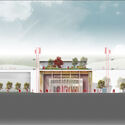
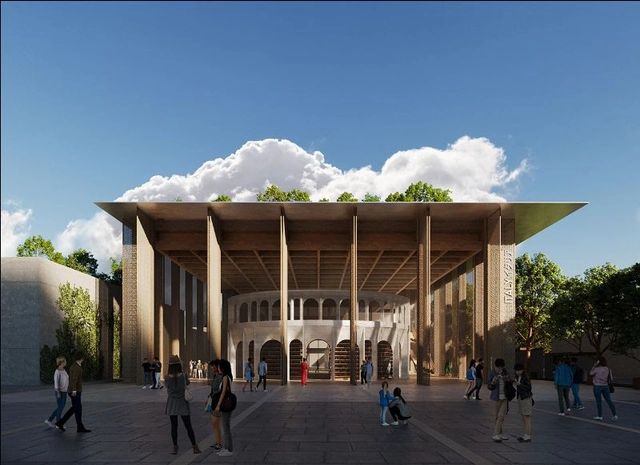
Mario Cucinella Architects has just revealed the design of the Italian Pavilion for Expo Osaka 2025. Envisioned as a dynamic entity, the pavilion aims to foster knowledge and innovation through the interplay of different generations and cultures. It will serve as a collaborative repository of Italian expertise, encompassing artistic, scientific, entrepreneurial, and social experiments. The display is designed around Italy's cultural treasures and aims to highlight, deconstruct, and then reinterpret them in a contemporary manner.

Mario Cucinella Architects Reveals Design for Italian Pavilion at Expo Osaka 2025 - Image 1 of 4Mario Cucinella Architects Reveals Design for Italian Pavilion at Expo Osaka 2025 - Image 2 of 4Mario Cucinella Architects Reveals Design for Italian Pavilion at Expo Osaka 2025 - Image 3 of 4Mario Cucinella Architects Reveals Design for Italian Pavilion at Expo Osaka 2025 - Image 4 of 4Mario Cucinella Architects Reveals Design for Italian Pavilion at Expo Osaka 2025 - More Images

The Fractals at the Heart of Indigenous African Architecture

Subscriber Access | 

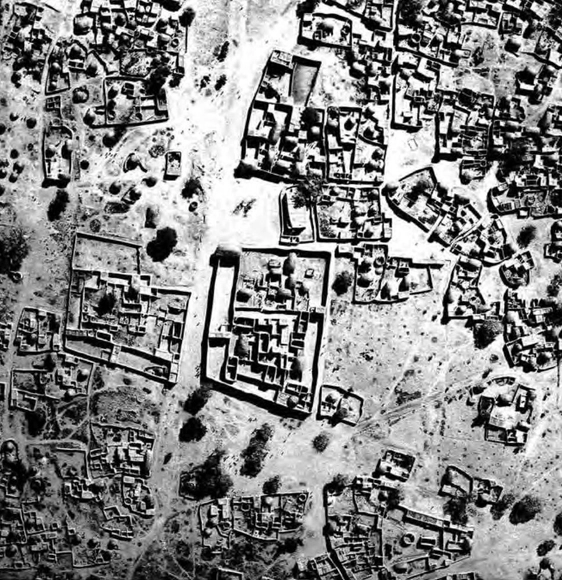
Fractals are complex geometric shapes with fractional dimensional properties. They have emerged as swirling patterns within the frontiers of mathematics, information technology, and computer graphics. Over the last 30 years, these patterns have also become important modeling tools in other fields, including biology, geology, and other natural sciences. However, fractals have existed far beyond the birth of computers, and have been observed by anthropologists in indigenous African societies. One of which is Ron Eglash; an American scientist who presents the evidence of fractals in the architecture, art, textile sculpture, and religion of indigenous African societies. In his book, “African Fractals: Modern Computing and indigenous design”, the fractals in African societies are not simply accidental or intuitive but are design themes that evolve from cultural practices and societal structures.

The Fractals at the Heart of Indigenous African Architecture - Image 1 of 4The Fractals at the Heart of Indigenous African Architecture - Image 2 of 4The Fractals at the Heart of Indigenous African Architecture - Image 3 of 4The Fractals at the Heart of Indigenous African Architecture - Image 4 of 4The Fractals at the Heart of Indigenous African Architecture - More Images+ 2

Minimaforms “The Order of Time” Installation Reveals Constructed Relationships in the Ordering of Space

Subscriber Access | 

Minimaforms Presents The Order of Time at the Architectural Association School of Architecture Gallery. It is an immersive installation aimed to connect the preoccupations of physics, art, and architecture by revealing the ordering of spaces and constructed relationships through direct experience.

Three Sculptural installations are the highlight of the exhibition. Spherical organizations deployed through mathematical logic and designed to extend space within reflective light boxes, gifting its viewer a new immersive moment at every turn. ArchDaily had the chance to engage in a conversation with Theodore Spyropoulos; Artist & Architect at Minimaforms and Director of the Architectural Association’s Design Research Lab, on issues that tackled the interdisciplinary nature of architecture, the creative process of the installation, and how it influences the creation of spaces, buildings & cities.

Minimaforms “The Order of Time” Installation Reveals Constructed Relationships in the Ordering of Space - Image 1 of 4Minimaforms “The Order of Time” Installation Reveals Constructed Relationships in the Ordering of Space - Featured ImageMinimaforms “The Order of Time” Installation Reveals Constructed Relationships in the Ordering of Space - Image 2 of 4Minimaforms “The Order of Time” Installation Reveals Constructed Relationships in the Ordering of Space - Image 3 of 4Minimaforms “The Order of Time” Installation Reveals Constructed Relationships in the Ordering of Space - More Images+ 6

Morphing: Mathematical Transformations In Architecture

Subscriber Access | 

Cylinders, spheres and cubes are a small handful of shapes that can be defined by a single word. However, most shapes cannot be found in a dictionary. They belong to an alternative plastic world defined by trigonometry: a mathematical world where all shapes can be described under one systematic language and where any shape can transform into another. As digital tools are becoming increasingly complex, this book seeks to use mathematics "as a means to demystify the inner computational workings of digital tools" by proposing a framework to convey mathematical transformations as design tools.