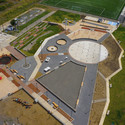
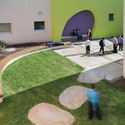
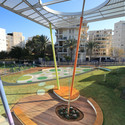
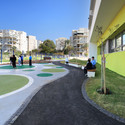
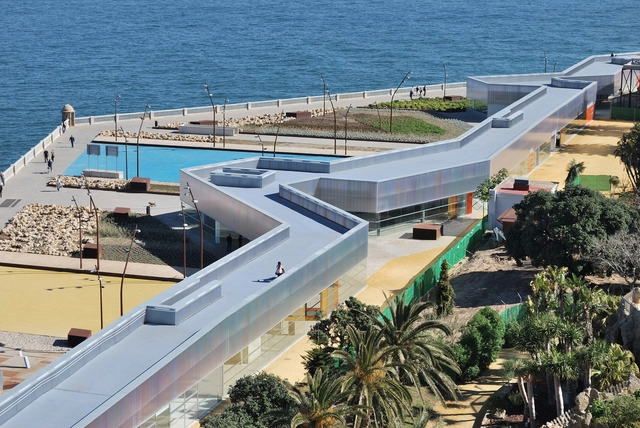
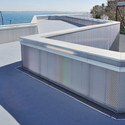
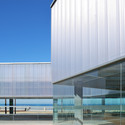
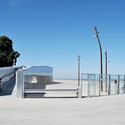
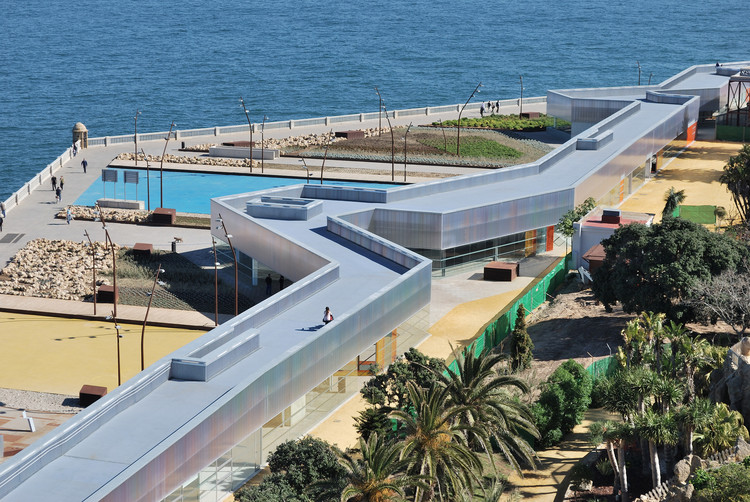
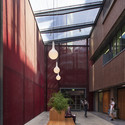
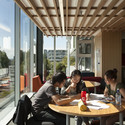
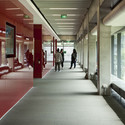
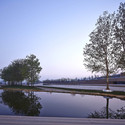
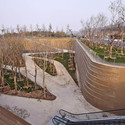
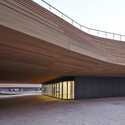
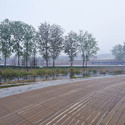
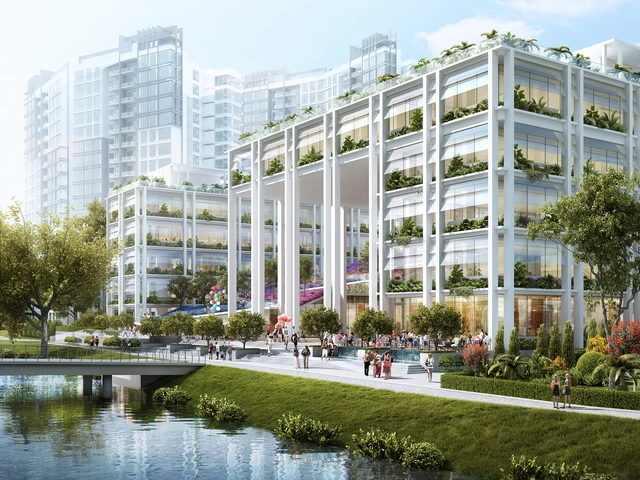
London-based Serie Architects, in collaboration with Multiply Architects of Singapore, has unveiled its winning design for a Neighbourhood Centre and Polyclinic in Punggol, Singapore. Called Oasis Terrace, the project will become the new center for public amenities for Singapore’s Housing & Development Board in Punggol.
The design spans 27,400 square meters, of which 9,400 square meters will be comprised of healthcare facilities, while the rest will include “communal gardens, play spaces, gyms, retail spaces, dining, [and] learning spaces,” all of which is expected to come together into “a new generation of integrated development.”
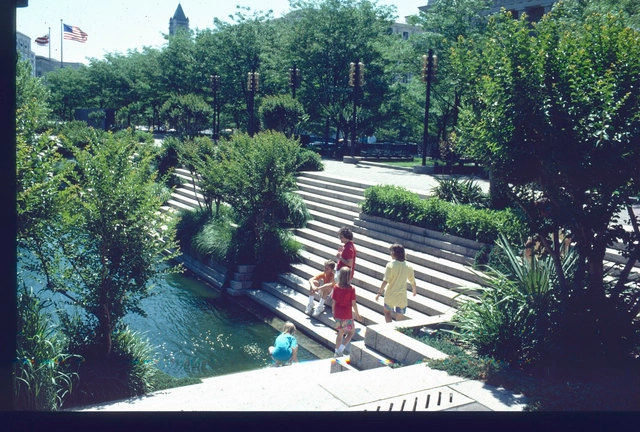
The competition, hosted by the United States Federation for the Commemoration of the World Wars and sponsored by the World War I Centennial Commission, received over 350 entries. While these entries did generally follow the guidelines they were given, most of the designs incorporated the complete demolition of the park.
Now, because the park is one of the most significant works of Modernist landscape architect M. Paul Friedberg, with planting plan designs by Oehme, van Sweden & Associates, landscape architecture organizations like The Cultural Landscape Foundation are speaking up against the possibility of demolition.
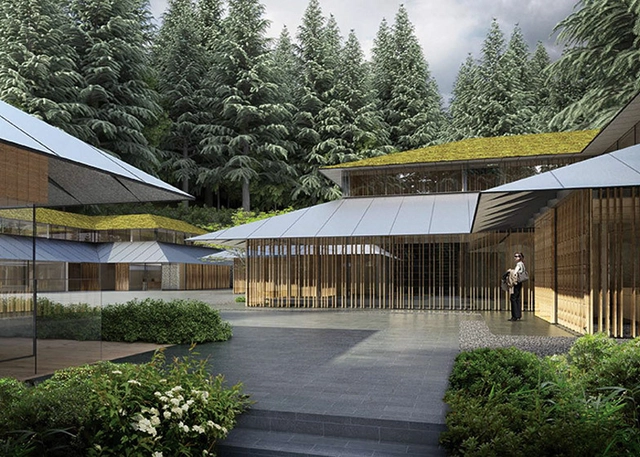
Plans have been unveiled for Kengo Kuma's first public commission in the US. The Portland Japanese Garden has commissioned Kuma to design a new "Cultural Village" to accommodate the garden's growing popularity.
Based off the Japanese tradition of monzenmachi (gate-front towns), where activity exists just outside the gates of shrines and cultural sites, the village will provide a "free-flowing" courtyard space for events and educational activities, as well as multi-purpose classrooms, galleries, a library, tea cafe, and more. In addition to this, a new visitor entrance will be built on an existing site at the bottom of the hillside site on Kingston Avenue, just on the outskirts of downtown Portland.
"The Portland Japanese Garden's careful growth is a very important cultural effort, not only for Portland but also for the US and Japan," said Kuma in a press release.
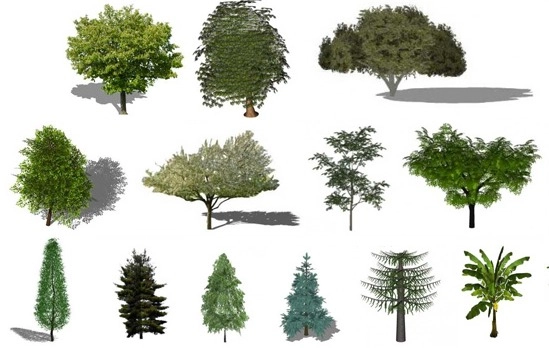
Are your animated shrubs looking a little tired? Has your digital flora dried up? Are you looking to remedy perennial render problems? Look no further: we've found a solution that will truly make your renders bloom. With the help of a botanist, OneCommunity, an open source software website, has released a list of the most realistic plants optimized for SketchUp. The archive includes everything from palm trees to an array of water and bog plants, bamboo shoots, and tropical evergreen trees. The best part? It's free.
It's time to breathe new life into your wilted renders. Find out how to make yours blossom after the break!
For most people, spending time outdoors in well-designed public spaces is one of the highlights to city life. Why, then, do we spend comparatively little time and money on designing them? In this article, originally posted on Metropolis magazine as "Designing Outdoor Public Spaces is Vital to the Future of our Cities" Kirt Martin, the vice-president of design and marketing at outdoor furniture designer Landscape Forms, makes the case that landscape architects and industrial designers working in the public realm are key for our cities' health and happiness.
All of us treasure our time in outdoor spaces. So why do we devote so little of our attention to their design?
As a designer in the site-furniture industry, I am always curious about the value people place on the outdoors. I like to ask people I meet to describe a great city like New York, Chicago, or Paris and what they most remember about being there. Or I ask them, if they won $25,000 to spend on a dream vacation, where they would go and what they would do. Their fond memories of a celebrated city or an escape into the wild often have little in common, except for one thing: Their most memorable and meaningful experiences almost always revolve around the outdoors.
https://www.archdaily.com/771035/why-landscape-designers-will-be-key-to-the-future-of-our-citiesKirt Martin
KAMJZ have unveiled their proposal for the UIA’s MOLEWA (Mount Lu Estate of World Architecture) competition, which tasked participants with designing several cultural and commercial complexes near one of the world’s largest flower theme parks in Ruichang, China. Titled Ruichang Flower Market, KAMJZ's design contemplates a series of shopping streets with high-end, as well as more vernacular shopping spaces, in particular a specialty area carrying flowers grown in the neighboring Flower Theme Park, traditional crafts, and souvenirs.
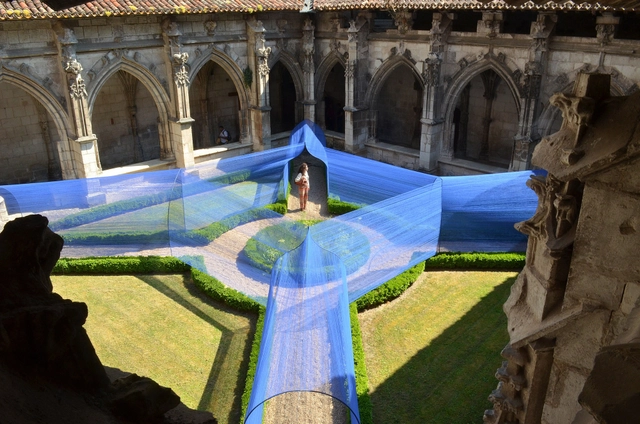
Installation in Courtyard. Image Courtesy of Atelier YokYok + Ulysse Lacoste
Atelier YokYok has created an immersive experience of string and light for their "Shooting Vaults” installation at St. Stephen’s Cathedral in Cahors, France. Created in collaboration with Ulysse Lacoste and Laure Qaremy, the project will be on display through the month of June.
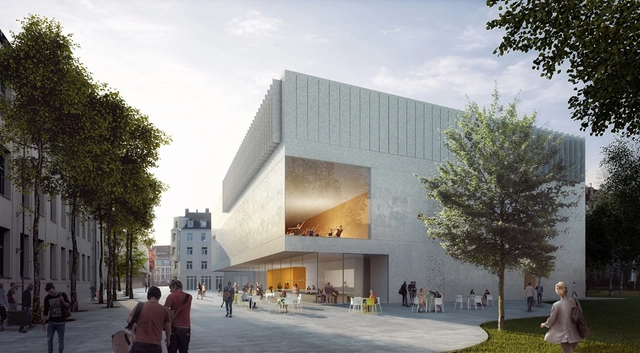
HPP Architects has won a competition to extend the campus of Cologne's University of Music and Dance. Chosen over 13 entries, the winning design will enclose a site in the Kunibertsviertel, close to Cologne’s railway station, and transform it into an "attractive" urban area. The plan, deemed by the jury to be a "clear example of a successful urban remedy," also calls for the conversion of an existing building into an animated concert and dance hall.
Millennium Park. Image Courtesy of Urban Land Institute
The Urban Land Institute (ULI) has selected six finalists for the 2015 Urban Open Space Award competition, which recognizes public spaces that benefit and revitalize their surrounding communities. This was the first year that ULI expanded the program to include global submissions.
“The submissions from this year are representative of how quality urban open space has become more than just an amenity for cities,” said jury chair Michael Covarrubias. “The international diversity of the projects is reflective of how developers continually work to meet global demand by the public for the inclusion of healthy places in cities.” See all of the finalists after the break.
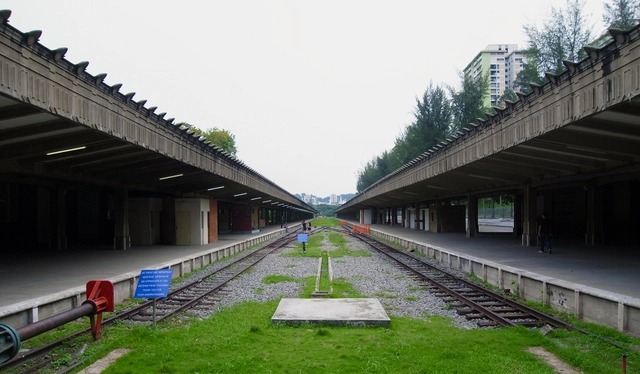
MVRDV, OMA and DP Architects are among five shortlisted teams competing to design the Singapore Rail Corridor. Spanning the island south to north, from the Tanjong Pagar Railway Station to the Woodlands Checkpoint, the corridor is the site of Singapore’s previous rail link to Malaysia. With this competition, the Singapore government hopes to develop a feasible plan to transform the 24 kilometer stretch into a public greenway that connects four important urban nodes: Buona Vista, the Bukit Timah Railway Station area, the former Bukit Timah Fire Station, and Kranji.
“The expanse of the corridor running through the centre of the entire country presents an unprecedented opportunity to develop a new typology of landscape with transformative effects for the country as a whole. This is a project that has the potential to improve quality of life for generations to come," says OMA Partner Michael Kokora.
64 teams responded to the government's call for ideas, and now only five have been selected to move onto the competition's second stage. These five teams are...
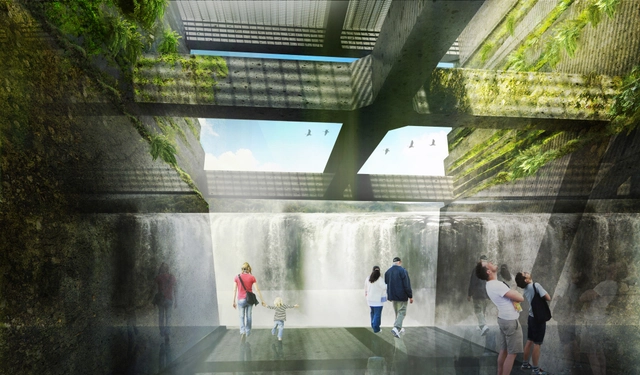
For the first time in 100 years, Oregon’s Willamette Falls will open to the public, with a Riverwalk proposed by Mayer/Reed, Snøhetta and DIALOG. The second largest waterfall in the US, Willamette Falls has a diverse history, and the proposed design seeks to celebrate and amplify the power of the falls, weaving the pedestrian through its rich cultural and geological history.
The final destination of many west-bound pioneers on the Oregon Trail during the 1800s, the falls also served as a gathering spot and source of fish for Native Americans. During the 19th and 20th century, it was an industrial powerhouse, accommodating woolen, lumber, flour and paper mills, and a brick making operation. Yet after the bankruptcy of the Blue Heron Paper Mill, the site has been inhospitable to the public, haunted by empty industrial buildings.
The Japanese Institute of Landscape Architecture (JILA) will be celebrating its 90th anniversary in May 2015, and is pleased to host an international competition for design proposals envisioning future Tokyo with/without parks in 2105, 90 years from today.





.jpg?1437157057&format=webp&width=640&height=580)


.jpg?1433459246&format=webp&width=640&height=580)