-
Architects: Studio Ben Allen
- Area: 235 m²
- Year: 2024
-
Professionals: Format, Sprinks Construction

This week marked World Health Day, observed annually on April 7 by the World Health Organization. This year's edition issued the call to "Stand with science," inviting renewed engagement with scientific knowledge as a foundation for collective action across disciplines. In architecture and urban design, this imperative resonates through projects that translate research into spatial strategies: from the deployment of digital twins to inform urban planning and decision-making, to rewilding initiatives that integrate biodiversity as a tool to mitigate climate change, and materially informed practices that engage resource-conscious construction. Within this broader framework, recent works also foreground architecture's social agency at multiple scales, including a landscape-driven cancer support center in Kent that aligns wellbeing with environmental sensitivity, an urban installation in Brescia operating as a civic awareness device around life in prison and pathways to reintegration, and the transformation of a street in Mantua into a pedestrian-oriented, biodiversity-rich public space.
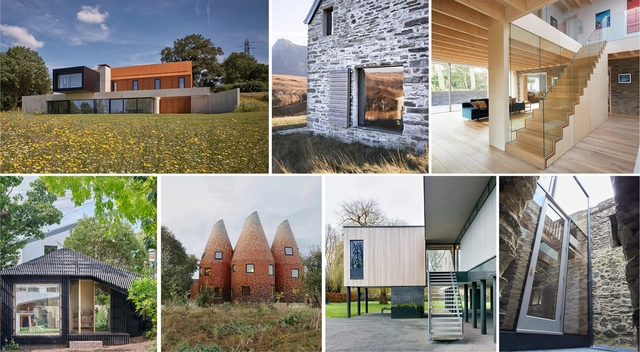
The Royal Institute of British Architects (RIBA) has announced its longlist of best new homes in the United Kingdom for the year 2021. The jury, which includes Architect and Chair Amin Taha, Co-founder of Ash Sakula Architects Cany Ash, and RIBA House of the Year 2019 winner Kieran McGonigle, have selected 20 newly-built houses or extensions that feature imaginative and innovative residential typologies that cater to the environment and their users.

UK-based artist Alex Chinneck has unveiled his latest architectural installation, transforming the walls of a soon-to-be-demolished 1960s office building on the former Kent Wool Growers site in Ashford, England. “Open to the Public” features an eight-meter-high double zip running down the side of the building, revealing the forlorn interior.
The double zip descending the short elevation is joined by a long single zip running the full length of the building, peeling back the walls and windows in a move inspired by the area’s history of textiles and fabric.

James Macdonald Wright and Niall Maxwell’s reimagining of the English country house, “Caring Wood,” has been selected as the 2017 RIBA House of the Year, bestowed annually by the Royal Institute of British Architects (RIBA) to the “best new house or house extension designed by an architect in the UK.”
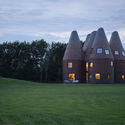
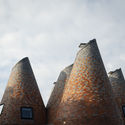
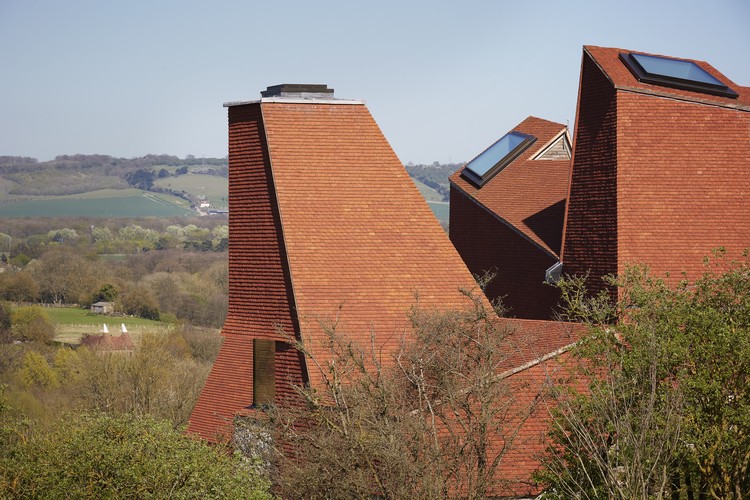
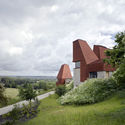
Inspired by the traditional ‘oast houses’ – agricultural buildings used for kilning hops – found in the county of Kent, the house was lauded by the jury for its celebrating of local building crafts and traditions, including the use of handmade peg clay tiles, locally quarried ragstone and coppiced chestnut shingles.


Yesterday, the shortlisted teams for Kent State’s new, $40 million College of Architecture and Environmental Design pitched their designs to the Kent community. From “simple and functional to splendidly provocative”, these proposals offer a range of innovative solutions that will satisfy Kent’s mission to create a modern campus that offers an outstanding academic experience and enriches the greater community of Kent, Ohio.
The four finalists, which were selected from 37 international teams, were challenged to design a 122,000 square foot, sustainable exemplar, possibly capable of achieving net-zero energy, that unites Kent State’s architecture program under one roof, while inspiring interdisciplinary collaboration within flexible learning spaces.
Get a sneak peak of each proposal after the break.

A team of graduate students recently created a temporary installation on the Kent State University, Kent campus in Ohio. The project grew out of an internal challenge in the matR design competition. Designed by graduate students Brian Thoma, Carl, Veith, Victoria, Capranica, Matt Veith, and Griffin Morris, the tunnel-like structure called “The Passage” was a study to support the conceptualization and actualization of innovative and experimental material research. The students created the initial form in Rhinoceros with a couple Grasshopper definitions as a waffle structure of 26 vertical ribs and 24 horizontal struts. More images and information after the break.