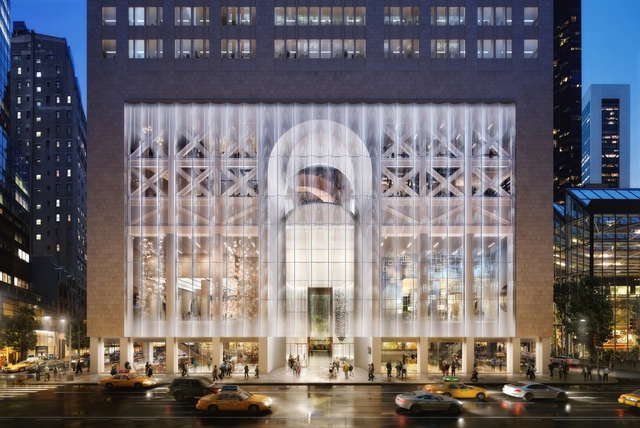
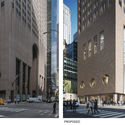
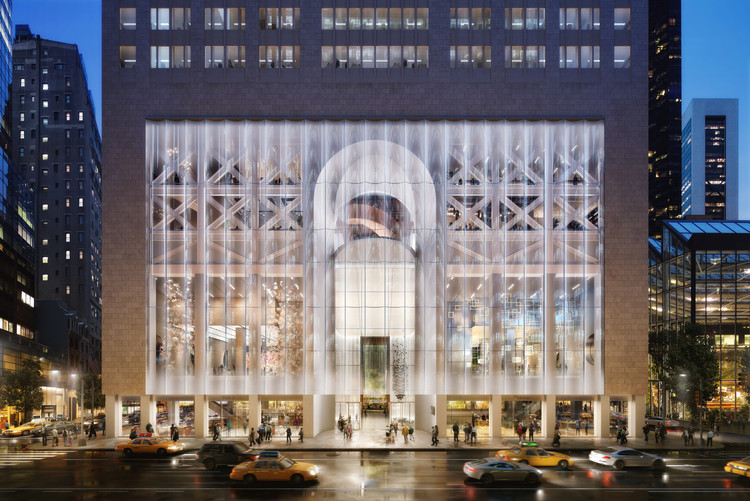
Designed by Snøhetta, the project centers on improving the transparency of its street presence. To do this, the stone facade at the building base will be replaced with a undulating glass curtain wall intended to be more inviting and attractive toward pedestrians, while the existing mid-block public passageway will be opened into a much larger outdoor landscape.
In Good Fences Make Good Neighbors, a new exhibition by Ai Weiwei presented by the Public Art Fund, the artist and activist takes on the security fence as a medium for urban intervention, with New York City as his canvas. Some of the works might be easy to miss, like the chain link fences suspended over a gap between two buildings on East 7th Street, just steps from Ai’s old basement apartment. But others, like the monumental Gilded Cage at Doris Freedman Plaza in Central Park, or Arch, nested under the Washington Square arch, are unmistakable and grandiose.
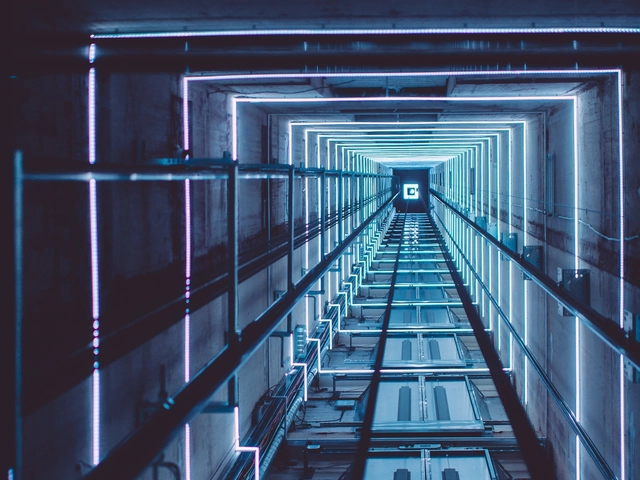
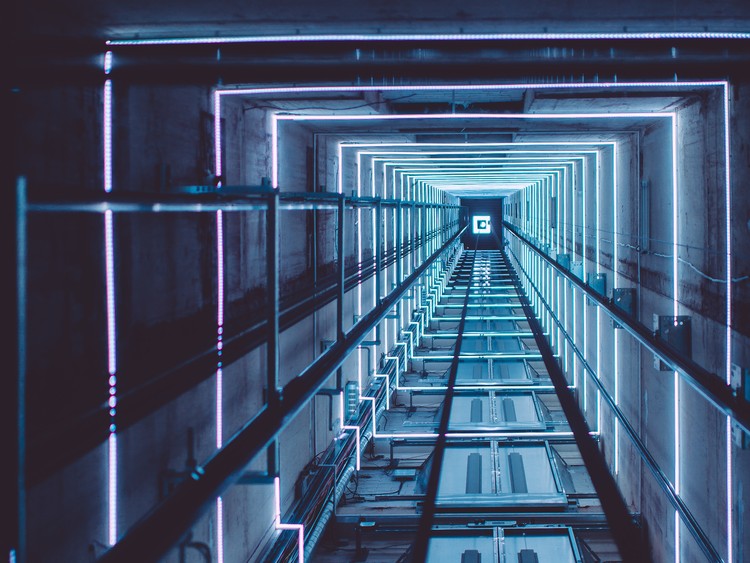
Elevator rides may offer an uplifting experience in the literal sense, but while they are indispensable in modern buildings, users face extremely compact spaces which are designed to fit effectively into buildings. Awkward looks at the floor or past other people’s faces reveal our discomfort with the elevator’s crowded anonymity. Couldn’t a more spatial experience lead to a more exciting journey? Flat screens and projections are starting to be included in elevators, but these are just the beginning of a revolution in the atmospheres created during vertical transportation.
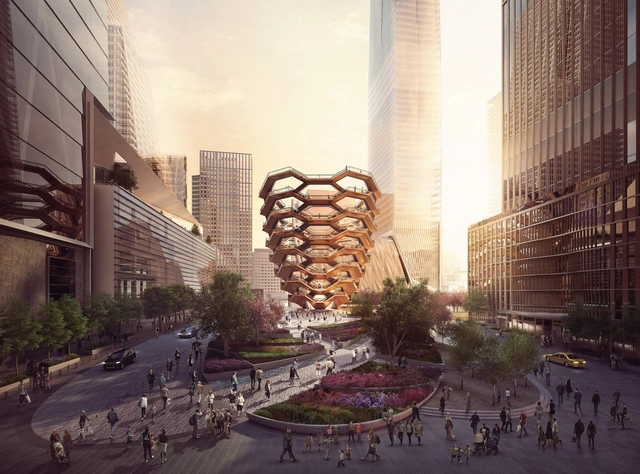
The 150-foot-tall steel structure has been compared to a bedbug, a beehive, and a döner kebab. Its base is 50 feet wide and its upper span measures 150 feet. Image Courtesy of Forbes Massie-Heatherwick Studio
When Thomas Heatherwick—the nimble London-based designer known for work that defies easy categorization—unveiled his design for a new public landmark called Vessel at Hudson Yards to a crowd of reporters and New York City power players in September, questions abounded. What is it? What will it do to the neighborhood? And what does it say that Stephen Ross, the president and CEO of Related Companies, the primary developer of Hudson Yards, is financing the entire $250 million piece by himself?
It’s natural that Ross chose Heatherwick Studio to design his centerpiece, because the office’s creations stun. For the UK Pavilion at the 2010 Shanghai Expo, it extruded 60,000 clear acrylic tubes from a center space to create a fuzzy, crystalline object whose apparent fragility is as mesmerizing as it is clever. As the studio moves toward ever-larger and ever-more-public commissions, the people who will live with its work will need to seriously consider what it will mean for their neighborhoods and cities.
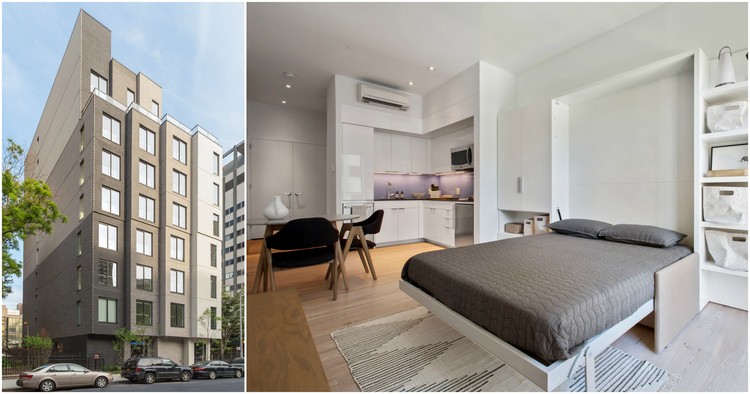
The situation was dire: People were flocking to cities for work, but scarce land and lack of new construction were driving up rent prices. Middle-income residents couldn’t afford the high-end housing stock, nor did they want to enter cramped—sometimes illegally so—apartments. Luckily, a new housing solution appeared: In exchange for small, single-occupancy units, residents could share amenities—like a restaurant-kitchen, dining area, lounge, and cleaning services—that were possible thanks to economies of scale. Sound familiar?
It should: It’s the basic premise behind Carmel Place, a micro-apartment development in Manhattan’s Kips Bay that recently started leasing. The development—whose 55 units range from 260 to 360 square feet—was the result of Mayor Bloomberg’s 2012 adAPT NYC Competition to find housing solutions for the city’s shortage of one- and two-person apartments. Back then, Carmel Place needed special legal exceptions to be built, but last March the city removed the 400-square-foot minimum on individual units. While density controls mean another all-micro-apartment building is unlikely, only building codes will provide a de facto minimum unit size (somewhere in the upper 200 square foot range). What does this deregulation mean for New York City’s always-turbulent housing market? Will New Yorkers get new, sorely needed housing options or a raw deal?
Manufacturers: Big Ass Fans, Gaggenau, Lutron, FSB Franz Schneider Brakel, Acor, +20Aluminum Group, Cassina, Ceadesign, FeeLux, George Kovacs, Herman Miller, Hydroswing, Hygolet de México, Kelley Bros, Kohler, Lounge and Ottoman, Neo-Metro, SONOS, Schüco, Stages, Stanley Hardware, Tate Access Floors, Toto, Twin Eagles USA, VitrA-20
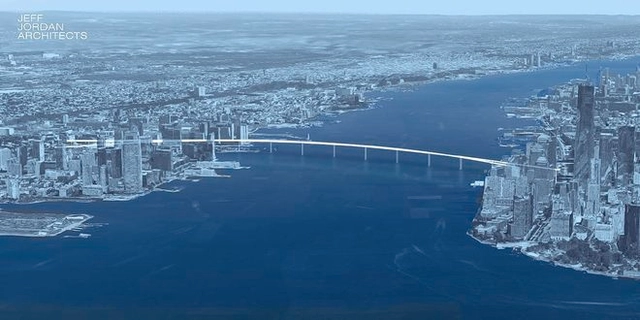
Courtesy of Jeff Jordan Architects, via http://libertybridgeorg.wix.com/libertybridge
Despite being separated by only a few miles, Manhattan and Jersey City seem much further apart; the Hudson River forces commuters to take long, roundabout routes or rely on the over-worked PATH system. Inspired by a need for connectivity between the two cities, Kevin Shane began conceptualizing a new pedestrian bridge, dubbed Liberty Bridge, which would connect Jersey City to Battery Park. Read more about this conceptual proposal after the break.
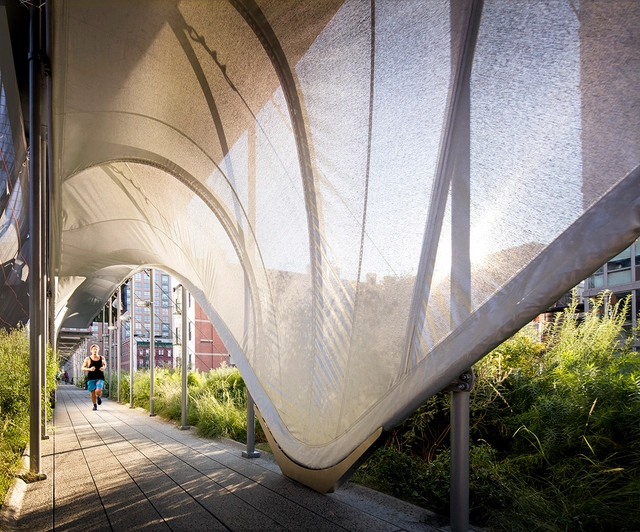
With the construction of their High Line-adjacent residential building 520 West 28th Street, Zaha Hadid Architects have constructed a temporary construction shelter to protect pedestrians in the event of any falling construction materials. However, as is often the case with Zaha Hadid designs, this is a construction shelter unlike any other, serving as a protective shelter but also as an artistic installation.
Named Allongé, the installation is "is inspired by the connectivity and dynamism of movement along the High Line," allowing visitors to the High Line to move through 34 meters (112 feet) of sweeping metallic fabric supported by a curvilinear steel frame, offering a spatial experience that foreshadows the presence of Hadid's building at the site.











_Frank_Oudeman_3.jpg?1497946037&format=webp&width=640&height=580)
_Frank_Oudeman_11.jpg?1497946385 "© Frank Oudeman")
_Frank_Oudeman_4.jpg?1497946144 "© Frank Oudeman")
_Frank_Oudeman_14.jpg?1497946430 "© Frank Oudeman")
_Frank_Oudeman_17.jpg?1497946478 "© Frank Oudeman")
_Frank_Oudeman_3.jpg?1497946037)
















.jpg?1486465833&format=webp&width=640&height=580)
.jpg?1486466233 "© Eric Laignel")
.jpg?1486466104 "© Eric Laignel")
.jpg?1486466199 "© Eric Laignel")
.jpg?1486466087 "© Eric Laignel")
.jpg?1486465833)