




-
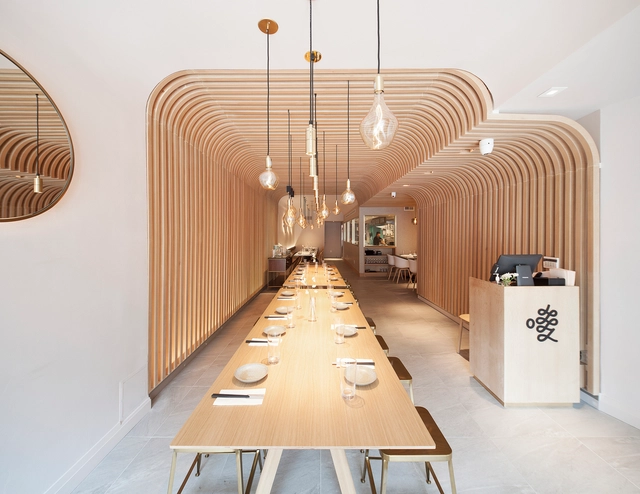
Architects: New Practice Studio
- Area: 280 m²
- Year: 2018
-
Manufacturers: Boca Lighting, Tala





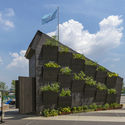
In an effort to spark public discussion and new ideas on how sustainable design can manifest as decent, affordable housing, Yale University has collaborated with UN Environment and UN-Habitat to unveil a “tiny house” fully powered by renewable energy. At 22-square-meters, the eco-house is designed to “test the potential for minimizing the use of natural resources such as water.”
The prototype was unveiled during the United Nations High-Level Political Forum on Sustainable Development, constructed from locally-sourced, bio-based renewable materials. While the first prototype is designed for the climate and context of New York, future iterations can be adapted for site-specific conditions around the globe. Design and fabrication of the module was carried out by Gray Organschi Architecture, working in direct partnership with the Yale Center for Ecosystems in Architecture.







Architect Elizabeth Diller of firm Diller Scofidio + Renfro has once again been named one of TIME’s most influential people in 2018. TIME Magazine’s annual ‘Time 100’ List recognizes the achievement of artists, leaders, activists, entrepreneurs, and athletes who are exemplary in their fields. Diller has been named to the category of “Titans,” along with Roger Federer, Oprah Winfrey, Jeff Bezos, Elon Musk and Kevin Durant. This is Diller’s second time on the list but the first time being honored as a "Titan."
Other honorees this year include Shinzo Abe, Justin Trudeau, Xi Jinping and Jimmy Kimmel.

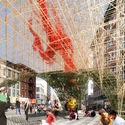
ODA New York has released images of its proposed “Dragon Gate” pavilion for New York’s Chinatown, seeking to act as a symbolic gateway to the famous Manhattan neighborhood. Using modern materials and forms to invoke symbols of traditional Chinese culture, the scheme seeks to capture Chinatown’s remarkable duality: a community of tradition resistant to change, yet one regarded as a uniquely contemporary phenomenon showcasing New York’s inclusive diversity.
Situated on a triangular traffic island at the intersection of Canal, Baxter, and Walker Streets, ODA’s scheme seeks to activate a currently-underused pedestrian space. The Dragon Gate consists of a triangular form adhering to a three-dimensional, gridded structure formed from interwoven, tubular, bronze steel inspired by bamboo scaffolding. As the structure densifies, selected pieces will be painted red to create the illusion of a dragon in mid-flight.




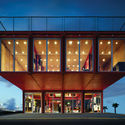
Shipping containers, once a darling of architectural upcycling, have received a lot of criticism recently, as architects are beginning to recognize that their perceived advantages—ready-made habitable space and structure, and an opportunity to recycle a widely available material—are based in little more than hopeful PR spin. But for one of the most prominent practices which regularly uses shipping containers in their work, LOT-EK, the attraction of these architectural ready-mades always went beyond the ecological and practical rationalizations provided by others. In this interview at the firm's New York studio, part of Vladimir Belogolovsky’s “City of Ideas” series, LOT-EK founders Ada Tolla and Giuseppe Lignano discuss the conceptual foundations of their fascination with shipping container architecture.