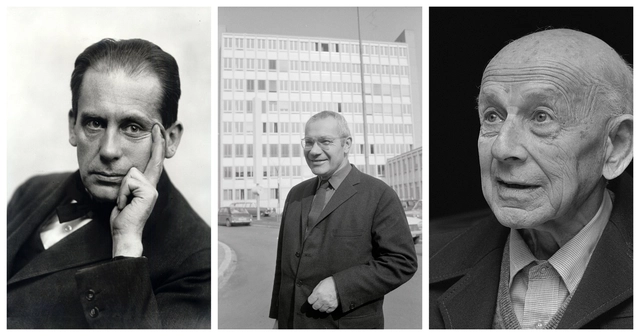
After the dissolution of the Bauhaus due to Nazi political pressure in April 1933, the ideas, teachings, and philosophies of the school were flung across the world as former students and faculty dispersed in the face of impending war. Of the numerous creative talents associated with the Bauhaus, many went on to notable careers elsewhere. Some made a living as artists or practitioners, others either continued or began careers as teachers themselves - and many did both throughout the course of their lives.
In the last few years something has happened to architects’ willingness to strive for originality. The boldest visions now often come from the old guard of architecture - and frankly, I enjoy conversations with them much more. The current insistence on having common ground pushed so many younger architects into a zombie-like copycat state of mind. But to me, common ground means not to think alike – then there is space for discourse.
My most recent conversation with Helmut Jahn at his Chicago office is a case in point. “Architecture is all about going with your gut. I prefer when form follows force rather than function,” he told me. His distinguished career has been one of twists and turns, and he is not planning to give up exploring new ideas any time soon. His 1985 quadrant-in-plan Thompson Center reinvented a mundane government typology into a soaring public place, with its curved colored glass facade decisively welcoming a postmodernist period to Chicago (one we thought had finished, but now seems to be ongoing, encompassing all of post-Modern movements as its mere shades and variations.) Jahn’s architecture shook and modernized a number of global cities, and with time and experience, what began as a rebellion against Mies’s “less is more” modus operandi matured into nuanced, measured, though unquestionably gutsy, production of towers, airports, convention centers, headquarters, and, most importantly, public spaces. As Jahn himself says, “...anything you don’t need is a benefit. Not only you have to have less things but with the things you have left you have to do more.”
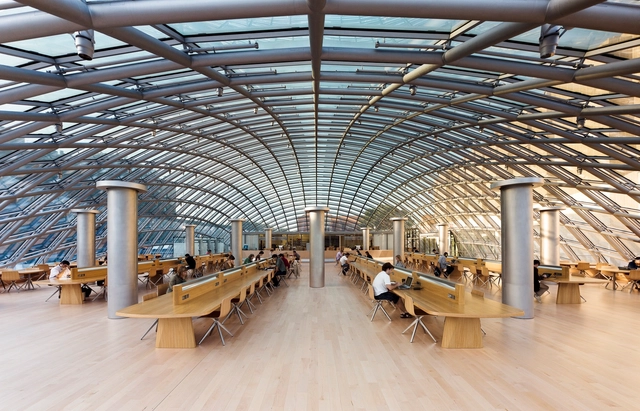
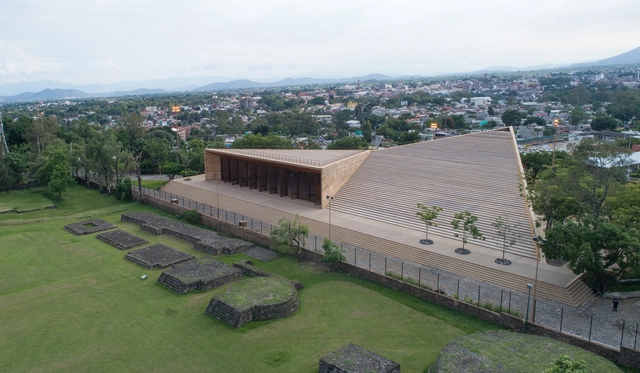
Minutes ago in Detroit, Director Dirk Denison and 2018 MCHAP Jury Chair Ricky Burdett announced the six finalists of the 2018 edition of the Mies Crown Hall America Prize. Selected from a longer list of 31 projects announced earlier this summer in Venice, these outstanding works of architecture will compete for the top honor, the MCHAP Award, which will be announced in October. The authors of the winning award will take home $50,000 to fund research and a publication and will be recognized as the MCHAP Chair in IIT’s College of Architecture.
The six finalist buildings were completed between January 2016 and December 2017. The descriptive texts, provided by the MCHAP jury, celebrate the merits of each individual project.
https://www.archdaily.com/899111/6-projects-in-brazil-mexico-peru-and-usa-selected-as-finalists-for-the-2018-mies-crown-hall-americas-prizeAD Editorial Team
Their challenge was in considering the forms and ways that their selection "might extrapolate out from the cropped photographic frame into a spatial and lifestyle construction across a larger, horizontal site" – in this case, a field of plinths, the size and positioning of which is a direct reference to the footprint of Mies van der Rohe's 1947 plan for the IIT Campus in Chicago.
https://www.archdaily.com/880306/in-horizontal-city-24-architects-reconsider-architectural-interiors-at-2017-chicago-architecture-biennialAD Editorial Team
The MCHAP.emerge prize is awarded biennially by the College of Architecture at Illinois Institute of Technology (IIT). As winner, PRODUCTORA will be given the opportunity to lead a research studio in 2017 related to 'rethinking metropolis' along with $25,000 of funding.
PRODUCTORA was a finalist among practices from Canada, the United States, Chile and Paraguay. The decision was made by Jury President Stan Allen, architect and former Dean of Princeton University’s School of Architecture (New York); Florencia Rodriguez, editorial director of Piedra, Papel y Tijera publishers (Buenos Aires); Ila Berman, Professor of Architecture, University of Waterloo (Waterloo); Jean Pierre Crousse of Barclay & Crousse (Lima), and Dean Wiel Arets (Chicago).
Wiel Arets, Dean of the College of Architecture at Illinois Institute of Technology (IIT) and Dirk Denison, Director of the Mies Crown Hall Americas Prize (MCHAP), have announced the inaugural MCHAP shortlist – 36 “Outstanding Projects” selected from the 225 MCHAP nominees.
“The rich diversity of these built works is a testament to the creative energy at work in the Americas today,” said Arets. “When viewed alongside the innovative work by the MCHAP.emerge finalists and winner, Poli House by Mauricio Pezo and Sofia von Ellrichshausen which we honored in May, we see the evolution of a distinctly American conversation about creating livable space.” See all 36 winners after the break.
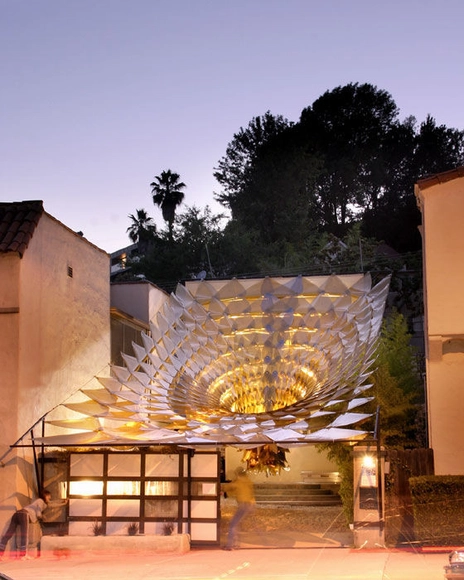
Maximilian’s Schell; Los Angeles, California, US / Benjamin Ball and Gaston Nogues
Four projects have been shortlisted for the inauguralMies Crown Hall Americas Prize (MCHAP) for Emerging Architecture. Announced by the College of Architecture at Illinois Institute of Technology (IIT) and its Dean Wiel Arets, the prestigious prize aims to recognize an emerging practice with the most outstanding built work in the Americas. The winner, which will be announced in May, will be awarded a $25,000 prize and an IIT research professorship that will focus on rethinking the metropolis.
Spanning the Americas from Chile to Canada, the shortlisted projects are...
The College of Architecture at Illinois Institute of Technology (IIT) and its Dean Wiel Arets has announced the creation of the Mies Crown Hall Americas Prize (MCHAP) and the MCHAP for Emerging Architecture. With an objective to “reward the daring contemplation of the intersection of the new metropolis and human ecology,” these two biennial prizes will “recognize the most distinguished built constructs of the North and South American continents” while fostering research toward rethinking the metropolis.
MCHAP is an extension of the larger curricular and research initiatives of IIT, as established by Dean Wiel Arets, who states: “This new prize will not be bestowed to an individual or organization based solely off inventive form, however clever its design, or based solely off a submitted image, no matter how captivating. The prize's jury will instead be holistic in their approach to selecting exceptional works. Architecture, as a discipline, will continue its pursuit of technology, so that it can further advance. And architecture is for people; it is strengthened by their presence.”