Things aren't going too well right now. Each new day seems to add to the uncertainty about the immediate and long-term impact of the Coronavirus pandemic. Whether you think that people are overreacting or it is truly a global health emergency, one fact is objectively true: Covid-19 has affected billions of lives: if not physically than economically and mentally.
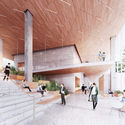
Vista do átrio. Image Cortesia de Safdie Architects
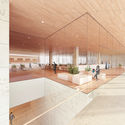
The first Brazilian project by Safdie Architects has broken ground in Sao Paolo's Morumbi neighborhood on November 6. Developed in partnership with Perkins+Will, The Albert Einstein Education and Research Center is part of the Albert Einstein hospital complex.
The new center, named Campus Cecilia and Abram Szajman, will be one of the most advanced institutions in Latin America for medical studies. It will feature innovations in learning methods and technologies, as well as flexible research laboratories capable of adapting to the advancement of hospital techniques.
The population’s aging phenomenon is occurring worldwide. We say phenomenon because all population pyramids are reversing, which means birth rates are steadily decreasing over the years, and at the same time, life expectancy has been increasing. Thus, the elderly population is growing at a faster rate than children.
According to IBGE (Brazilian Institute of Geography and Statistics), in 2017 there were more than 30 million people over the age of 60 in Brazil (14.6% of the population). To understand this growing demographic, let's take a look at other countries' statistics. Mexico's total population is about 28 million, the size of Australia's and New Zealand's combined population. We are talking about a demographic the size of a country.
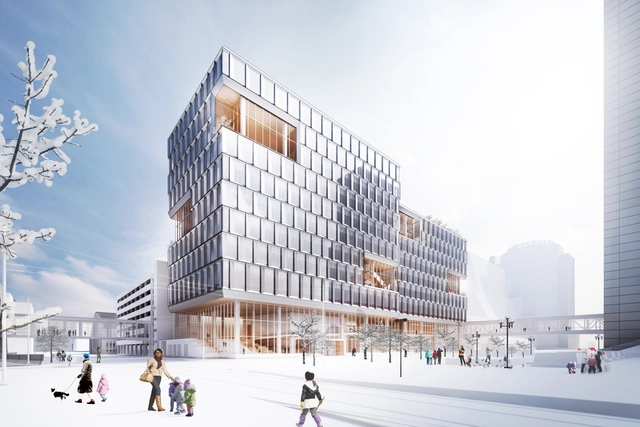
Designed by Henning Larsen and MSR Design, the New Public Service Building for the city of Minneapolis aims to consolidate several departments, currently found across multiple different sites, into one unified building. The scheme promotes the health and well-being of its 1,300 employees through maximizing daylight and green space throughout, integrating a significantly sustainable remit within the 385,000 square foot, 11 story proposal. Located diagonally across from the existing city hall, Henning Larsen brings a “knowledge-based Scandinavian design approach” to the high-performance office space, hoping to set a “new architectural agenda in North America."
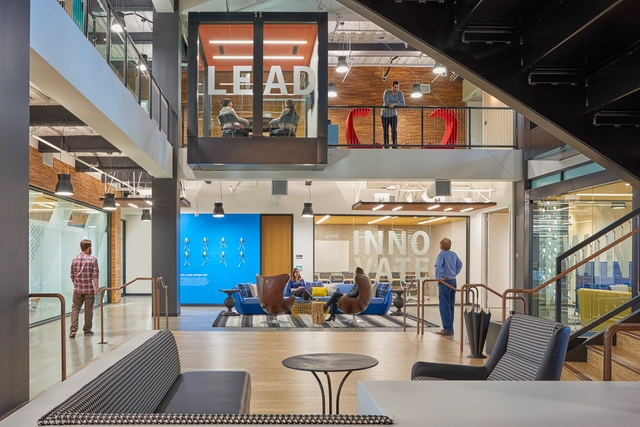
Symantec HQ - The building features a blend of natural materials, bold colouring, and branding. Image Courtesy of Little
Architecture continually evolves to meet societal demands. Recently, a global effort to tackle climate change, and to achieve optimum energy efficiency in buildings, has brought standards such as BREEAM and LEED to the fore. However, as scientific analysis and awareness of human mental health has increased, architects are once again required to place humans at the centre of the design process. This growing trend has led to the development of WELL Building Certification – considered the world’s first certification focused exclusively on human health and wellbeing.
A recent study conducted by Dodge Data & Analytics with the American Institute of Architects (AIA) has found that architects and building owners are beginning to place higher priority of the impacts of design decisions on human health. Nearly 75% of architects and 67% of owners responded that health considerations now play a role in how their buildings are designed, indicating that healthy environments have become an important tool in marketing to tenants and consumers.
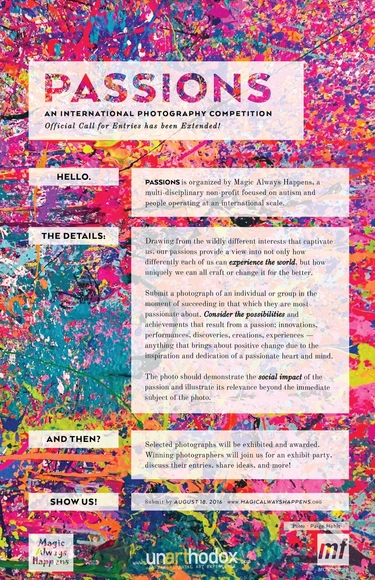
PASSIONS: An International Photography Competition Official Call for Entries
Organized by Magic Always Happens, PASSIONS benefits autism research and action, and is a juried award and exhibit to be shown at Unarthodox in New York City later this year. Drawing from the wildly different interests that captivate us, our passions provide a view into not only how differently each of us can experience the world, but how uniquely we can all craft or change it for the better.
Van Alen Institute and West Palm Beach launched Shore to Core, a design and research competition to reimagine the West Palm Beach downtown and understand how cities impact wellbeing. In the design competition, two finalist teams will be selected to participate in a 3-month design process and receive $45,000 to develop their work. The research team will receive $40,000 to develop their work, $10,000 to implement their pilot study.
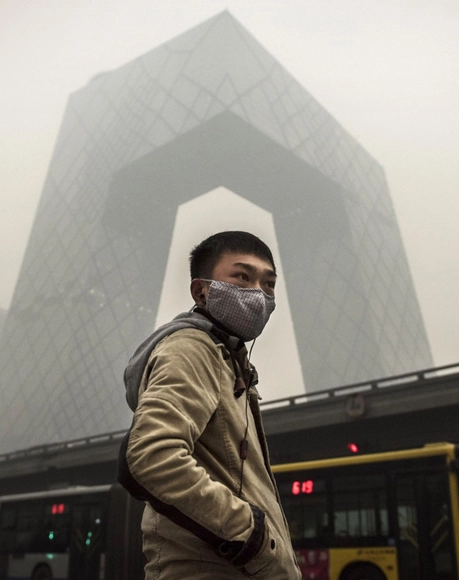
In an article for The Guardian, Oliver Wainwright steps "inside Beijing's apocalypse": the poisonous, polluted atmosphere that often clings to the Chinese capital. He explores ways in which those who live in this metropolis have started to redefine the spaces they frequent and the ways in which they live. Schools, he notes, are now building inflatable domes over play areas in order to "simulate a normal environment." The dangers were made clear when "this year’s Beijing marathon [...] saw many drop out when their face-mask filters turned a shade of grey after just a few kilometres." Now, in an attempt to improve the living conditions in the city, ecologists and environmental scientists are proposing new methods to filter the air en masse. Read about some of the methods here.
The American Institute of Architects (AIA) and MIT’s Center for Advanced Urbanism has produced a new report examining urban health in eight of the USA’s largest cities, which has been translated into a collection of meaningful findings for architects, designers, and urban planners. With more than half of the world’s population living in urban areas - a statistic which is projected to grow to 70% by 2050 - the report hinges around the theory that “massive urbanization can negatively affect human and environmental health in unique ways” and that, in many cases, these affects can be addressed by architects and designers by the way we create within and build upon our cities.
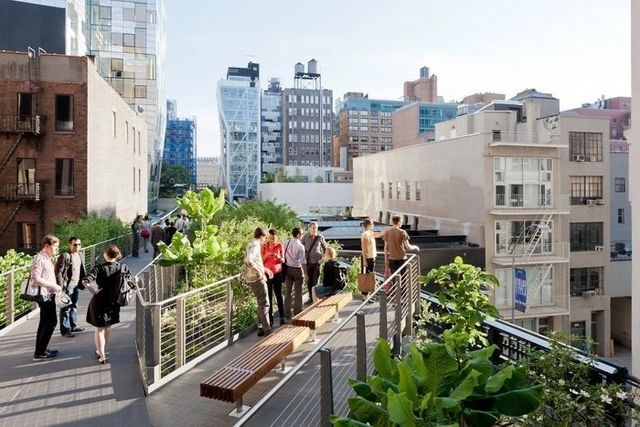
From Atlanta's Beltline to Los Angeles' Spring Street "Parklets," architecture and design is increasingly more relevant in the fight against obesity and chronic disease, conditions which have reached epidemic levels in the United States. In the article, "Toward a Fit Nation," the AIA and FitNation identify 18 projects from around the country, ranging from large complexes to temporal installations, that encourage physical activity and healthy lifestyles. The AIA National Headquarters will be curating the FitNation exhibit till January 31, 3014. Read the article here.
https://www.archdaily.com/451594/toward-a-fit-nation-18-projects-that-promote-healthy-lifestylesJose Luis Gabriel Cruz
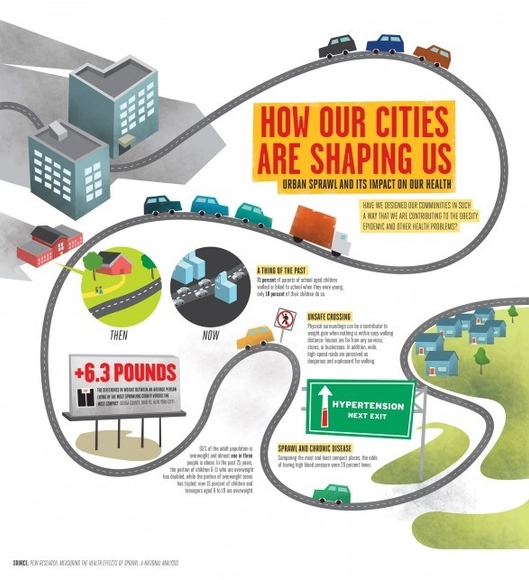
Architects and city planners are becoming more and more familiar with the health effects of our built environment. This to-the-point infographic designed by Chris Yoon cites a few ways in which mid-20th century city planning trends have contributed to a growing obesity problem in the United States. This data has alarmed scientists, planners and city officials into stressing the importance of redesigning the physical spaces so as to encourage physical activity and healthy choices.
Peter Williams is the founder and executive director of an organization whose goal is to improve global health, using design to create healthier environments as preventative measures for tuberculosis, AIDS and malaria. Architecture for Health in Vulnerable Environments, or ARCHIVE for short, has projects in countries all over the world, including Haiti, Cameroon, and Ethiopia. ARCHIVE identifies and addresses the causes of poor health in disadvantages communities and uses strategies related to housing design improvements to create environments that promote better health.
Walkability, density, and mixed-use have become key terms in the conversation about designing our cities to promote healthy lifestyles. In an interview with behavioral psychologist, Dr. James Sallis of the University of California San Diego in The Globe and Mail, Sallis discusses how his research reveals key design elements that encourage physical activity. In the 20th century, the automobile and new ideals in urban planning radically changed the way in which cities were structured. Residential and commercial areas were divided and highways were built to criss-cross between them. Suburban sprawl rescued city dwellers from dense urban environments that had gained a reputation for being polluted and dangerous. In recent decades, planners, policy makers and environmentalists have noted how these seemingly healthy expansions have had an adverse affect on our personal health and the health of our built environment. Today, the conversation is heavily structured around how welcoming density, diversity and physical activity can help ameliorate the negative affects that decades of mid-century planning have had on health. Sallis describes how much of a psychological feat it is to change the adverse habits that have developed over the years and how design, in particular, can help encourage the change.
In architecture we talk about space and form. We talk about experience and meaning. All of these qualities are inextricably the sensory experience of light, touch, smell and sound. Sound expert Julian Treasure asks architects to consider designing for our ears, citing that the quality of the acoustics of a space affect us physiologically, socially, psychologically and behaviorally.
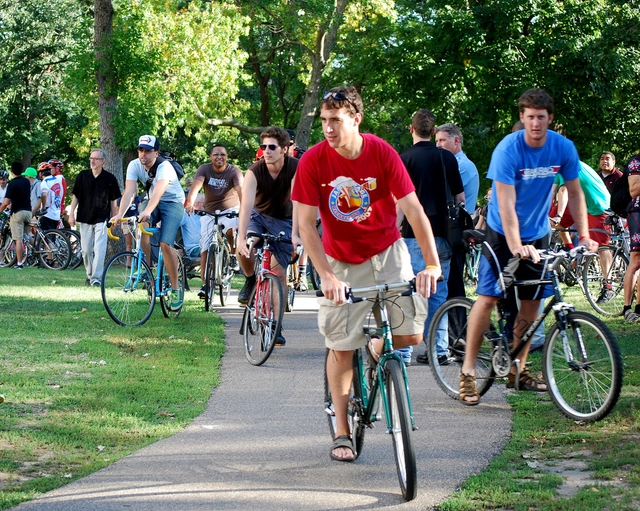
Loring Park, Minneapolis. Image via Flickr User Waiting Line; Licensed via Creative Commons
The American College of Sports Medicine (ACSM) released a new report, “American Fitness Index" (AFI), ranking 50 of the largest US metropolitan areas by fitness and health. ACSM gathered information that identified population, health and the built environment and found what most of us can assume: that the physical built and planned environment of our cities has a profound impact on our physical health. "Cities near the top of the index," the executive summary reads, '" have more strengths that support healthy living and fewer challenges that hinder it... the opposite is true for cities near the bottom." Most of the metropolitan areas identified in the top ten are cities in the north, including areas of Washington, Minnesotta, Colorado, and cities within New England. California ranked the most metropolitan areas in the top ten. Cities near the bottom of the list were concentrated in the south, many of which are located in Texas. The report is the first step of the AFI to work towards its goal of promoting active lifestyles by identifying and supporting programming of sustainable, healthy community culture.
More details from the report and what tells us about our built environment.


.jpg?1584702899&format=webp&width=640&height=580)

.jpg?1541592816&format=webp&width=640&height=580)





.jpg?1366939417&format=webp&width=640&height=580)