1. ArchDaily
  2. Future Urbanism

Future Urbanism: The Latest Architecture and News

The Line at a Crossroads: Revisiting NEOM's Vision for a Utopian City

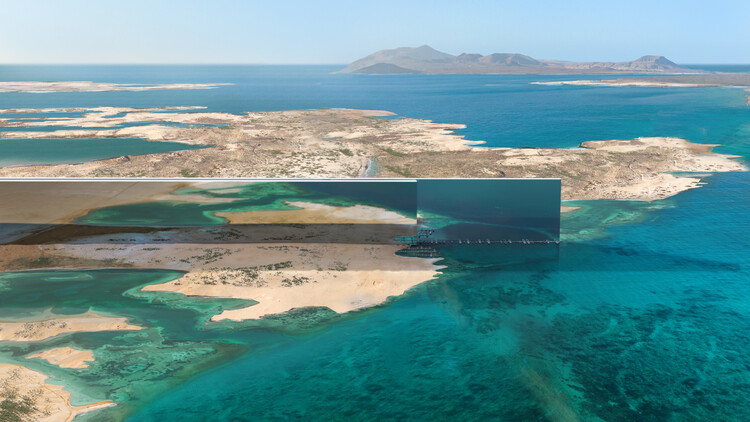
In 2023, ArchDaily's editor-in-chief sat down with Tarek Qaddumi, Executive Director of the Line Design at NEOM, at the closing of the Line Exhibition in Riyadh. Qaddumi described a layered, three-dimensional city organized around the idea of a "five-minute sphere" of access: walkable communities stacked vertically, connected by high-speed rail, freed from cars and conventional street infrastructure, and designed to coexist symbiotically with the surrounding natural landscape. It was a compelling vision, and in the context of the moment, it was simultaneously credible and appealing. For architects and urban thinkers grappling with the failures of twentieth-century city-building, the ideas articulated were worth engaging and planning.

The Line at a Crossroads: Revisiting NEOM's Vision for a Utopian City - Image 1 of 4The Line at a Crossroads: Revisiting NEOM's Vision for a Utopian City - Image 2 of 4The Line at a Crossroads: Revisiting NEOM's Vision for a Utopian City - Image 3 of 4The Line at a Crossroads: Revisiting NEOM's Vision for a Utopian City - Image 4 of 4The Line at a Crossroads: Revisiting NEOM's Vision for a Utopian City - More Images+ 5

Local Knowledge and Ecological Context: City Making Lessons from Chicago’s Wild Mile

Subscriber Access | 

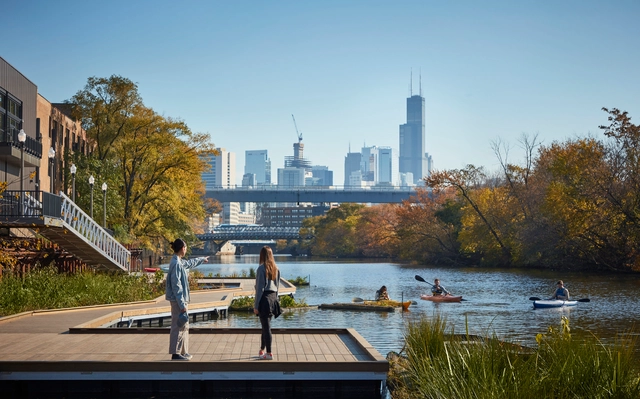
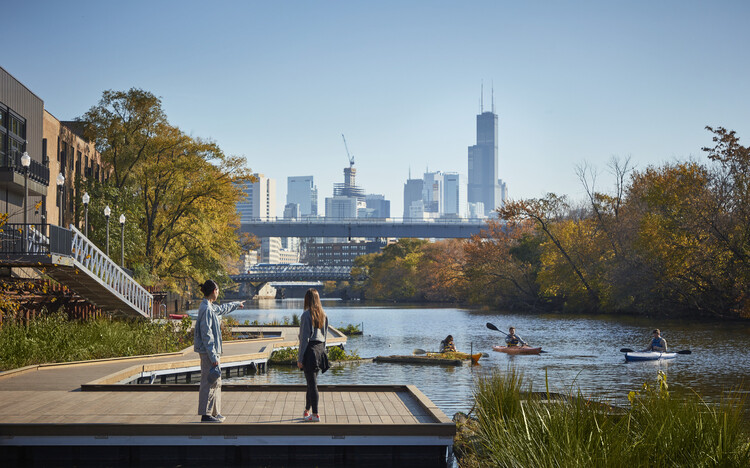
For more than a century, residents of growing American cities reshaped their rivers to serve industrial and manufacturing needs. Waterways were straightened, deepened, paved, or buried to support shipping routes and to move materials efficiently across regions. These transformations created an urban landscape in which rivers were treated as productive infrastructure rather than as living ecological systems.

This approach left a lasting imprint. Riparian habitats disappeared, water quality declined, regional biodiversity grew vulnerable, and communities grew accustomed to river corridors dominated by steel walls and concrete channels. The industrial reshaping of rivers in places such as Chicago, Los Angeles, and the Mississippi basin created durable patterns of development that still influence how cities function today.

Local Knowledge and Ecological Context: City Making Lessons from Chicago’s Wild Mile - Image 1 of 4Local Knowledge and Ecological Context: City Making Lessons from Chicago’s Wild Mile - Image 2 of 4Local Knowledge and Ecological Context: City Making Lessons from Chicago’s Wild Mile - Image 3 of 4Local Knowledge and Ecological Context: City Making Lessons from Chicago’s Wild Mile - Image 4 of 4Local Knowledge and Ecological Context: City Making Lessons from Chicago’s Wild Mile - More Images+ 7

How Will Transportation Work in the Future? A Look at the Rise of Electric Mobility in Cities

Subscriber Access | 

From greenhouse gas emissions and air pollution to deforestation, one of the leading contributors to global warming today is emissions from the transportation sector. Exploring its origins and evolution, as well as the major challenges it faces, the development of electric mobility in urban environments represents a global transition that requires a coordinated mix of policies and actions to achieve cleaner and more sustainable transportation systems. Designing safe and comfortable infrastructure for walking and cycling, promoting public transit and shared mobility, and designing more efficient streets that include electric vehicles, among other actions, are part of a growing worldwide effort to reduce carbon emissions.

How Will Transportation Work in the Future? A Look at the Rise of Electric Mobility in Cities - Image 1 of 4How Will Transportation Work in the Future? A Look at the Rise of Electric Mobility in Cities - Image 2 of 4How Will Transportation Work in the Future? A Look at the Rise of Electric Mobility in Cities - Image 3 of 4How Will Transportation Work in the Future? A Look at the Rise of Electric Mobility in Cities - Image 15 of 4How Will Transportation Work in the Future? A Look at the Rise of Electric Mobility in Cities - More Images+ 11

Designing for Two Worlds: How Space Exploration is Shaping the Future of Architecture on Earth

Subscriber Access | 

Space exploration isn’t merely a testament to human ambition or a quest for new territories and resources. Our ventures beyond Earth’s atmosphere are driven by a deeper purpose: to understand better our place in the cosmos and to pioneer innovations that can transform life on our home planet.

While venturing beyond our planet captures the imagination, the true impact of space exploration may be felt much closer to home. Public perception often frames space exploration as a distant endeavor with limited relevance to terrestrial challenges. However, this perspective overlooks the substantial contributions of space programs to our world. By driving technological innovation, expanding our scientific knowledge, and inspiring future generations, space exploration has proven to be an invaluable catalyst for addressing global issues.

Designing for Two Worlds: How Space Exploration is Shaping the Future of Architecture on Earth - Image 1 of 4Designing for Two Worlds: How Space Exploration is Shaping the Future of Architecture on Earth - Image 2 of 4Designing for Two Worlds: How Space Exploration is Shaping the Future of Architecture on Earth - Image 3 of 4Designing for Two Worlds: How Space Exploration is Shaping the Future of Architecture on Earth - Image 4 of 4Designing for Two Worlds: How Space Exploration is Shaping the Future of Architecture on Earth - More Images+ 30

Ephemeral Architectures: Engaging Communities through Temporary Structures

Subscriber Access | 

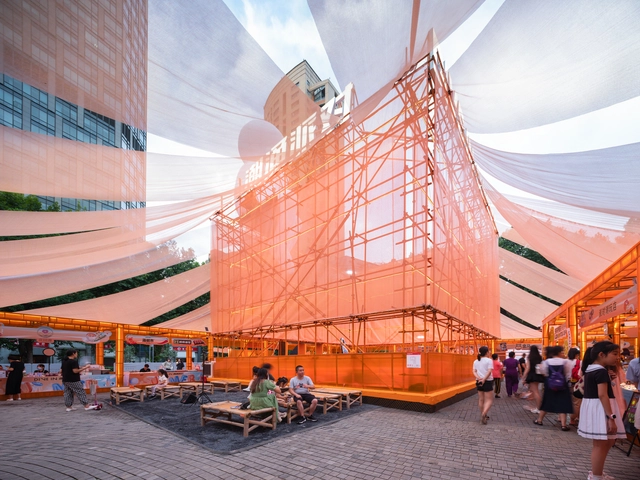
Ephemeral architectures, characterized by their temporary and flexible nature, have emerged as powerful tools for revitalizing urban spaces and fostering architectural creativity. These transient installations transform public areas, engaging communities, and prompting reflections on the potential futures of our cities. By temporarily transforming environments, ephemeral architectures encourage both architects and the public to reimagine the possibilities of urban living. This dynamic interplay, between the temporary and the permanent, challenges traditional architectural practices and opens up new avenues for sustainable and inclusive urban development.

Ephemeral Architectures: Engaging Communities through Temporary Structures - Image 1 of 4Ephemeral Architectures: Engaging Communities through Temporary Structures - Image 2 of 4Ephemeral Architectures: Engaging Communities through Temporary Structures - Image 3 of 4Ephemeral Architectures: Engaging Communities through Temporary Structures - Image 4 of 4Ephemeral Architectures: Engaging Communities through Temporary Structures - More Images+ 32

The New Space Race: 6 Challenges for Extraterrestrial Architecture

The New Space Race: 6 Challenges for Extraterrestrial Architecture - Sustainability
© AI SpaceFactory

Up until now, space architecture has been mainly focused on engineering, centered on projects like orbital space stations or Martian exploration convoys, commissioned by world space agencies such as ESA (Europe) or NASA (USA). But in recent years, an increasingly broader spectrum of professionals (e.g. architects, sociologists) as well as entrepreneurs and investors (not all well intentioned) have joined the challenge of designing extraterrestrial built environments, the new space race of the 21st century.

The fast development of technology, the increase of world population and the climate change crisis create the perfect setting to think about life outside of our planet, and as these trends continue to evolve and converge, new opportunities to explore options beyond our traditional limits appear (NEOM), as well as new organizations which support this research (like SATC, SICSA). Even though no one is currently on Mars, many ongoing projects and simulations (MARS-ONE, Mars City Science) are already exploring how we will design, build and inhabit the new realms of humanity in outer space.

Harvard GSD Student Envisions Autonomous Building that Rearranges Spaces Throughout the Day

Subscriber Access | 

As self-driven cars are being introduced to our city streets and tech companies have expanded their influence far beyond the boundaries of our computer and smartphone displays, a new generation of architects are charged with imagining how to employ the technology of tomorrow in ways that will advance and improve the world’s built environments. With autonomous transportation, virtual and augmented reality and artificial intelligence promising unprecedented tools for revolutionizing human infrastructure in a future that no longer feels particularly distant, present-day data gathering and analysis capabilities have already transformed our ability to understand trends on an unforeseen scale.

Taking full advantage of modern data science capabilities and semi-automated robotic technology currently deployed in factory settings around the world, Masters candidate Stanislas Chaillou from the Harvard GSD imagines how today’s new tech could help realize the longtime architectural ambition of creating flexible buildings capable of adapting to variable uses.

Studio Gang Creates 7 Strategies to Reimagine Civic Spaces As Vibrant Urban Hubs

Subscriber Access | 
Studio Gang Creates 7 Strategies to Reimagine Civic Spaces As Vibrant Urban Hubs  - Image 10 of 4
© Studio Gang

The Nolli Map made history when it was created in 1748, largely because of its focus on public spaces. With it, Giambattista Nolli highlighted the fact that public places don’t exclusively exist in the forms of streets and parks, but also in enclosed spaces. Yet the importance of our communal areas is constantly being undermined. Our public areas exist to promote inclusion and equal opportunities, but despite that they are being forgotten and abandoned, debilitating their ability to bind communities together.

Given that the main goal of Studio Gang’s newly released, free, downloadable booklet, Reimagining The Civic Commons has been to “help communities everywhere activate their civic commons,” then, it is unsurprising that the booklet includes graphic maps reminiscent of Nolli’s visual aim. The booklet, which arose from work funded by the Kresge Foundation and Knight Foundation, focuses on the advancement of 7 types of “existing assets”: libraries, parks, recreation centers, police stations, schools, streets and transit. Since the start of Studio Gang's research, a larger, $40 million initiative has begun—funded by the JPB Foundation, The Knight Foundation, The Kresge Foundation and The Rockefeller Foundation along with a multitude of local donors—with plans taking shape in Philadelphia, Chicago, Detroit, Memphis and Akron. The graphic guide is designed to offer adaptable, cost-effective and flexible approaches to these spaces, so that it can be implemented over time and in a variety of different communities. Read on for our summary of the report’s 7 strategies for improvement.

Crafting Urban Life in Three Dimensions: An Interview with Adam Snow Frampton by James Schrader

Subscriber Access | 

The following are excerpts from one of 41 interviews that student researchers at the Strelka Institute are publishing as part of the Future Urbanism Project. In this interview, James Schrader speaks with Adam Snow Frampton, the co-author of Cities Without Ground and the Principal of Only If, a New York City-based practice for architecture and urbanism. They discuss his work with OMA, the difference between Western and Asian cities, his experiences opening a new firm in New York, and the future of design on an urban scale.
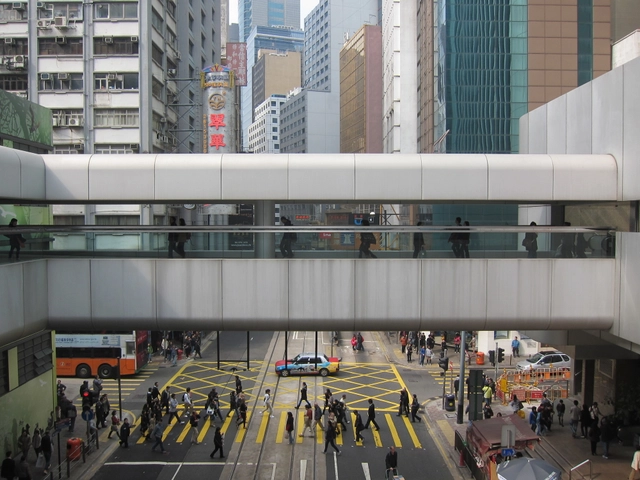
James Schrader: Before we get to future urbanism, I thought it would be interesting to look a bit into your past. Could you tell me about where your interest in cities came from? Were there any formative moments that led to your fascination with cities?

Adam Snow Frampton: I was always interested in cities, but not necessarily exposed to much planning at school. When I went to work at OMA Rotterdam, I was engaged in a lot of large-scale projects, mostly in the Middle East and increasingly in Asia, where there was an opportunity to plan cities at a bigger scale. In the Netherlands, there’s not necessarily more construction than in the US, but there is a tradition of thinking big and a tendency to plan. For instance, many Dutch design offices like OMA, West 8, and MVRDV have done master plans for the whole country.