1. ArchDaily
  2. Doris Kim Sung

Doris Kim Sung: The Latest Architecture and News

Understanding Soft Architecture: The Shift from Monument to Moment

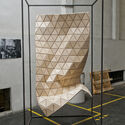
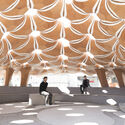
In recent years, architecture has increasingly embraced adaptability, flexibility, and responsiveness as core design principles. This evolution reflects a shift from traditional notions of static, permanent structures to dynamic environments that can adjust to changing needs and conditions. Central to this transformation is the concept of "soft architecture", which leverages pliable materials and innovative systems to create spaces that are functional, sustainable, and user-centric. Soft architecture takes shape through membranes that breathe, façades that move, structures that inflate or fold, and surfaces that bend rather than break. It involves designing for transformation — not only in how a building performs environmentally, but also in how it can accommodate shifting functions, user interactions, or temporary occupations. This approach to building challenges traditional notions of durability and control, proposing instead a more responsive and open-ended architecture. It reflects a growing awareness that buildings, like the societies they serve, must be able to evolve.
Understanding Soft Architecture: The Shift from Monument to Moment - Image 1 of 4Understanding Soft Architecture: The Shift from Monument to Moment - Image 2 of 4Understanding Soft Architecture: The Shift from Monument to Moment - Image 3 of 4Understanding Soft Architecture: The Shift from Monument to Moment - Image 4 of 4Understanding Soft Architecture: The Shift from Monument to Moment - More Images+ 53

When Biology Inspires Architecture: An Interview with Doris Kim Sung

Subscriber Access | 
When Biology Inspires Architecture: An Interview with Doris Kim Sung  - Image 3 of 4

Material Minds, presented by ArchDaily Materials, is our new series of short interviews with architects, designers, scientists, and others who use architectural materials in innovative ways. Enjoy!

Before attending Columbia University for her Masters in Architecture, Los Angeles-based architect Doris Kim Sung took a fairly non-traditional approach to becoming an architect: she was a biologist. Naturally then, Sung’s architectural work tends to take inspiration from the biological world, particularly in the way she experiments and innovates with materials. Much of her work involves thermal bimetals, a material that expands and contracts with temperature swings; it can even act as a sun shade and ventilation system, without the need for electricity.

So where does a biologist-turned-architect draw inspiration from? We interviewed Ms. Sung to find out for ourselves -- the responses, like her work at dO|Su Architecture, are simply fascinating.

TEDx: Metal that breathes / Doris Kim Sung

Subscriber Access | 

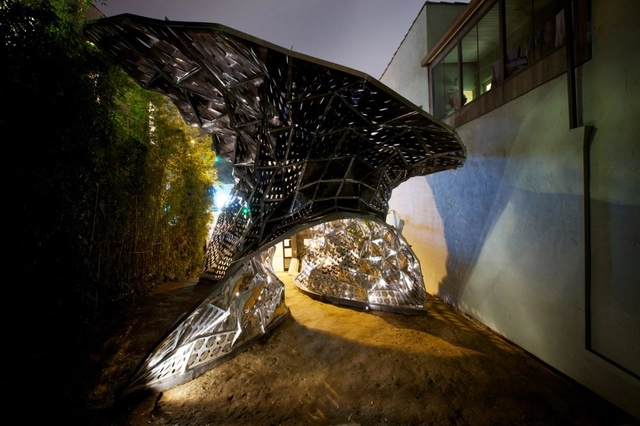
Biology student turn architect, Doris Kim Sung has dedicated her studies to the infinite possibilities of thermobimetals, smart materials that respond dynamically to temperature change. As tested with DO|SU Studio Architecture’s recent installation “Bloom”, whose surface is completely fabricated with thermobimetal, these smart materials are capable of relieving our dependence on energy-inefficient mechanical systems with their self-shading and self-ventilating properties.

Imagine a building skin capable of maintaining thermal comfort in an environmentally responsible and cost effective way by responsively mimicking the characteristics of human skin.