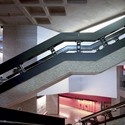
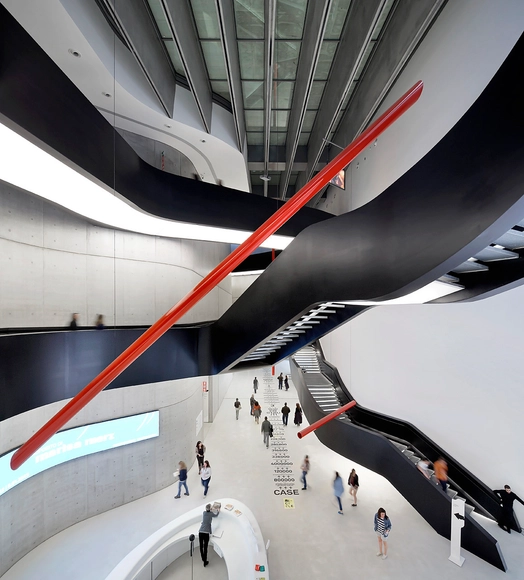
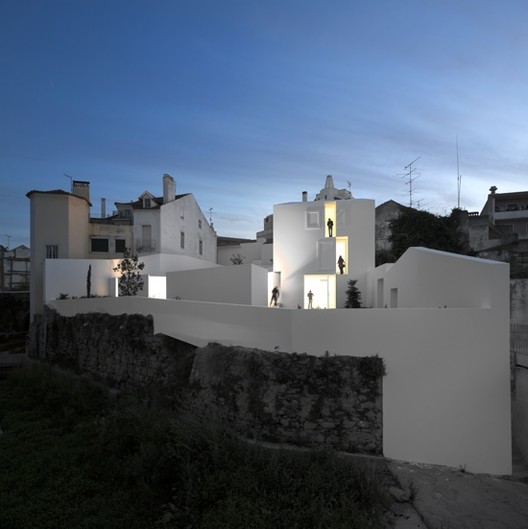
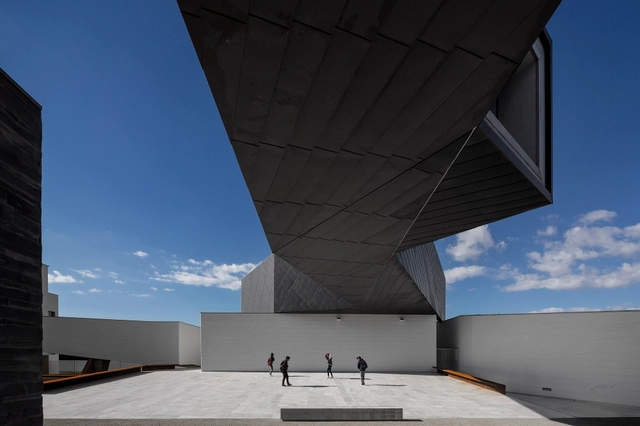
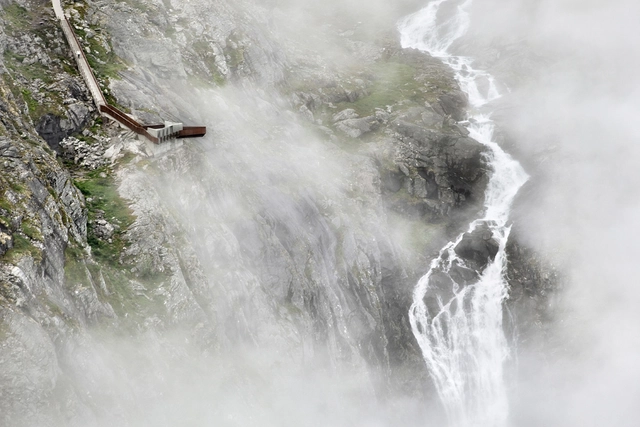
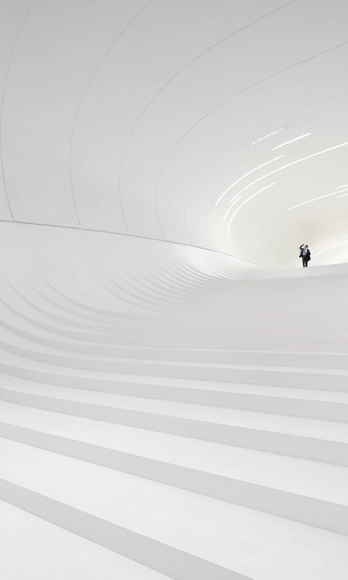
Hufton + Crow have been named “Architectural Photographer of the Year 2014” by Arcaid Images. The news was announced in Singapore at the World Architecture Festival after the duo’s interior image of Zaha Hadid’s Heydar Aliyev Centre staircase received the highest score from the judges. Hufton + Crow also received runner-up in the award's exterior category with another image from the Heydar Aliyev Centre. You can check it out, after the break.
1. Iwan Baan Torre David #2, 2011 Image courtesy of the artist and Perry Rubenstein Gallery, Los Angeles. Image Courtesy of Barbican Art Gallery
Currently on exhibition at Barbican Art Gallery in London is Constructing Worlds, an exploration of architectural photography from the 1930s to now. The exhibition brings together over 250 rarely seen works by 18 leading photographers who have demonstrated the medium’s ability to look beyond simple documentation of the built world and reveal wider truths about society. Learn more about the exhibition after the break.
German photographer Yannick Wegner has shared with us his latest time-lapse exploration through the Museo Soumaya. Designed by FR-EE / Fernando Romero Enterprise, the 150-foot structure has become iconic in Mexico City’s Polanco district due to its sculptural physique and scale-like skin of 16,000 mirrored steel hexagonal tiles.
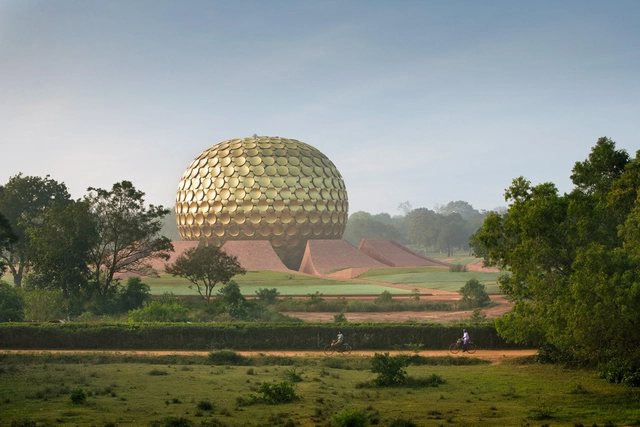
Brooklyn based architectural photographer James Ewing has placed first in the American Photographic Artists’ APA Awards for architecture. The image, as Ewing describes, “was created to describe the verdant landscape that surrounds the Matrimandir and the community of Auroville.”
“The land was in an advanced state of desertification when the Auroville project was started in the 1960s. Heavy erosion had removed most of the topsoil and left a barren scorched earth. Through many years of careful engineering and land management Auroville has created a lush, wooded, garden city. I sought out an elevated vantage point that allowed me to present the building in context with its landscape. The building without the landscape would only be half of the story. The cyclists in the foreground show scale and provide a contrast between the familiar low-fi technology of the bicycles and the fantastic sci-fi form of the Matrimandir itself.”
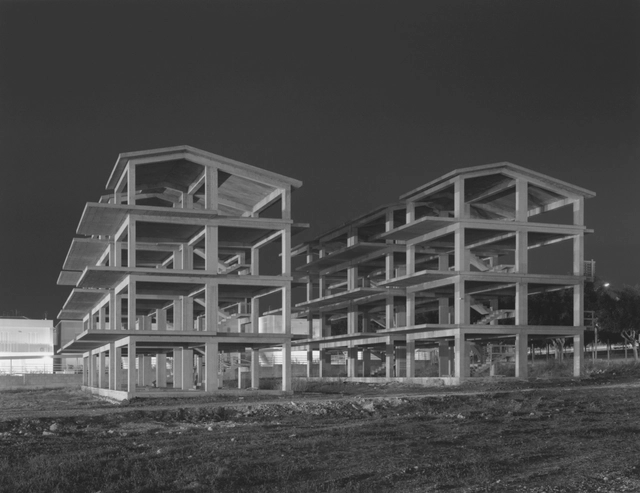
Europe's ancient ruins are numerous: Pompeii, the Parthenon, the Colosseum - but what about new ruins? Skeletons of incomplete buildings now litter the skylines of European cities. A form of memento mori, these abandoned constructions prove that no structure is permanent or impervious to the changing desires of a society in flux. EnglishphotographerSam Laughlin documents the creation of these 'ruins' in his series Frameworks, a contemporary dissection of the aging built environment.
Enter the abandoned world in Frameworks with more photos and info after the break.
To coincide with the opening of the Royal Institute of British Architects (RIBA)'s new Architecture Gallery at their headquarters in London's Portland Place, the first major retrospective of Edwin Smith will open next month. Smith, one of Britain's foremost 20th century photographers, was considered a master of capturing the essence of the places, landscapes and buildings he documented over an extensive career. The exhibition, entitled Ordinary Beauty, will display over a hundred carefully curated black and white images from a collection of over 60,000 negatives and 20,000 prints donated by Olive Cook, Smith's widow and collaborator, to the RIBA Library.
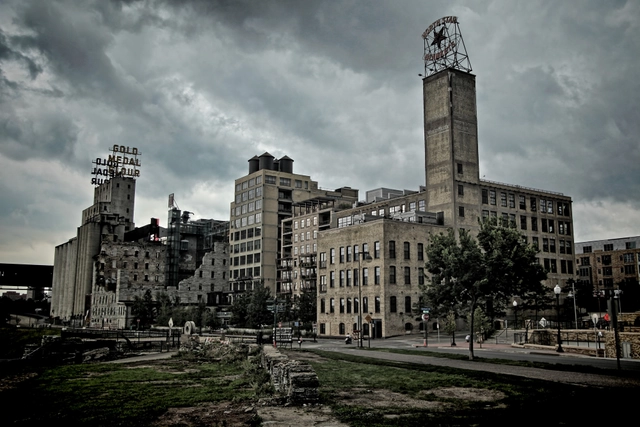
Historic mill city ruins in downtown Minneapolis. Image Courtesy of Flickr CC License / Joey Lax-Salinas
Lately, architects are sharing an increasing captivation with ruins. As our technologies for envisioning the buildings of the future become ever-more accurate – enabling us not only to walk through, hover over, and inhabit walls, but also to calculate exact quantities of materials, structural load capacities and costs – our fascination for ruin, a process that is governed by laws of nature and time in a manner that is spatially unpredictable and rarely uniform, has also seen a rise in popularity.
Blogs such as Ruin Porn, Abandoned America and Architecture of Doom draw from a recent sub-genre of photography, identified as ‘ruins photography’ or ‘ruin porn’. While buildings can go into decay for many reasons, these images tend to focus on urban decay, especially in cities such as Detroit, Chicago and Berlin, which saw a surge of industrialization in the last century that has since dwindled.
https://www.archdaily.com/537712/beyond-ruin-porn-what-s-behind-our-obsession-with-decayShayari De Silva
It's clear that architecture inspires and impassions Timothy Soar - not only has the UK photographer spent most of his life visiting and capturing great architectural works, but - unlike most photographers, or architects for that matter - he also speaks eloquently about the architecture that inspires him. Describing his favorite building, AHMM's Yellow Building, he tells us it "delivers exquisite simplicity out of a complex lattice. The building has a lyrical poetry in the way it wraps and folds itself around the occupants – deft, confident and generous. It is one of London’s great spaces."
Moreover, Soar believes deeply that his architectural photography does more than merely idealize built forms; not only do his images enable the architects he works with to "refine and amplify" the ideas within their built works, and thus aid them in defining their next work, but it also seeks to advocate architecture for all: "My work as a photographer is predicated on a desire to [...] to be an advocate for design that elevates, to help construct an argument where good design isn’t an occasional, rare and special thing but an everyday, routine and expected event." Read the whole interview and see more of Soar's fantastic images, after the break
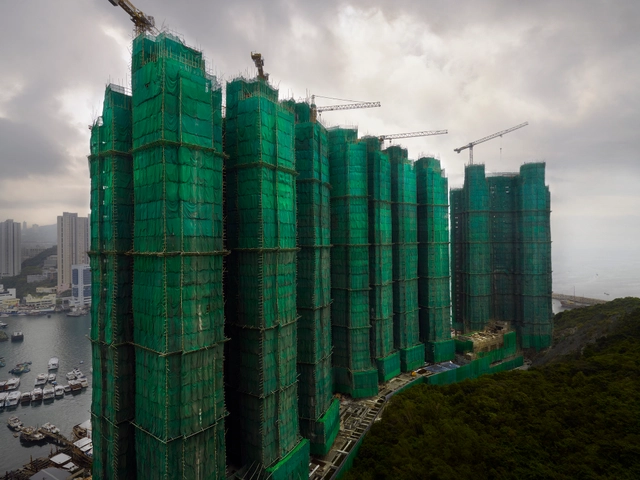
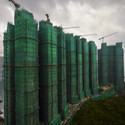
In 1994, a routine construction technique that has been practiced in Hong Kong for over 100 years caught the attention of photographer Peter Steinhauer - and led him to put almost a decade of work into capturing this unique urban phenomenon. The bamboo scaffolding and fabric wrappings he photographs serve the simple purpose of catching construction debris, but at a glance they look more like works by Christo and Jeanne Claude, the artists that have made their name wrapping buildings like the Reichstag in Berlin.
The resulting photos showcase the colossal towers of Hong Kong wrapped in brightly-colored fabric; their usually varied facades are made monolithic, like a plastic massing model rendered full-size. Steinhauer named his photo series "Cocoons" due to the effect they create over time: the buildings metamorphose under cover and emerge transformed.
Allan Crow may be, as he humbly puts it, just one of "two blokes that take photos." But Hufton+Crow, the photography studio founded by him and Nick Hufton ten years ago, has reached far more than humble success. The duo have shot some of the most talked-about architectural works of the last few years -from Zaha Hadid's Galaxy Soho to Steven Holl's Sliced Porosity Block to BIG's Danish Maritime Museum - and have been published in renowned websites and magazines around the world. Learn more about how Crow began his career as well as his favorite architecture, after the break.
ArchDaily has partnered with The Architectural Review to bring you short thematic introductions to the magazine's monthly editions. Up now: AR's April 2014 issue, which examines the complexities of architecture photography. Editor Catherine Slessor asks "what happens when controlled views of buildings are redefined by and adapted to new technologies?"
Roland Barthes once observed that there is no such thing as a photograph. ‘Whatever it grants to vision and whatever its manner, a photograph is always invisible, it is not it that we see’, he wrote in Camera Lucida. What we do see is the scrutinising gaze of the photographer, which can beguile or unsettle, but should always evoke some kind of response.
As a scientific and ‘truthful’ medium, photography has served architecture well, especially in the Modernist era when the evolving medium synthesised perfectly with a new approach to design. Yet the relationship between architecture and photography is an inherently compromised one. Unlike art practice, architectural photography lends itself less to searching critical enquiry, being essentially an unspoken pact between architect, photographer and publisher to render buildings in a way that discreetly flatters architectural ambition and sells copies of books or magazines.
In this interview, originally published by Paperhouses as "Decisive Moment: Conversation With Fernando Guerra", the Portuguese photographer details his career in architectural photography, and how he approaches the art of photographing buildings. As an advocate of free sharing and online publicity, and one of a new breed of photographers who - shock horror - likes to include people in his shots of buildings, Guerra is well placed to explain how the world of architectural photography has changed over the past decade.
I do not want to call it an interview—it was a fabulous discussion that Fernando Guerra led as a loose narrative with notes on work that he practices with hedonism and filled with life. They are all stories dedicated to the great beauty of doing what one loves and letting it grow.
Last June, we published our first list of must-see Instagram feeds to follow, but we knew it was only the tip of the iceberg. Once again we’ve scoured the web (and followed your excellent suggestions) to track down the 25 Instagrammers who will be sure to inspire – including dare-devil adventurer raskalov, up-and-coming architecture photographer nicanorgarcia, and our very own editor-in-chief.
See the 25 awesome architecture instagrammers, after the break…
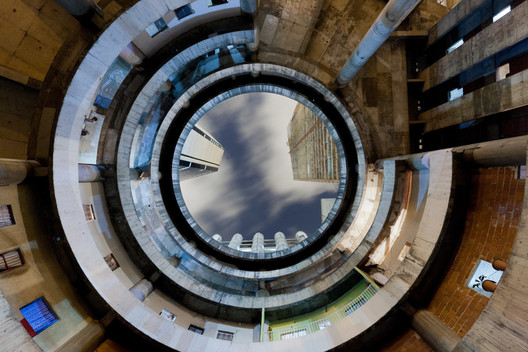
This image, by photographer Daniel Chia, of the 1960s Jalan Bukit Ho Swee public housing block has placed third in Singapore for the 2014 Sony World Photography Awards. It was one of 24 images awarded from a selection of 70,000 entries. You can view all the stunning, award-winning photographs here.
Steven Holl Architects has shared with us an impressive gallery of images of their recent project, Nanjing’s Sifang Art Museum. Rising above the lush landscape of the Pearl Spring, the new museum was designed as a physical manifestation of the parallel perspective, a technique prevalent in early Chinese paintings. From a subtly distorted courtyard with no vanishing points to an upper level gallery with calculated views and pristine light, the experience through the Sifang Art Museum is unlike any other.
UPDATE: The winning images will go on show February 28th in London at the "Building Images: The Arcaid Images Architectural Photography Awards 2013" exhibition. They will remain on view through April 25th inside a renovated factory on 7–9 Woodbridge Street.
The Architectural Photography Awards, hosted by Arcaid Images, have announced the winner, runner-up and shortlisted images for this year's best architecture photos. A distinguished panel architects and editors that included Catherine Slessor, Eva Jiricna, Zaha Hadid, Ivan Harbour and Graham Stirk were asked to look beyond architecture and into composition, atmosphere and scale to ultimately judge four categories of images: Interiors, Exteriors, Sense of Place and Building In Use. Their selections reflect this vision admirably.
https://www.archdaily.com/449463/winners-announced-for-the-2013-arcaid-images-architectural-photography-awardsJose Luis Gabriel Cruz


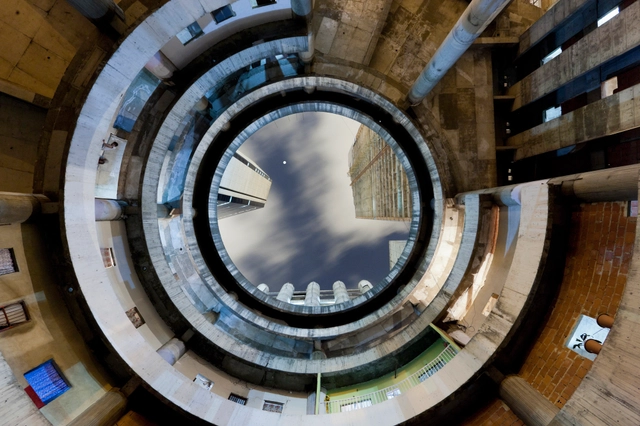


__Chongqing_Municipality__2006.jpg?1412045399 "9. Nadav Kander Chongqing IV (Sunday Picnic), Chongqing Municipality, 2006 © Nadav Kander, courtesy Flowers Gallery. Image Courtesy of Barbican Art Gallery")



___N_Ireland__1965_(c)_Edwin_Smith__RIBA_Library_Photographs_Collection.jpg?1408906178&format=webp&width=640&height=580)