1. ArchDaily
  2. Archasm

Archasm: The Latest Architecture and News

Open Call: The Museum of Language, London

BACKGROUND
Carl Sandburg has accurately described language as the most indispensable tool in the life of us social animals, men. Men have traversed through ages and grown into the most superior race on Earth because of their advanced linguistic and communication skills. Human language is unique in comparison to other forms of communication, as it allows us to produce a vast range of expressions and emotions from a finite set of elements.

The timeline for the development of modern day languages spans thousands of years. Sounds have developed into words, meanings, scripts, grammar, fonts and a formal system of communication called linguistics. One organization suggests that there are about 7099 living languages in the world, but which are not evenly distributed around the world geography. Only 23 languages account for more than half the world’s population. Roughly a third of languages are now endangered, often with less than 1,000 speakers remaining.

Language is much more than just a means of communication. It is also an inseparable part of our culture. In fact, language allows culture to exist. Language allows us to pass on ideas, knowledge, and even attitudes on to the next generation. Language allows culture to develop by freeing people to move beyond their immediate experiences”. Language is intrinsic to the expression of culture. As a means of communicating values, beliefs and customs, it has an important social function and fosters feelings of group identity and solidarity. It is the means by which culture and its traditions and shared values may be conveyed and preserved.

Languages are the most important part of a particular cultural heritage. As one culture dies and another grows, the same happens to their languages. Language is a relic that needs preservation as other inventions and objects of importance. It is an intangible resource that can also unlock some of the lost secrets and even civilizations that existed on the face of the earth.
The aim of the competition is to design an iconic museum of language in the heart of London that will deconstruct the science of linguistics into various aspects of- speech, script and sense. The proposal must not only become an archive for the past and present world languages but also serve as a learning center that works to develop languages and future communication systems.
Competition Entry Imagines Dynamic Library Design for London's Hyde Park

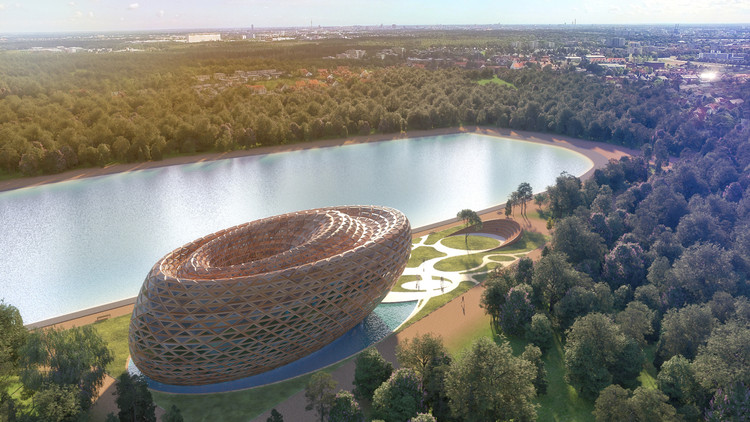
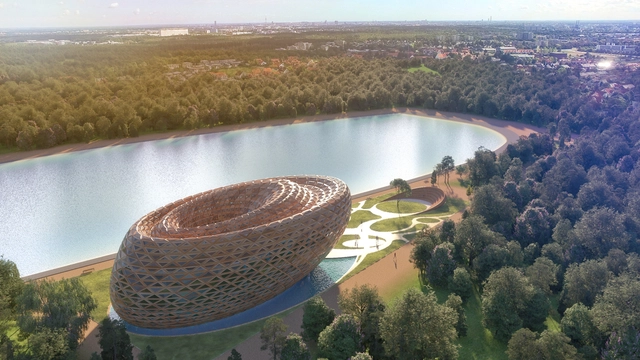
Michel Kozman has imagined a light-filled library for Hyde Park as part of the Archasm Hyde Park Library Competition that ran earlier this year. The competition, which attracted 378 registrations, called for “a stimulating and exciting approach towards the design of a library at Hyde Park.” The brief requested consideration be given to modern forms of media, including audiovisual and digital technologies, challenge the traditional library typology and become a zone within the park for knowledge exchange and gathering.

Competition Entry Imagines Dynamic Library Design for London's Hyde Park - Image 1 of 4Competition Entry Imagines Dynamic Library Design for London's Hyde Park - Image 2 of 4Competition Entry Imagines Dynamic Library Design for London's Hyde Park - Image 3 of 4Competition Entry Imagines Dynamic Library Design for London's Hyde Park - Image 4 of 4Competition Entry Imagines Dynamic Library Design for London's Hyde Park - More Images+ 14

Open Call: School Without Classrooms (Berlin)

The competition seeks the creation of a middle school (age group 5-12) that completely negates the present day 'bench-table-chalkboard' idea of a classroom and a regularized building typology of a school. The competition seeks to radicalize the school system through architecture not only in terms of improving the quality of study environment but revamping the system and breaking all the physical and metaphorical class divisions into an entirely new school system. The competition seeks ideas from participants to create a fun built environment for a middle school that understands the individual needs of each child yet being very collaborative in nature. The school should strive to create a new pedagogical space that emphasizes on people-oriented design in behavioral terms as they interact and use spaces.

Open Call: Chandigarh Unbuilt Competition to Complete Le Corbusier's Capitol

Online international competition organizer archasm has launched its “Chandigarh Unbuilt: Completing the Capitol” ideas competition, which seeks designs to finalize and complement Le Corbusier’s Capitol Complex in Chandigarh, India.

Three buildings at the complex have been built according to Le Corbusier’s plans—the Secretariat, Assembly Hall, and High Court—but the fourth and final building, called the Museum of Knowledge, has yet to be conceptualized.

Archasm is looking for designs that will serve the purpose of a knowledge and connaissance museum in the context of the 21st century, while also considering the “importance of Le Corbusier’s version of modern architecture,” as well as the use of surrounding public space and its affect on the community.