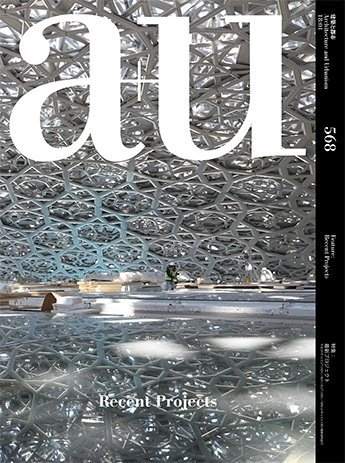
This edition of a+u introduces the 23 recent works of architecture and technology that emerged from their relationship with the urban structure or the development history. In this issue, we focus our attention on the process of conceiving and realizing the projects driven by various motivations and tactics. We invite readers to look beyond the confinement of a single building and examine the works on their possibilities to be in use for a long time.
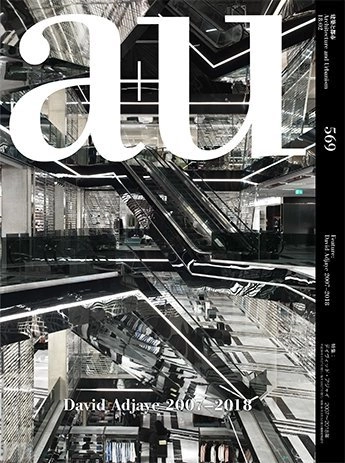
This issue follows the previous a+u monograph of Sir David Adjaye OBE (published November 2007), featuring Adjaye Associates' projects completed after 2007. You will see that the works of this London-based practice have expanded globally. The issue includes an essay by the architect himself on his approach to light and density.
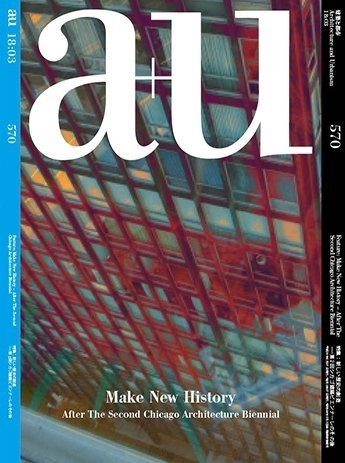
This issue focuses on the second edition of the annual Chicago Architecture Biennial, 2017, that featured the participation of 140 artists from 20 countries, under the theme Make New History. Guest edited by Sharon Johnson and Mark Lee, Artistic Directors of the Biennial, the first part looks back on the Biennial through a conversation with architectural historian, Michael Hays. The second part introduces built work and projects selected with reference to the exhibition's theme by the guest editors and participating architects.
1. Abstract: Food is one of the most fundamental elements of human existence. Looking back, the way we produce, store and consume food has evolved greatly. Humans have thrived because our ancestors learnt how to gather, produce and consume food, all with their bare hands. And mankind has sustained due to these crucial elements of knowledge passed through generations. With industrialization came mass production, and with mass production came an influx of consumers - who started paying instead. Skills and crafts related to agriculture and food production are now mostly obsolete in the urbane environment. Mass consumerism through supermarkets and even online mediums is slowly changing how we perceive, acquire and consume food. This has raised issues like overconsumption, poor quality, high wastage and an over-dependence on manufacturing agencies. In the long run our perception of fresh foods/fruits will be completely eroded by advertisements and fancy packaging, which can have irreversible impacts on health, and hence, the human evolution cycle. The time to intervene is now. As a designer how can you bring farming to the cities where people can see, participate or celebrate cultivation - and understand what they eat, much better? Where not only awareness related to food is available, but as a community we become more responsible for our actions. How can you change the image of cities as the ones that only consume, to ones that contribute too? Or make farming so easy for people using technologies of today that makes it easy for people to grow it in their homes? Urban meal mine1(n), is a place where people can generate/learn/contribute to grow food for their city. This is usually located in the heart of the city where skilled labour + abundant transport + short distance logistics + faster production technologies can break even revenue over the high cost land it occupies. Learn more on http://unfuse.uni.xyz 2. Site: The site for this intervention is the New Covent Market located in the Nine Elms District, London opposite to historic Battersea power station. The site is close to the river Thames and is a part of Nine Elms regeneration plan. It consists of a 4 decade old market structure which houses a wide variety of wholeseller’s of foods, fruits, vegetables and flowers. The site is surrounded by residential and commercial developments of various scales, and is expected to invite people from around the city. It also has two brand new tube stations proposed in attempt to rejuvenate transport links to the Nine Elms district. 3. Eligibility The competition is open to all students and professionals (Worldwide). Minimum eligible age for participation is 18 years. This competition is open for both students and professionals. Team size is maximum of 4 members per team. All disciplines are eligible. Team: Teams with all student participants (with valid id’s required) will be categorized under student teams. Teams with even one professional participant will be categorized under professional team. 4. Submission A maximum 6 – A3 sheets in digital format (JPEG) (120ppi). Minimum requisites in the sheets (For a complete submission): Site plan (Compulsory), Key conceptual sections x 2 (Minimum), 3D views x 3 (Minimum / Should include 1 aerial view), Elevation x 1 Cover image of size 1500 x 600 px or larger in aspect ratio 1 : 2.5. Floor plans, images, sketches (if any) can be added to support the entry in the form of additional images. 5. Prizes A total of 4000$ worth rewards to be won. Winner: 1500$ in cash + Trophy + Certificate + Publication Runner up: 550$ in cash + Trophy + Certificate + Publication People's Choice (Students): 500$ - Trophy + Certificate + Publication People's Choice (Professionals): 500$ - Trophy + Certificate + Publication Honorable Mention (Students x 4): Medal + E - certificate + Bi-Annual Digest of Unfuse + Publication Online presentation: 30 Shortlisted Entries - E- certificate - Entries promoted through partner websites.
2017 is in the past. Nevertheless, the year has left us a series of lessons, new wisdom and better tools to help us face the challenges of 2018. What surprises will this year bring us?
We asked our editors at Plataforma Arquitectura (ArchDaily's Spanish arm) to make predictions based on what they've learnt in 2017, and to share with readers the topics they expect to be in the limelight in 2018.
https://www.archdaily.com/889638/the-9-architecture-topics-you-need-to-know-about-in-2018Pola Mora