With the 2017 Salone del Mobile now behind us, photographer Laurian Ghinitoiu has shared a collection of photographs from Milan Design Week. From housing prototypes to immersive "digital installations", the annual design show—which is often touted to be the fourth largest of any kind in the world—this year brought together a wide range of practitioners and design companies. In Milan, unusual collaborations are the order of the day.
Cities around the world are facing a shortage of attractive housing options that use resources in a responsible, environmentally-positive manner. Looking to solve this challenge, New York-based firm SO-IL has teamed up with car manufacturer MINI to create MINI LIVING – Breathe, a “ forward-thinking interpretation of resource-conscious, shared city living within a compact footprint.
Now on display at the Milan Salone del Mobile 2017, the prototype structure is constructed of a translucent fabric membrane stretched across a modular metal frame that rises vertically from a previously unused 50-square-meter urban plot. Six rooms and a roof garden provide the space for flexible programmatic arrangements, adhering to the MINI LIVING principles of “Creative use of space” and “Minimal footprint.”
Photographer Laurian Ghinitoiuhas visited Herzog & de Meuron's Elbphilharmonie Hamburg, Germany – a 2017 winner of the ArchDaily Building of the Year award. The striking silhouette of this cultural centre and concert hall, which is identical in ground plan to the brick block of the older building upon which it sits, is often photographed as an isolated object. In this photo-essay, the context of the port around the project is often foregrounded – and unusual views offer new perspectives onto its iconic design.
Employing the latest in aluminum and metals innovation, Ben van Berkel and UNStudio have erected the ALPOLIC fair stand at BAU 2017, the world’s leading trade fair for architecture, materials and systems. Emphasizing the inherent strength of the ultra-light material, the parametric design utilizes geometric principles to create a self-supporting semi-private stand for gathering and the display of products.
This episode of Monocle 24'sOn Design podcast, which briefly surveys the state of Indian architecture and suggests a blueprint for a 21st Century vernacular, was written and recorded by ArchDaily's European Editor at Large,James Taylor-Foster.
In the first half of 2016 an exhibition was opened in Mumbai. The State of Architecture, as it was known, sought to put contemporary Indian building in the spotlight in order to map trends post-independence and, more importantly, provoke a conversation both historical and in relation to where things are heading.
https://www.archdaily.com/802970/is-india-building-the-wrong-sort-of-architectureAD Editorial Team
SANAA's Zollverein School of Management and Design in Essen, Germany, is a perfect 35 meter-cube. The building's dominant presence, which is particularly striking amid its suburban context, extends to the interior spaces. The architects felt "that exceptional ceiling heights were appropriate for the educational spaces, particularly for the studio level that occupies an entire slab of the structure." Indeed, this production floor is "an unusually lofty and fully flexible space," enclosed only by the external structural walls. Photographer Laurian Ghinitoiu has visited the building, which was completed in 2010, to capture a fresh view on this seminal project.
This week the 2016 Venice Architecture Biennale—Reporting From the Front—will close. Six months have passed and hundreds of thousands of architects, urbanists, designers and tourists have perused both the National Participations (of which more were represented this year than ever before) and the central exhibition curated by Alejandro Aravena – the first South American to direct the most prestigious event on the architectural calendar. ArchDaily has compiled our most extensive coverage of the event and, as the 15th incarnation of Biennale shuts its gates for the last time, our collection of articles, interviews and publication excerpts remains permanently accessible.
https://www.archdaily.com/800063/2016-venice-architecture-biennale-reporting-from-the-front-6-months-in-5-minutesAD Editorial Team
In this latest photoset, photographer Laurian Ghinitiou gives us a first look at BIG’s Transitlager, a new mixed-use arts complex located within and around an existing warehouse building in Basel, Switzerland. Now nearing completion, the renovation and expansion is characterized by its reaction to the existing geometries of the nearby industrial infrastructure, taking the form of two distinct buildings, one placed on top of the other. The complex will contain a series of multifunctional floors for art, commerce, working and living in becoming the center of the new arts district of Dreispitz.
In this latest photoset, photographer Laurian Ghinitiou turns his lens toward JDS Architects’ Maison Stéphane Hessel, a recently-completed, competition-winning mixed-use building in Lille, France. Containing space for a 70-cradle nursery, a 200-bed youth hostel and an office for socioeconomic innovation, the expressively playful building has been designed to respond to the three stages of human growth, from birth, through adolescence and into adulthood. The building volume lifts at its entrances to create public space and invite the entire community to use the building as a retreat from the bustling city, while inside, carved spaces with built-in, soft-edged furniture provide the ideal setting for learning and development.
Zaha Hadid Architects' new Port House in the Belgian city of Antwerp, which has been almost a decade in planning and construction, officially opens this week. A monumental new structure sits above a repurposed and renovated (formerly derelict) fire station, providing a new headquarters for Europe's second largest shipping port. Housing 500 staff, who will now be under the same roof for the first time, the building represents a sustainable and future-proof workplace for its employees. Photographer Laurian Ghinitoiu has visited to capture his unique perspective on this new addition to the city's crane-covered skyline.
This exclusive photo essay by Laurian Ghinitoiu was originally commissioned for the fifth issue ofLOBBY. Available later this month, the latest issue of the London-based magazine—published in cooperation with the Bartlett School of Architecture—examines the theme of Faith as "a fervent drive, a dangerous doctrine, a beautifully fragile yet enduring construct, an unapologetic excuse, a desperate call for attention and a timely consideration on architectural responsibility."
In 1986 the Pritzker Architecture Prize announced their first German laureate. In a speech at the ceremony in London’s Goldsmiths’ Hall, the Duke of Gloucester suggested that the prize “may not guarantee immorality,” inferring, perhaps, that not even the most prestigious award in architecture could compete with an œuvre so compact, focussed and enduring as that of Gottfried Böhm – a “son, grandson, husband, and father of architects.”
Text via Blain|Southern. For her first exhibition with Blain|Southern, Chiharu Shiota will create a new site-specific monumental installation in the Berlin gallery, eight years after she last exhibited in her home city.
Shiota is primarily known for her immersive installations, such as The Key in the Hand, with which she represented Japan at the Venice Biennale in 2015. Weaving intricate networks of yarn, the artist creates new visual planes as if she were painting in mid-air.
The installation Uncertain Journey fills the gallery’s vast central atrium with dense webs of red yarn – seemingly growing from above, reaching down towards the skeletal hulls of boats which rest on the gallery floor below. The colour of blood, the nexus of yarn is laden with symbolism, for the artist it alludes to the interior of the body and the complex network of neural connections in the brain. Enclosed by the canopy overhead, the boat carcasses raise existential questions of fate and belonging, evoking ideas that can be as complex as the tangled yarn itself.
This past weekend, the Bauhaus in Dessau was animated by the Bauhaus Festival. Titled “Circus, Circus – from Black to White,” the event was intended to present all the fun of the fair with a monochrome twist--in opposition to the wild colors usually associated with circuses--and in the words of the Bauhaus was a “kinetic explorations of bodies, objects, media, space and sound.” The event was also an opportunity to tap into the legacy of Bauhaus legend László Moholy-Nagy, whose experiments in film and media blend well with the performative nature of the circus. The event featured a number of performances by artists, while “Cybernetic Circus” by Anhalt University of Applied Sciences and the Initiative Neuer Zirkus turned the grounds of the Bauhaus into an “architectural landscape” of performance modules inspired by Maholy-Nagy. Also featured were installations by students at Burg Giebichenstein University of Art and Design Halle titled “Neo Luna Park.” Photographer Laurian Ghinitoiu traveled to the event to capture the festivities, showing their interaction with Walter Gropius’ famous building.
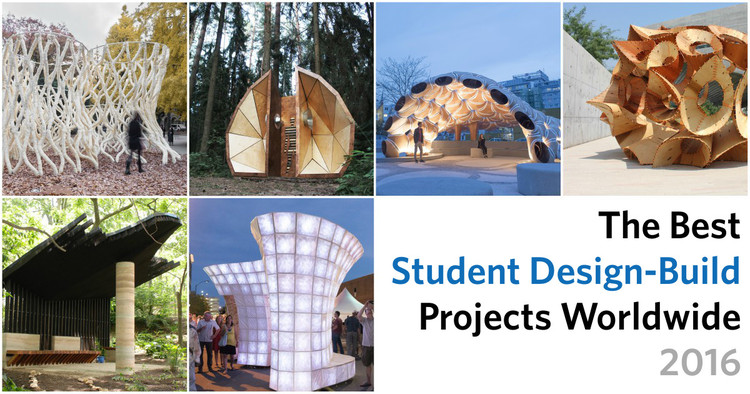
Last year, we asked the graduating students among the ArchDaily community to show us the design-build projects which they may have completed as part of their studies. The response we received was astonishing, and we were so impressed with the results that we simply had to do it again this year. So, two months ago we once again teamed up with ArchDaily Brasil andallfourArchDailyen Español sites to put out another call for submissions, and once again the response was overwhelming. Across over 100 submissions, the quality of the projects we received was so high that this year's results are bigger and better, containing 36 projects from 20 different countries. So, read on for the best student-built work from around the world in 2016.


.jpg?1492020579&format=webp&width=640&height=580)
.jpg?1492020513&format=webp&width=230&height=230&crop=true)
.jpg?1492020331&format=webp&width=230&height=230&crop=true)
.jpg?1492020534&format=webp&width=230&height=230&crop=true)
.jpg?1492020424&format=webp&width=230&height=230&crop=true)
.jpg?1492020579)
.jpg?1492100907&format=webp&width=640&height=580)


.jpg?1492100907)
.jpg?1491327845&format=webp&width=640&height=580)
.jpg?1491327852&format=webp&width=230&height=230&crop=true)
.jpg?1491327860&format=webp&width=230&height=230&crop=true)
.jpg?1491327869&format=webp&width=230&height=230&crop=true)
.jpg?1491327876&format=webp&width=230&height=230&crop=true)
.jpg?1491327845)
.jpg?1488821716&format=webp&width=640&height=580)
.jpg?1488821999&format=webp&width=230&height=230&crop=true)
.jpg?1488822128&format=webp&width=230&height=230&crop=true)
.jpg?1488821802&format=webp&width=230&height=230&crop=true)
.jpg?1488821732&format=webp&width=230&height=230&crop=true)
.jpg?1488821716)
.jpg?1487613531&format=webp&width=640&height=580)
.jpg?1487613696&format=webp&width=230&height=230&crop=true)
.jpg?1487613705&format=webp&width=230&height=230&crop=true)
.jpg?1487613547&format=webp&width=230&height=230&crop=true)
.jpg?1487613680&format=webp&width=230&height=230&crop=true)
.jpg?1487613531)


.jpg?1484934632&format=webp&width=640&height=580)
.jpg?1484934664&format=webp&width=230&height=230&crop=true)
.jpg?1484934679&format=webp&width=230&height=230&crop=true)
.jpg?1484934695&format=webp&width=230&height=230&crop=true)
.jpg?1484934710&format=webp&width=230&height=230&crop=true)
.jpg?1484934632)

.jpg?1482176359&format=webp&width=640&height=580)
.jpg?1482177176&format=webp&width=230&height=230&crop=true)
.jpg?1482177234&format=webp&width=230&height=230&crop=true)
.jpg?1482176800&format=webp&width=230&height=230&crop=true)
.jpg?1482176583&format=webp&width=230&height=230&crop=true)
.jpg?1482176359)

.jpg?1479757131&format=webp&width=640&height=580)
.jpg?1479756827&format=webp&width=230&height=230&crop=true)
.jpg?1479756994&format=webp&width=230&height=230&crop=true)
.jpg?1479756858&format=webp&width=230&height=230&crop=true)
.jpg?1479757009&format=webp&width=230&height=230&crop=true)
.jpg?1479757131)
.jpg?1479192914&format=webp&width=640&height=580)
.jpg?1479192822&format=webp&width=230&height=230&crop=true)
.jpg?1479192791&format=webp&width=230&height=230&crop=true)
.jpg?1479193093&format=webp&width=230&height=230&crop=true)
.jpg?1479192869&format=webp&width=230&height=230&crop=true)
.jpg?1479192914)
.jpg?1477400767&format=webp&width=640&height=580)
.jpg?1477400756&format=webp&width=230&height=230&crop=true)
.jpg?1477400056&format=webp&width=230&height=230&crop=true)
.jpg?1477400087&format=webp&width=230&height=230&crop=true)
.jpg?1477398338&format=webp&width=230&height=230&crop=true)
.jpg?1477400767)
.jpg?1474634758&format=webp&width=640&height=580)
.jpg?1474634442&format=webp&width=230&height=230&crop=true)
.jpg?1474634454&format=webp&width=230&height=230&crop=true)
.jpg?1474634533&format=webp&width=230&height=230&crop=true)
.jpg?1474634733&format=webp&width=230&height=230&crop=true)
.jpg?1474634758)
.jpg?1474570511&format=webp&width=230&height=230&crop=true)
.jpg?1474569951&format=webp&width=230&height=230&crop=true)
.jpg?1474569428&format=webp&width=230&height=230&crop=true)
.jpg?1474569212&format=webp&width=230&height=230&crop=true)

.jpg?1474121915&format=webp&width=640&height=580)
.jpg?1474121884&format=webp&width=230&height=230&crop=true)
.jpg?1474121948&format=webp&width=230&height=230&crop=true)
.jpg?1474121816&format=webp&width=230&height=230&crop=true)
.jpg?1474121873&format=webp&width=230&height=230&crop=true)
.jpg?1474121915)
.jpg?1473087666&format=webp&width=640&height=580)
.jpg?1473088561&format=webp&width=230&height=230&crop=true)
.jpg?1473087820&format=webp&width=230&height=230&crop=true)
.jpg?1473088648&format=webp&width=230&height=230&crop=true)
.jpg?1473088081&format=webp&width=230&height=230&crop=true)
.jpg?1473087666)


.jpg?1473019568&format=webp&width=230&height=230&crop=true)