Zaha Hadid has been announced as the winner of the 41st Veuve Clicquot Business Woman Award at a ceremony in London on Monday. Now in its 41st year, the Veuve Clicquot Award was set up by the Champagne house to recognize the work of successful businesswomen worldwide, who embody their spirit of Madame Clicquot.
Madame Clicquot was a 19th Century businesswomen who, after being widowed at the age of 27, took the reigns of her husband's Champagne businessa became one of the first women to lead a male-dominated company. The company describes her as a women who was 'proud and strong-willed' who demanded "only one quality, the finest." The award appraises the nominees under the headings of entrepreneurship, financial success, corporate social responsibility and whether or not they are seen as a role model to others.
Designed as an experiment on “the architectonics of music,” the basic geometry of the Daeyang Gallery and House was inspired by Istvan Anhalt’s 1967 Symphony of Modules - a uniquely transcribed sheet of music found in John Cage’s contemporary music compendium, Notations. Reminiscent of the “blocky and shard-like shapes” of Anhalt’s sketch, Holl’s design features three copper-clad pavilions punctured by a symphony of carefully placed, rectangular skylights that animate the interior with “bars of light”. As Kennicott describes, Holl uses music as a “powerful metaphor for the dynamic unfolding of experience” (captured in this film by Spirit of Space).
Read Kennicott’sMusic Holl: A Copper Clad Pavilion in its entirety here on Dwell. Continue after the break to compare Steven Holl's sketch above with Anhalt’s Symphony of Modules.
Since June, we've been reporting on the Design Corps and SEED (Social Economic Environmental Design)'s, SEEDocs, a series of mini-documentaries that highlight the stories of award-winning public interest design projects. As each mini-doc has been an excellent, inspiring exploration of the challenges and benefits of community-oriented design, we are pleased (and not a little sad!) to announce that the final seed-doc has just been released.This month's mini-doc, probably the series' best, focuses on the Nyanza Maternity Hospital, designed by MASS Design Group. MASS of course garnered much attention for their Butaro Hospital, also in Rwanda (for an interesting inside-look at the construction of Butaro, read this excellent article by MASS co-founder Marika Shiori-Clark). Should this hospital be funded and realized, it will no doubt make more headlines for the innovative public-interest design firm. Read more about MASS Design Group's lastest project in Rwanda, after the break...Part of what sets MASS Design Group apart is their receptive, "open slate" approach to projects. As Sierra Bainbridge, Director of Implementation at MASS, explains in the doc: "we don't come in with any ideas, at all, about what's going to happen - just a very very long list of questions. We can only build a very good building if we check in and understand, every step of the way, that we are understanding the clients the way that they intend for their needs to be understood."Of course, as Ms. Bainbridge points out in the doc, sometimes the clients themselves - the nurses, doctors, and patients who use the facility - don't even know how their needs could be better met, since they have gotten so used to their current, sub-par facility, a dilapidated structure built in 1931. This is where the experience of the architect comes in. With one of the highest infant and maternal mortality rates in the world, Rwanda loses over 40,000 infants, toddlers, and mothers each year; deaths that, in about 50% of cases, could have been prevented with improved hospital care. MASS Design has isolated one of the major factors in these preventable deaths: poor air circulation. When patients sit in crowded, stuffed hallways-come-waiting rooms, disease spreads rapidly. The very buildings that were designed to heal, actually kill. And so, the crowning features of MASS's design for the Nyanza Maternity hospital are solar chimneys – "a new ventilation concept that pulls fresh air up throughout the building, dramatically reducing the potential spread of disease." With the design completed, now the project only lacks donor funding to come to fruition. Please share the video, and the word, about this extraordinary project - we'll be waiting to publish it on ArchDaily once it's built. Did you miss theother SEEDocs? See them all:
Maria Auxiliadora School - On August 15th, 2007 a powerful earthquake hit the region of Ica, Perú, destroying the small Maria Auxiliadora School. The first responders left after a matter of months, but the damage remained. With help from Architecture for Humanity Design Fellow, Diego Collazo, the community decided to take the school’s – and their children’s – future into their own hands.
Escuela Ecológica- In this school in Lima, Peru, students learn in small, dark rooms and play in the dirt. The community desperately wanted a park where the children could play and a school where they could comfortably learn. With the help of a local architect and a group of professors and students from the University of Washington, the community is making those dreams a reality.
Bancroft School Revitilization - In Manheim Park, a low-income, neglected neighborhood in Kansas City, Missouri,there was an abandoned, abestos-ridden school that no one used - until residents approached BNIM Architects with the idea of turning it into a revitalized community center. With the help of the Make It Right Foundation, BNIM collaborated with the neighborhood to design a multi-use center with affordable housing units, a health clinic, and public gathering space.
The Grow Dat Youth Farm - A brilliant example of “Urban Agri-puncture” (a strategy that uses design & Urban Agriculture to target a city’s most deprived, unhealthy neighborhoods), changing the lives of New Orleans youth. Central to the farm’s development has been the creation of a campus, designed and constructed by students enrolled at the Tulane City Center, who turned an abandoned golf course to an energy-efficient, organic farm sensitive to regional climate.
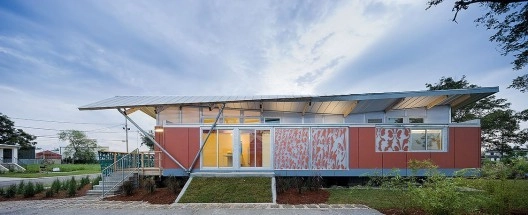
Ever since the New Republic published Lydia DePillis's piece entitled "If you Rebuild it, They Might Not Come" - a criticism of the progress of Brad Pitt's Make It Right Foundation - numerous blogs and journals have been in a uproar, defending Make It Right's efforts at rebuilding the vastly devastated Lower Ninth Ward and presenting a much more forgiving perspective on the progress of the neighborhood since the engineering disaster that exacerbated the effects of Hurricane Katrina in 2005. To date, 86 LEED Platinum homes have been designed and constructed by world-renowned architects including Frank Gehry and Morphosis, at a cost of approximately $24 million. Make It Right has promised to build up to 150 such homes, but DePillis's article points out how amenities in the neighborhood are low and how the number of residents returning to the neighborhood is dwindling. Make It Right has made a commitment and the debate that ensues questions whether it is going far enough in delivering its promise to rebuilding community.
Last week the UK's Culture Minister Ed Vaizey announced that he was commissioning a review of the country's architecture policy, to be led by Sir Terry Farrell along with a number of high profile advisors, including Thomas Heatherwick, Alison Brooks and Alain de Botton. According to Vaizey, the review, expected to be complete by the end of the year, "will be a rallying point for the profession."
In his article in The Guardian, Olly Wainwright rather hopefully questioned: "might this year-long study result in an innovative new piece of legislative guidance – perhaps along the lines of Denmark's architecture policy, introduced in 2007?" While Wainwright somewhat flatly concludes, "somehow, that seems unlikely," there's no doubt that the UK could only stand to gain from learning from Denmark's innovative policy.
So what lessons could the UK (and the world) learn from the Danes? Read on after the break...
“Although Mr. Ito has built a great number of buildings in his career, in my view, he has been working on one project all along, -- to push the boundaries of architecture. And to achieve that goal, he is not afraid of letting go what he has accomplished before.” -- Yung Ho Chang, Member of the Pritzker Jury for 2013
Toyo Ito has been announced as the Pritzker laureate for 2013. Ito is the thirty-seventh recipient of the Pritzker Prize and its sixth Japanese recipient.
The Pritzker jury applauded Ito for his ability to synthesize many architectural languages and functionalities in the expression of one personal “syntax,” inspired by the organic structures found in nature and the sensual nature of the human user.
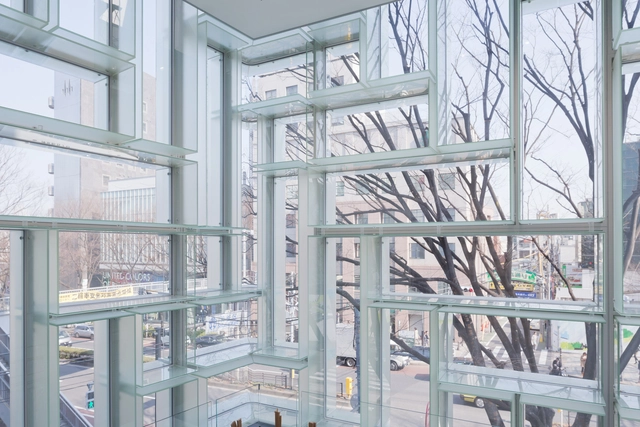
Calling him a “creator of timeless buildings,” the Pritzker Jury further praised Ito for “infusing his designs with a spiritual dimension and for the poetics that transcend all his works.” Among those works, the Jury singled out his Sendai Mediatheque, whose innovative use of structural tubes “permitted new interior spatial qualities,” TOD’S Omotesando building in Tokyo, “where the building skin also serves as structure,” and Tokyo’s Tama Art University Library as particularly inspiring.
In response to the accolade, the highest award in the profession of architecture, Ito humbly expressed that, with each project, he only becomes more “painfully aware of [his] inadequacy, and it turns into energy to challenge the next project.” For that reason, Ito professed, “I will never fix my architectural style and never be satisfied with my works.”
Read more of the Jury’s selection of Toyo Ito as the 2013 Pritzker Laureate, after the break...
Until his third year of high school, Toyo Ito's passion was not architecture, but baseball.
Fortunately for us all (and almost assuredly for the Pritzker laureate himself), he soon switched career paths.
Born in Seoul in 1941, Ito moved to Japan at the tender age of two. From the age of 12 (when his father died) to the time he went to University, Ito was part of the family business: making miso (bean paste). However, upon attending The University of Tokyo from 1965-1969, architecture became his life work.
Read more on the life and work of Toyo Ito, the 2013 Pritzker Laureate, after the break...
Marika Shioiri-Clark is an architect who uses design to empower global change and battle inequality. While attending Harvard for her Masters in Architecture, she co-founded the non-profit MASS Design Group and began working on what would become the the Butaro Hospital in Rwanda. In this article, which originally appeared on GOOD as "Building a Rwandan Wall", she explains the process by which the hospital was built and defends claims that the project, led by a group of Western architects, was somehow colonialist in nature.
As she puts it: "In a place like Rwanda, it’s not neo-colonialist to work on high-quality design projects as long as you’re deeply and authentically engaged with the community. In today’s world, it’s more neo-colonialist to assume that African people don't want well-designed buildings and spaces."
Read about Ms. Shiori-Clark's experiences, and the delicate balance that must be struck between local knowledge and innovative techniques, after the break...
As you might have heard, ArchDaily is celebrating our 5th birthday today! We decided it was time to get a bit nostalgic and look back at the projects of yesteryear, the ones that struck a chord with you, our ArchDaily readers, and helped us get to where we are today.
So, with no further ado, the 20 most visited projects in ArchDaily history! Beginning with....
See our 20 most popular projects of all time, after the break...
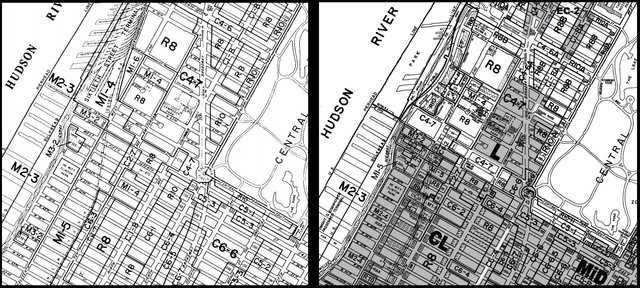
Let’s dump the word “zoning,” as in zoning ordinances that govern how land is developed and how buildings often are designed. Land-use regulation is still needed, but zoning increasingly has become a conceptually inappropriate term, an obsolete characterization of how we plan and shape growth. - Roger K. Lewis
Zoning, just over a century old concept, is already becoming an outdated system by which the government regulates development and growth. Exceptions and loopholes within current zoning legislation prove that city planning is pushing a zoning transformation to reflect the goals and needs of city building today and in the future. To determine how zoning and land use need to change we must first assess the intentions of future city building. Planners and architects, legislators and community activists have already begun establishing guidelines and ordinances that approach the goals of sustainability and liveability. The AIA has established Local Leaders: Healthier Communities through Design and has made a commitment to the Decade of Design: Global Solutions Challenge. NYC has come up with Active Design Guidelines: Promoting Physical Activity and Health in Design and its Zone Green initiative in regards to updating its zoning resolution. Philadelphia has augmented its zoning to include urban farms and community gardens. It is safe to assume that many other cities will follow this precedent.
Opening tonight, February 20, at 6:00pm PST at the Perry Rubenstein Gallery in Los Angeles, Iwan Baan's 'The Way We Live' exhibition features captivating large-scale images of urban, architectural, and home environments that capture Baan’s singular vision. Baan’s artistic practice examines how we live and interact with architecture, focusing on the human element, which brings buildings, intersections, and public gathering places to life. Running until April 13, this is Baan's first solo exhibition at the gallery. More information after the break.
In 1969, zoologist Desmond Morris released a book titled The Human Zoo; in it, he argued that human beings, tribal by nature, aren’t wired to live in the big, crowded modern-day cities we find ourselves in:
“Some people call the city a ‘concrete jungle’ — but jungles aren’t like that. Animals in jungles aren’t overcrowded. And overcrowding is the central problem of modern city life. If you want to look for crowded animals, you have to look in the zoo. And then it occurred to me: The city is not a concrete jungle — it’s a human zoo.”
Humans in a city are like animals in a zoo. It’s a fascinating claim, one that led me to a rather unusual thought.
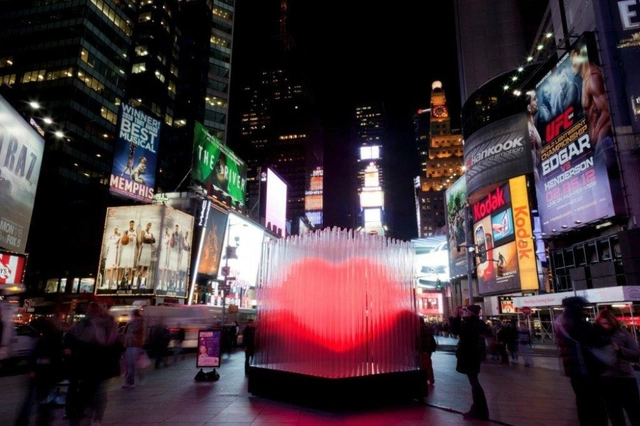
If we take for granted Morris’ claim that the city is essentially a human zoo, and that, as we are all aware, it’s far more difficult for animals to mate in captivity, then - could cities actually limit our capacity for love? As our world becomes more and more urbanized, will it also become more lonely?




.jpg?1365618202&format=webp&width=640&height=580)


.jpg?1365618206&format=webp&width=230&height=230&crop=true)
.jpg?1365618202)




.jpg?1362687201)