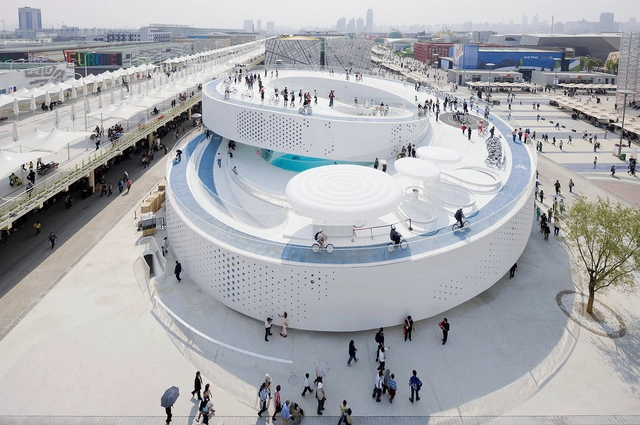
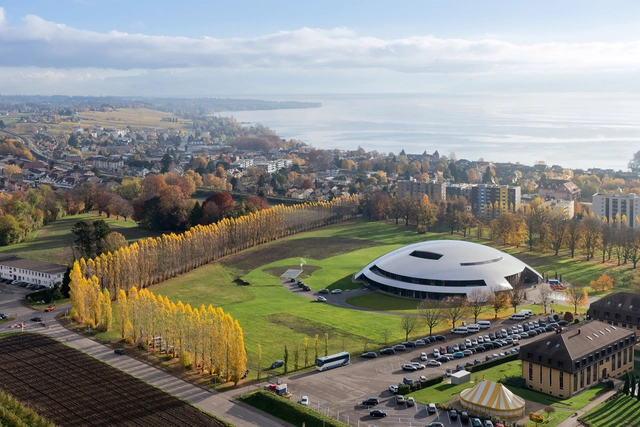
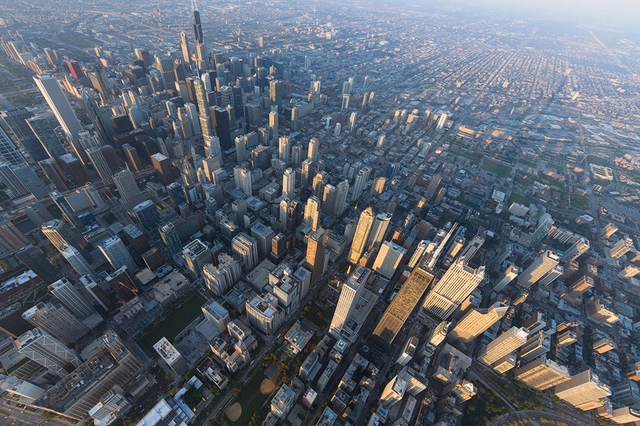
Iwan Baan was twelve years old when he received his first camera and, "within a week, [he] had traded it in for a better one." He is one of the most well-known and highly sought after architectural photographers in the world, recognised for shooting cities from above and for always highlighting people (occupation) in his images. In a short interview with Jonathan Glancey Baan is the first to state that he "doesn't know much about architecture" — something which has not inhibited his ability to produce some of the most successful photographs of the built world, and how we design, construct and occupy it. Set amid the backdrop of the first Chicago Architecture Biennial, Glancey laments the fact that Baan was not "around to photograph the dramatic rise of [the city's] skyline."
"There is never a good time to leave an institution but I wanted to leave the Serpentine at a time of strength and success," said Peyton-Jones, as reported by the Architects' Journal.
Concrete has long had a close relationship with the earth; as the favorite material for the creation of building foundations, one of its most common uses is effectively as a more reliable replacement for soil. In the twentieth century, concrete’s ability to transform our interaction with the ground was taken to the next step. As architects and engineers explored the opportunities offered by a combination of reinforced concrete and the modernist mindset, multiple attempts were made to replace the ground in a more dramatic way: by creating a new ground, separated from the earth itself. Most widespread among these plans was the engineer’s elevated highway which emerged worldwide, and the most relevant to architects the “streets in the sky” embodied by developments such as the Smithsons’ Robin Hood Gardens. Newcastle-upon-Tyne offers a city-wide example of this theory, embarking on an ambitious plan to become the “Brasilia of the North” by creating an elevated network of pedestrian routes entirely separated from the automobiles below - though the project was abandoned in the 1970s with only small sections implemented.
After Modernism’s dramatic fall from grace in the 1970s and 80s, this project to reinterpret the ground with concrete was largely forgotten. Of course architects still used concrete in their designs, but they were content with a purely traditional relationship to the ground: their buildings were discrete entities which sat upon the earth, and nothing more. However, as explored at length in Stan Allen and Marc McQuade’s 2011 book Landform Building: Architecture's New Terrain, recent years have shown architects willing to work upon the ground once again, in new and exciting ways. In the years since Landform Building’s publication, this trend has only intensified, as demonstrated by the following three projects.
Manufacturers: Assa Abloy, dormakaba, Roschmann Group, Sherwin-Williams, Thos. Moser, +391212 Studio, 9Wood, American Floor Covering, Ann Sacks, Armani Restoration, Automated Building Systems, Bisazza, Cherry Hill Glass, Chicago Metal Rolled Products, Connecticut Wells, Crenshaw Lighting, Cricursa, Curries Company, DJ Rossetti, De Vorm, Design Communications, Draperies, ETC, EcoLogic Energy Solutions, Extra Vega Milano, FUS, Get Real Surfaces, Haywood Berk, Legere Group, Marvin, Nemo Tile, Northeast Fire Protection, Penlyn Construction Corporation, Poltrona Frau, QSR Steel, Singer Equipment, Structurlam, The BILCO Company, Thrislington Cubicles, TriPyramid, Troy City Woodwork, Villa Construction, Zahner, thyssenkrupp-39
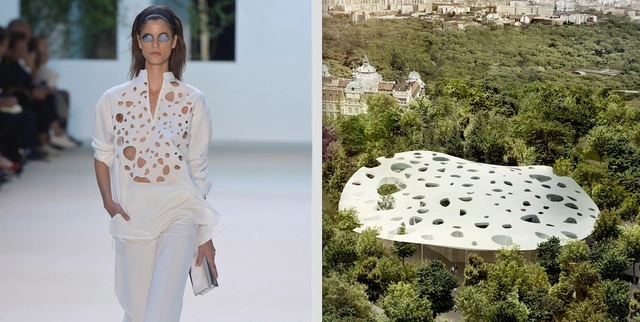
At this year’s Paris Fashion Week, Switzerland-based fashion house Akris showed its 2016 Spring/Summer Collection -- an assembly of garments based on the work of Japanesearchitect Sou Fujimoto.
Akris’ creative director, Albert Kriemler, was introduced to Fujimoto by photographer Iwan Baan while working on the Université Paris-Saclay. From a stance of admiration, Kriemler was thus influenced by Fujimoto’s work: "We share a vision to create an effortless relation between the body and the environment with utmost simplicity. Sou Fujimoto is an architect who understands that we have more senses than just the eye," said Kriemler.
Last week, the Chicago Architecture Biennial opened to over 31,000 visitors and much fanfare, and for good reason - it is the largest architecture event on the continent since the 1893 World's Columbian Exposition, featuring over one hundred exhibitors from over thirty countries. With a theme as ambiguous as "The State of the Art of Architecture," and with the hope of making the biennial, according to directors Joseph Grima and Sarah Herda, "a space for debate, dialog and the production of new ideas," the event was sure to generate equally wide-ranging opinions. Read on to find out what the critics had to say about the Biennial.
Created by the Union International des Architects (UIA)in 2005, World Architecture Day is celebrated on the first Monday of October with the aim of reminding the world about the collective responsibility of architects in designing our future cities and settlements.
This year, the UIA has selected “Architecture, Building, Climate” as the theme of the day, seeking to highlight the essential role that architecture, design and urbanism have in the reduction of greenhouse gas emissions. With international climate treaty negotiations set to happen later this year, the “UIA members, working bodies and partners will mobilize on 5 October to promote actions and solutions that apply the enormous power of architecture and urban design in coping with global climate change, one of the greatest challenges of our time.”
Through small actions architects can collectively make a big difference and create significant changes. To celebrate World Architecture Day, we have rounded up a selection of projects that have taken steps towards the challenge of protecting our environment.
Fogo is a small, rocky outcrop off the coast of Newfoundland, Canada, with a population of just over 2000 people. Its sub-arctic natural landscape of lakes, rivers and mountains is interspersed by eleven small settlements and has now become the scene for a collection of follies, studios and residences designed by Norwegian practice Saunders Architecture. Most recently, Fogo's rocky wilderness and contemporary architectural interest—reminiscent of the land around Todd Saunders' current home city of Bergen—has been captured in a one-hour documentary film directed by Marcia Connolly and Katherine Knight, entitled Strange & Familar: Architecture on Fogo Island.
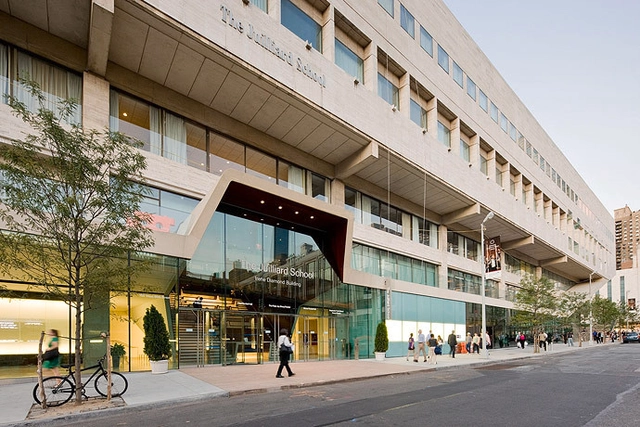
Once complete, the new school will offer a Master of Music degree from Juilliard in the areas of orchestral performance, chamber music performance, and collaborative piano; a pre-college program; an instrumental training program; adult education; and public performances and exhibits.
In designing and building multiple successful public buildings in central Africa and around the world, MASS Design Group has employed and guided thousands of local craftsmen, curating the building process to inspire dignity. Now, they wish to help the African people obtain the skills necessary to guide the process themselves. At the United Nations Solutions Summit this Sunday Christian Benimana, a program director for the non-profit design studio, will present plans for what they are calling the “Bauhaus of Africa”: three “African Design Centers” to be built over the next 10 years in strategic locations throughout the continent. The design centers will house an education program tasked with training a new generation of African architects - a workforce certain to be indispensable as Africa enters a period of unprecedented urban growth.
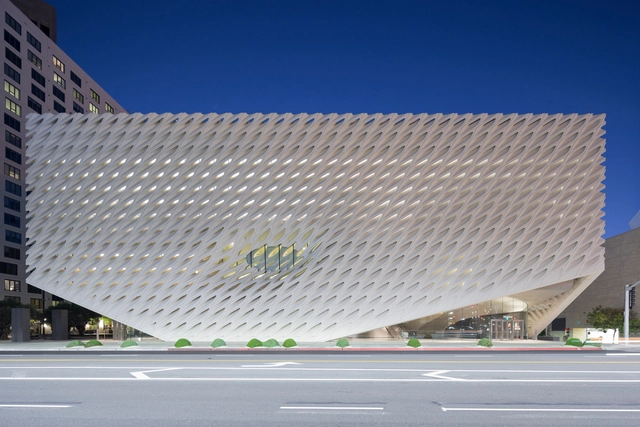
The Broad has officially opened its doors in downtown Los Angeles. Taking four years to complete, the highly anticipated, 120,000-square-foot building houses a prominent collection of postwar and international contemporary art owned by billionaire philanthropists Eli and Edythe Broad. During the press preview, VernissageTV caught up with the building's architect, Elizabeth Diller of Diller, Scofidio + Renfro, to gain a better understanding of The Broad's “veil over the vault" concept.
After teasing the general public by offering the press and 3,000 lucky local citizens with a preview day six months ago, the Broad Museum has finally opened its doors. Designed by Highline architects Diller, Scofidio + Renfro, the museum took four years and $140 million to build, adding its presence to LA’s architectural Broadway, Grand Avenue. With its visually striking facade given the tough task of responding to its enigmatic neighbor, Frank Gehry’s perennially polarizing Walt Disney Concert Hall, the building was sure to attract the attention of the critics, and they rose to the challenge in their droves. Read on to find out what five critics thought of the building dubbed “the veil over the vault.”
The Royal Institute of British Architects (RIBA) have revealed that Dame Zaha Hadid will receive the 2016 Royal Gold Medal — the first sole woman to be awarded the UK's highest honour for architects in her own right. Previous female winners (Sheila O’Donnell in 2015, Patty Hopkins in 1994, and Ray Eames in 1979) were each recognised alongside their husbands and practice partners.
Given in recognition of a lifetime’s work, the RIBA Royal Gold Medal is approved personally by Her Majesty The Queen and is awarded to those who have had a significant influence "either directly or indirectly on the advancement of architecture." Other notable Royal Gold Medallists include Frank Gehry (2000), Lord Norman Foster, Baron of Thames Bank (1983), Ludwig Mies van der Rohe (1959), Le Corbusier (1953), and Frank Lloyd Wright (1941). The medallists' names are engraved into the marble wall at the RIBA's headquarters in London.
Often, all that is needed for that big break in your career is getting experience at the right firm. But getting your foot in the door is daunting, especially if your ideal firm is one where thousands of other architects are applying constantly, regardless of whether a vacancy has been advertised. In this article originally posted on The Architect's Guide, Brandon Hubbard reaches out to some of the world's top architecture firms (Zaha Hadid Architects, Snøhetta, Perkins+Will, BDP and Callison) to find out how you can maximize your chances in the application process.
I recently reached out to several of the world’s top architecture firms and asked them a series of questions on what they look for in potential architecture job applicants.
After my discussions with these firms I discovered a common theme in how they acquire many new hires. As I covered in a previous article, Want a Great Architecture Job? Don't Send a Resume, many new employees are found through personal references and word of mouth. Developing these relationships within the architecture community is essential for a successful career.
The questions are structured to cover the various steps of the architecture job application process, from the first point of contact to the interview.
While the term “ecosystem services” may sound like a corporate antithesis to the course of natural order, it is actually an umbrella term for the ways in which the human experience is favorably altered and enhanced by the environment. Ecosystem services are therefore an important factor in creating cities which provide the maximum benefit to their residents with the minimal harm to their environment.
Aiming to find out how city planning can affect the provision of these ecosystem services, a new study published in Frontiers in Ecology and Environment by researchers at the University of Exeter's Environment and Sustainability Institute and Hokkaido University's Division of Environmental Resources evaluates the repercussions of rapid and fragmented urbanization and the possible detriment to ecosystem services and human well-being. In particular, the study is concerned with approaches to land-use and the outcomes they yield on the environment. Studied are two opposing tactics: a “land-sharing,” sprawl model (think Atlanta or Houston), or “land-sparing,” tight-knit urbanism (think New York or Tokyo).
Prehype, a venture development firm, has released its latest in a series of podcasts by partner Henrik Werdelin, featuring Danish architect Bjarke Ingels. Having worked with Prehype on investments into tech development, Bjarke Ingels discusses his experiences and perspectives on the industry, drawing parallels between entrepreneurship, tech development and architecture.
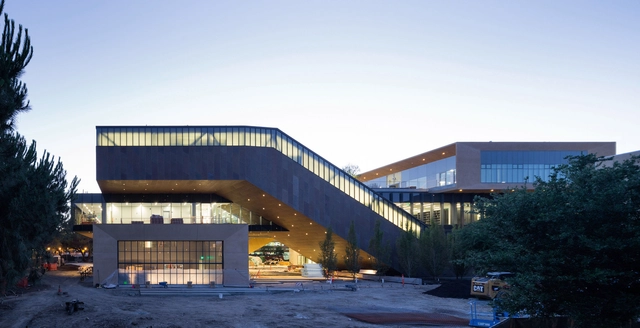
Diller Scofidio + Renfro (DS+R) has shared initial photos by Iwan Baan of their new McMurty Building for Art & Art History at Stanford University, which will be officially unveiled to the public on October 6. The 100,000 square foot building will open for the 2015 fall semester, and allow students studying art history and students practicing fine arts to work together under the same roof for the first time at Stanford. See and read more about the soon-to-be opened project after the break.



.jpg?1445874627&format=webp&width=640&height=580)


.jpg?1445874627)

_Dean_Kaufman.jpg?1461883250&format=webp&width=640&height=580)

_Dean_Kaufman.jpg?1461883165&format=webp&width=230&height=230&crop=true)
_Dean_Kaufman.jpg?1461883233&format=webp&width=230&height=230&crop=true)
_Dean_Kaufman.jpg?1461883182&format=webp&width=230&height=230&crop=true)
_Dean_Kaufman.jpg?1461883250)