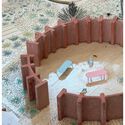
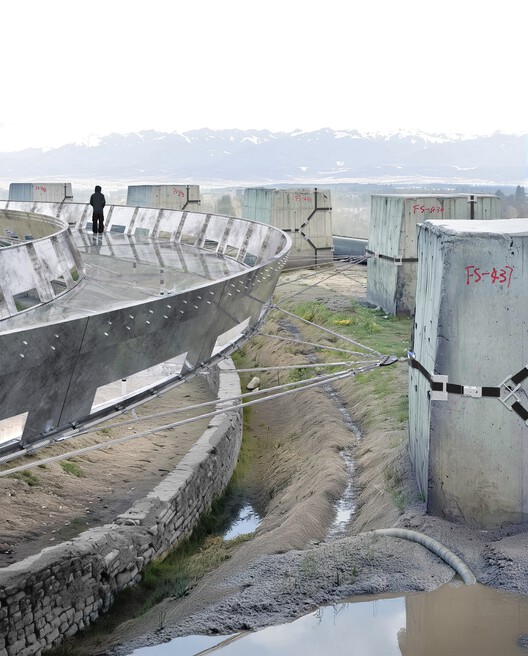
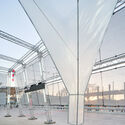
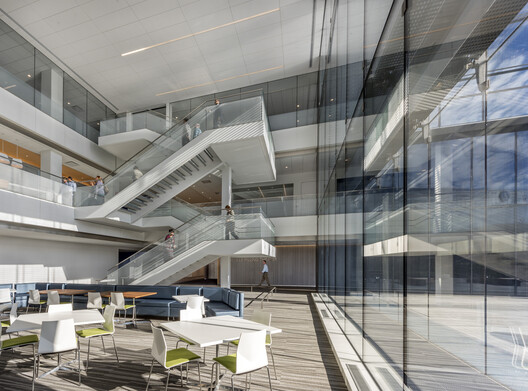
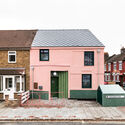
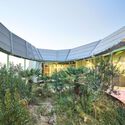
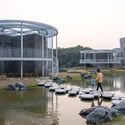
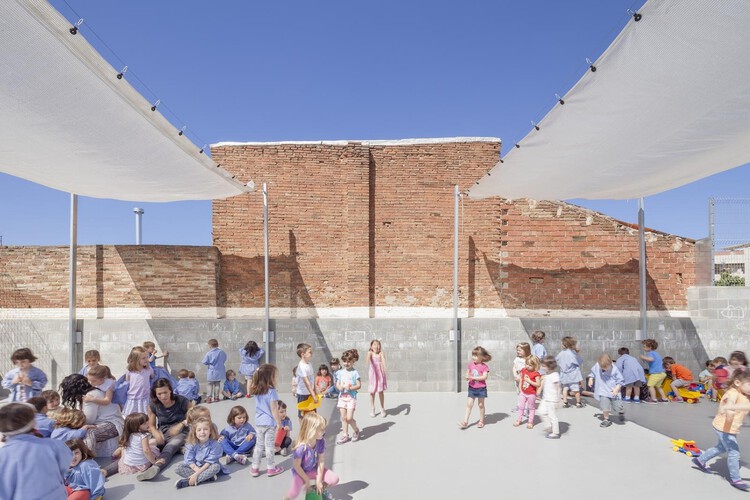
Sylphy by Boss Design x Okamura. Image Courtesy of Boss Design
For all the spatial experimentation of the contemporary workplace, one condition has remained largely unchanged: people are still sitting. Studies suggest that office workers spend up to 89% of their working day seated—close to 36 hours a week—despite decades of ergonomic awareness. As workplaces become more flexible, social, and design-led, this contradiction becomes harder to ignore.
The office is no longer organized around a single mode of operation, nor by a fixed spatial logic. Work has become multifunctional, shifting between collaboration and concentration, collective exchange and individual focus. In response, architecture and interior design are moving away from uniform, repetitive layouts towards environments that reflect the variability of human behavior.
Daryan Knoblauch's work sits at the intersection of architecture and live cultural production, with a focus on how space is made legible through tension and atmosphere. Rather than treating temporary work as a lesser category of architecture, Knoblauch approaches installations, stages, and event architectures as full disciplinary problems—where enclosure, stability, light, and movement must be resolved with the same seriousness as any building, often under tighter constraints and faster timelines.
Across projects, a consistent thread is the productive tension between high-modern precision and an intentionally raw clarity of assembly. Membranes and lightweight systems are not deployed as surface effects, but as structural and spatial instruments—tuned to wind, load, and occupation, and calibrated to produce a sublimity that is felt as much as it is seen. Here, ephemerality is not simply a duration, but a design condition: temporality makes forces—weather, wear, performance—more visible, and demands an ethic of making that is both exacting and adaptable.
Scientifically, glass is defined as an amorphous solid, meaning its atoms are not arranged in a regular crystalline structure. This is why the material is often described as a "liquid frozen in time." This structural configuration explains one of its most distinctive qualities: transparency. Without a crystalline lattice capable of scattering light, radiation passes through the material with relatively little interference. Although it often appears delicate, this same structure also allows glass to achieve significant mechanical performance. With industrial processes such as tempering, lamination, and specialized coatings, the material can reach high levels of strength, safety, and environmental performance.
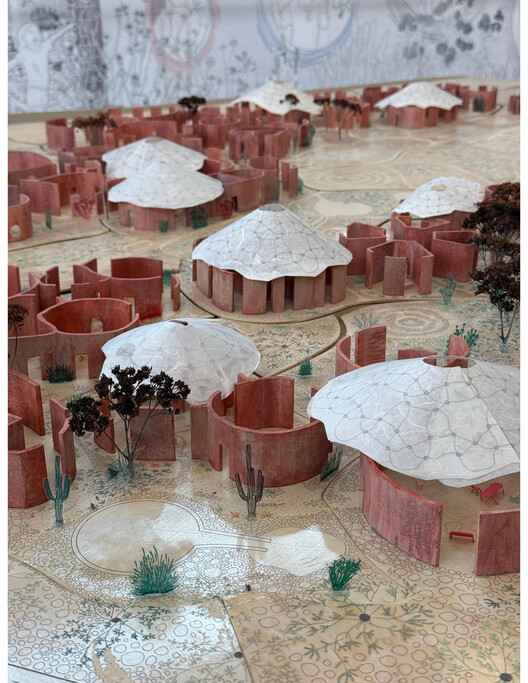
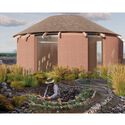
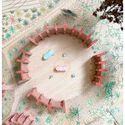
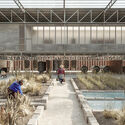
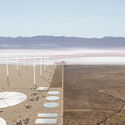
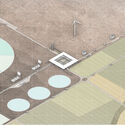
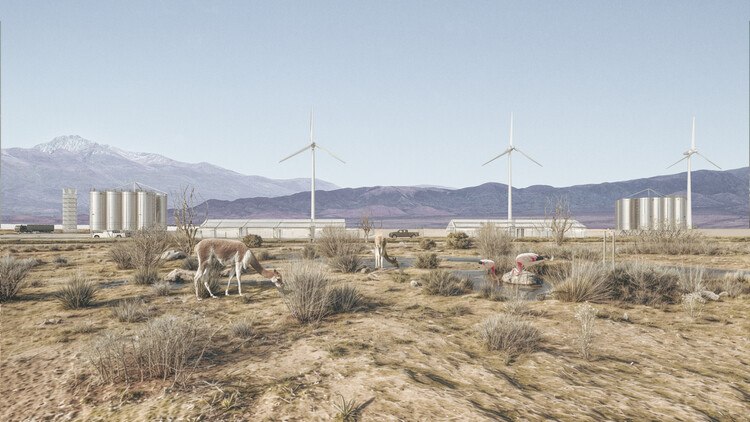
Remediation areas. Image Courtesy of Ezequiel Lopez, Maria Victoria Echegaray, and Agustina Durandez
When people think of Argentina, they often picture landmarks like the Obelisk of Buenos Aires. Yet the country spans over 2,780,400 km², making it one of the largest in South America and home to a wide range of landscapes and realities that frequently go unnoticed. In fact, the province of Jujuy in northern Argentina lies within the Lithium Triangle: a high-altitude region shared with Bolivia and Chile that contains roughly 54% of the world's lithium reserves. Within this territory sits the Olaroz Salt Flat, a site where today two competing dynamics converge: the expansion of industrial lithium extraction and the preservation of ancestral culture and lands inhabited by Kolla and Atacama communities, creating a clash of high-capacity industrial extraction and traditional, low-impact agrarian practices.
In light of this problem, one of the winning teams of the ArchDaily Student Project Awards, made up of Ezequiel Lopez, Maria Victoria Echegaray, and Agustina Durandez, decided to look into the issue. This was done as part of their thesis project for the Bachelor's in Architecture program at the National University of Córdoba. Their work stems from an interest in engaging with territories that remain peripheral to architectural discourse, using the thesis as an opportunity for sustained, in-depth research. This allowed them to formulate informed design responses grounded in both territorial and socio-economic realities. Rejecting the binary between extraction and preservation, the project approaches the territory as a system where both can coexist through spatial and technical mediation.
There is an ancestral gesture in shaping earth. Long before architecture was established as a discipline, clay was already being molded by hand and transformed by fire, turning raw matter into domestic utensils and cultural objects. Within the history of this craft, ceramic factories mark the transition from manual knowledge to serial production, expanding its scale without entirely severing its material origins. Scattered across different territories, these structures record the relationship between technique, landscape, and time. Over the decades, however, many of them lost their original function, replaced by more technological processes or absorbed by the urban development around them, entering an intermediate state between permanence and obsolescence.
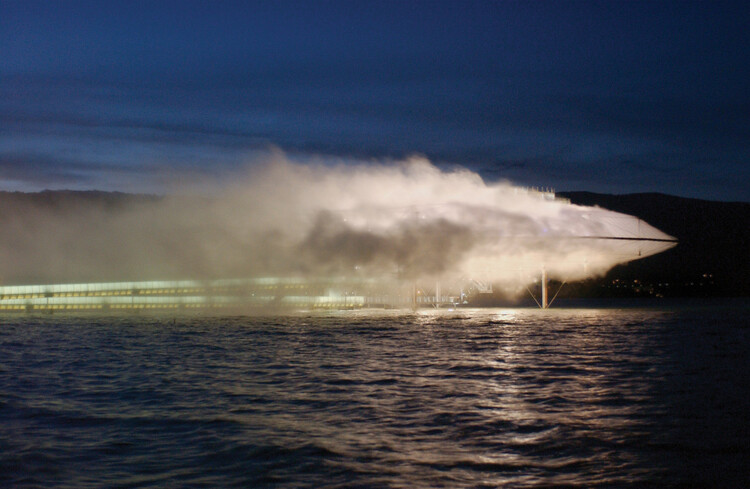
In Six Memos for the Next Millennium, Italo Calvino explores lightness from a literary perspective and argues, "Opposed to lightness is weight. Removing weight produces lightness; it is a value, not a defect." Drawing on Greek mythology, he reflects on one of Perseus's feats after severing the head of the terrible Gorgon Medusa without being turned to stone. Assisted by the gods Hades, Hermes, and Athena, Perseus flies with his winged sandals and uses a bronze shield as a mirror to reflect her image. Relying, like many architects, on what is lightest—the wind and the clouds—he also fixes his gaze on what is revealed through indirect vision: an image reflected in a mirror.
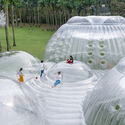
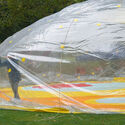
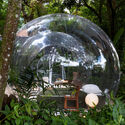
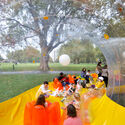
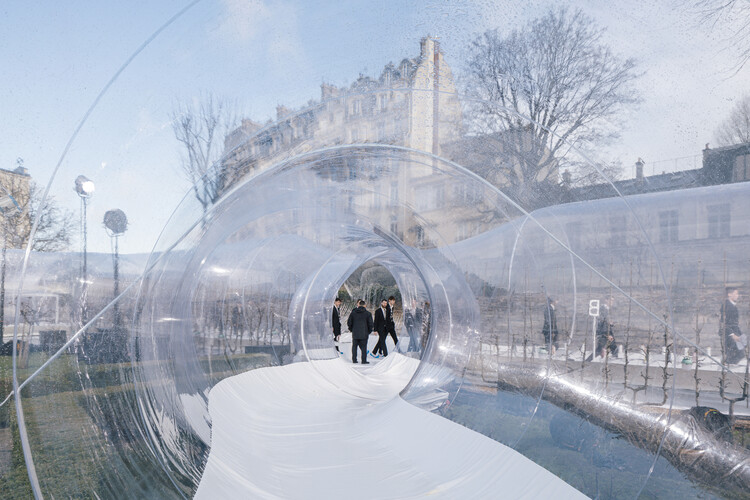
Historically, transparency has been naturalized as an inherent condition of modern architecture. With the shift from the heavy load-bearing wall to the lightweight glass envelope, glass was introduced into the discipline, blurring the boundaries between interior and exterior spaces. In connection with inflatable architecture, transparency is linked to lightness and impermanence, leaving temporary traces on the landscapes it inhabits. By using textiles or plastics as main materials and air as a structural system, the search for lightness in the built environment now recognizes more than a single atmosphere of application.
Blur Building, Lake Neuchatel, Yverdon-les-Bains, Switzerland, 2002. Image Courtesy of Diller Scofidio + Renfro
Architecture is traditionally chronicled through the persistence of the solid. We define the discipline by the weight of the lintel, the mass of the pier, and the resistance of the wall. Even when lightness is invoked, it is usually understood as a subtractive act, the thinning of a section or the precarious reduction of a load. Yet there is a parallel history, less visible and harder to isolate, in which the primary material of construction is not what occupies space, but what moves through it.
To treat air as a medium is to move past the binary of the envelope. The boundary between the interior and the world ceases to be a line of absolute separation and becomes, instead, a site of filtration and pressure. We begin to see the building as a thermal valve, a series of gradients where moisture, velocity, and heat are not merely background "conditions" to be mitigated by mechanical systems, but are the very substances being shaped.
Design teams are not short on tools; they're short on continuity. Project data remains fragmented across files, and decisions often lose context as work moves from planning to design to construction. As a result, teams spend valuable time reconnecting information instead of advancing projects.
This points to the need for workflows that preserve design intent and carry knowledge forward across each stage of the process. Within this framework, the idea of "design and make intelligence" can be understood as a shift toward continuity, where data, decisions, and lessons from planning, design, construction, and operations remain embedded in the project rather than stopping at handover. In this context, AI and automation operate with greater relevance, building on accumulated information instead of isolated inputs.
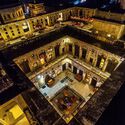
The courtyard is often remembered as a figure from the past, an inward-looking space of nostalgia, culture, and domestic ritual. But this framing misses its primary role. Before it was symbolic, the courtyard was operational. It organized air, moderated light, and absorbed heat. It did not decorate architecture; it made it habitable. In contemporary housing, these functions are normally delegated to mechanical systems, applied after form is fixed. In courtyard houses, they are resolved spatially, before a wall is even built.
What appears as a recurring typology across regions is, in fact, a set of highly specific responses to climate. The courtyard in Egypt does not behave like the courtyard in Morocco, nor like the courtyard in India. Each is calibrated to a different environmental problem, using the same spatial device. To read them as a single type is to flatten their intelligence. To compare them is to understand how climate can be embedded directly into form.
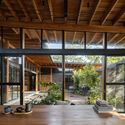
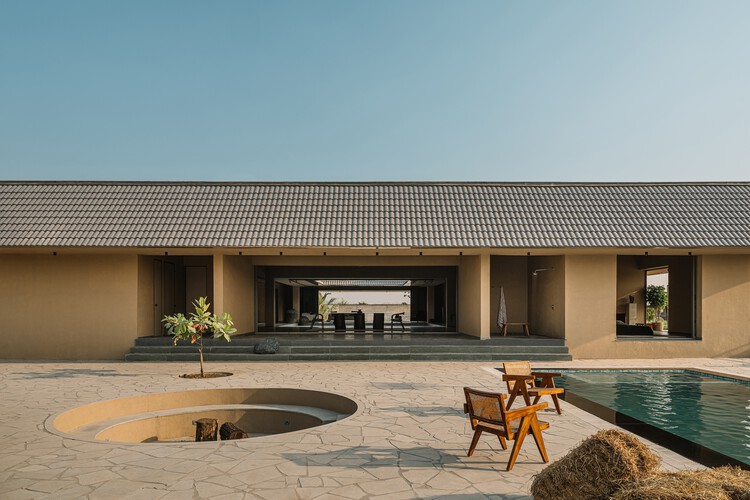
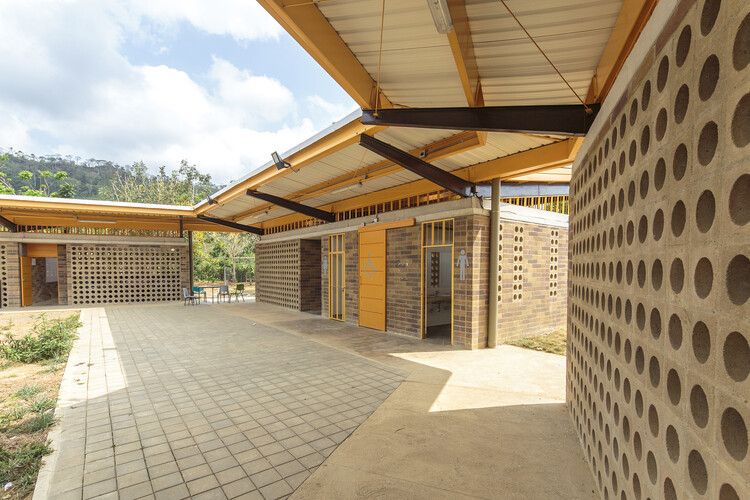
Architecture is often understood as a matter of enclosure. Walls define space, separating interior from exterior and establishing clear limits. Yet across many projects in Latin America, this distinction becomes less precise. Rather than operating as closed objects, buildings often remain open, allowing air, light, and movement to pass through them.
This condition is tied to more than form. Across the region, architecture has long responded to climates marked by heat, humidity, strong solar exposure, and seasonal rainfall, as well as to building cultures shaped by adaptation, collective labor, and direct engagement with the environment. In these contexts, fully sealed interiors are not always the most effective response. Space is often organized through shade, ventilation, and intermediate zones that regulate rather than isolate.
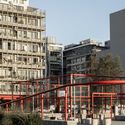
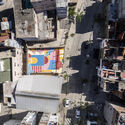
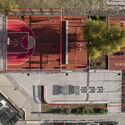
Architecture is often evaluated through what gets built. But in many cases, what matters happens after: how spaces are used, adapted, and made part of everyday life. For Región Austral, winner of ArchDaily's 2025 Next Practices Awards, this is where design really begins. Working across many contexts, the practice approaches public space not as a single object, but as something that needs to be activated, negotiated, and sustained over time. Their projects focus less on defining form and more on creating the conditions for use, with design serving as the starting point.
This approach can be seen across different contexts, from the Olympic Neighborhood Square to the Playón de Chacarita network. While each project responds to a specific situation, both explore how public space can support collective life in areas marked by fragmentation and inequality. Instead of following a predefined approach, the work adapts to different urban conditions, using participation and incremental strategies to shape how spaces function over time.
In 1962, the architect Buckminster Fuller envisioned a floating city that would free humanity from its dependence on the Earth. The speculative project consisted of enormous geodesic spheres that would naturally levitate in air warmed by the sun and be anchored to mountaintops. Designed to house thousands of people, Fuller’s Cloud Nine aimed to ease land ownership pressures, address housing shortages, and contribute to environmental preservation.
More than half a century later, we remain far from realizing Fuller’s vision. Creating a truly floating structure on the Earth’s surface is still, for now, an unattainable ideal. While supports continue to be necessary, we manipulate their position, intensity, and number, developing structural “acrobatics” to at least approach the idea of overcoming gravity — a desire that has long fascinated humanity.
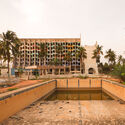
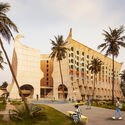
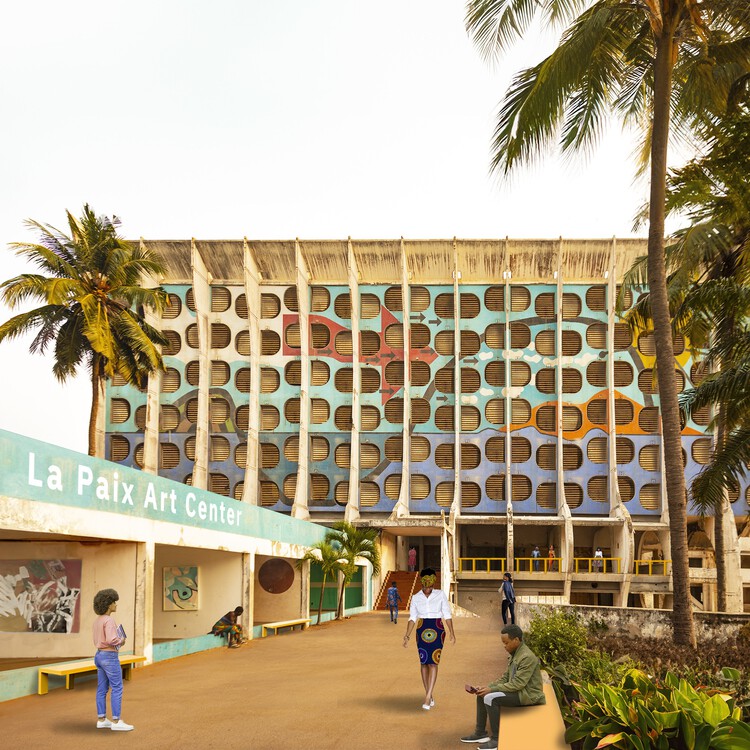
In late 2024, an event was held in the grounds of the recently refurbished colonial-era Palais de Lomé in the capital of Togo. Students from the architecture university of Lomé were attending the first Lomé Architecture Encounters (RAL #1), curated by the transdisciplinary Studio NEiDA, and which involved lectures, film screenings, workshops, and building visits. A parallel exhibition displayed the country's most significant architecture through history. The purpose of the event was to explore the architectural heritage of Togo, and it would be the start of a journey that crosses borders, asking questions about the conservation of modern heritage. Unlike colonial buildings like the Palais de Lomé itself, which are more appreciated and readily restored, neglected modern buildings like the Hôtel de la Paix require creative, bottom-up approaches to return them to their former vitality.
Loud noises, the continuous hum of equipment, abrupt changes in light, or intense reflections often go unnoticed. For neurodivergent individuals, these stimuli can provoke significant discomfort or even intense physical and cognitive reactions. The term "neurodivergent" refers to people whose neurological functioning differs from what is considered typical, encompassing conditions such as autism, ADHD, and dyslexia, as their brain processes information differently, particularly in relation to sensory input, attention and emotional regulation.
Yet light is not only visual, it is neurological. How it enters a space, moves across surfaces, and changes over time can profoundly affect cognitive comfort. Extreme contrasts, glare, direct beam penetration, and rapid variations in brightness require constant adjustment from the visual systems and, for individuals with greater sensory sensitivity, this effort can translate into fatigue, distraction, or discomfort.
Architecture begins as an encounter with gravity. It is the ancient act of placing weight upon the earth, of persuading matter to stand, hold, and shelter. Within this fundamental condition of heaviness, however, lies a quieter possibility: density itself can generate a sense of lightness—a perceptual condition in which the body, fully convinced of matter's weight, begins to experience space as suspension.
Much of contemporary architecture has pursued lightness through reduction: thinner structures, smoother surfaces, increasingly seamless transitions between interior and exterior. Here, lightness is equated with disappearance, as if gravity could be overcome by withdrawing material presence. Yet there exists another register in which lightness is not the result of absence, but of intensification. It emerges when material presence becomes so precise, so fully asserted, that it begins to alter perception itself—when mass remains heavy, but no longer behaves as simply inert.
Barcelona House - Strom Architects - Sliding - Helena Lee Photography
Throughout much of history, weight has been closely associated with the very idea of architecture. Vitruvius, whose notion of firmitas linked construction to stability and permanence, understood solidity as one of its fundamental qualities, and building largely meant resisting the effects of time, gravity, and natural forces. In Greek and Roman architecture, monumentality depended on the available construction systems and materials, such as stone and solid masonry, whose expression was defined by mass, thickness, and structural repetition. Columns, walls, and podiums, beyond supporting buildings, asserted their presence in the territory, communicating order, durability, and power. Architecture met the ground with weight.
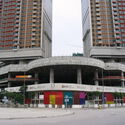
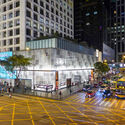
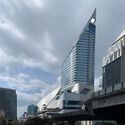
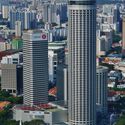
If elevated networks reveal a city that increasingly walks above the street, the podium–tower is the typology that often makes that condition feel inevitable. Across Southeast Asia, podium–tower projects have become one of the dominant languages of metropolitan growth: a system that concentrates housing, jobs, retail, and transit connections into highly legible and managed parcels. From an urban planning perspective, the model can be remarkably effective—absorbing congestion, formalizing circulation, and delivering density quickly. Yet as it spreads, the typology also raises a quieter question: what does it optimize for, and what does it erode—especially at the level of the street, where urban life is meant to be negotiated rather than curated?
At its simplest, the podium–tower is a hybrid structure consisting of a high-coverage, low-rise podium supporting one or more slender vertical towers. The podium typically carries the logistical and commercial weight of the development—retail, parking, loading, drop-offs, back-of-house services, and often amenity decks—while the tower stacks private programs above, whether residential, office, hotel, or mixed use. The promise is twofold: maximize urban density while maintaining a "human-scaled" street wall, and separate the messy logistics of city life from the quieter domain of living and work.
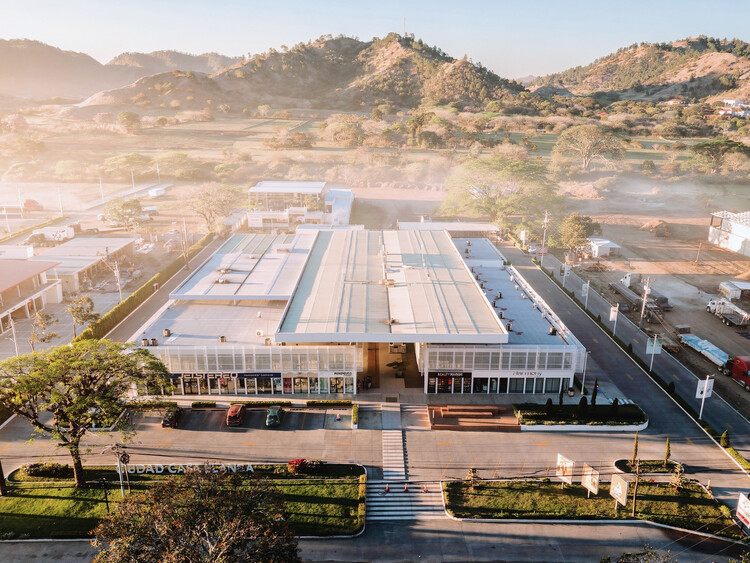
Honduras is the second-largest country in Central America, both in territory and population. Today, its urban fabric remains heavily influenced by modernist principles from the 1970s that prioritised high-speed arterial corridors and automobile-dependent "point-to-point" mobility. In addition, the country faced many challenges regarding public safety during the 2010s, which contributed to creating an urban space characterised by blind facades, high perimeter walls, and gated enclosures designed to isolate the interior from the public realm.
We had the opportunity to talk to Alejandra Ferrera, a Honduran architect raised in Danlí, a city in eastern Honduras. With over 15 years of practice across Brazil, the Netherlands, and Australia, she argues that while the security-driven design was a functional necessity of its time, it has resulted in a fragmented urban experience where the street serves only as a transit void rather than a place for social encounter. She suggests that even though this isolation was a justified safety measure, it created detachment between the inhabitants and the city. She also argues that overall, the public safety situation contributed to the creation of a wounded national identity that often looks outward for quality, dismissing the potential of its own context.
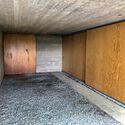
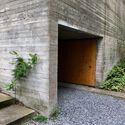
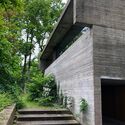
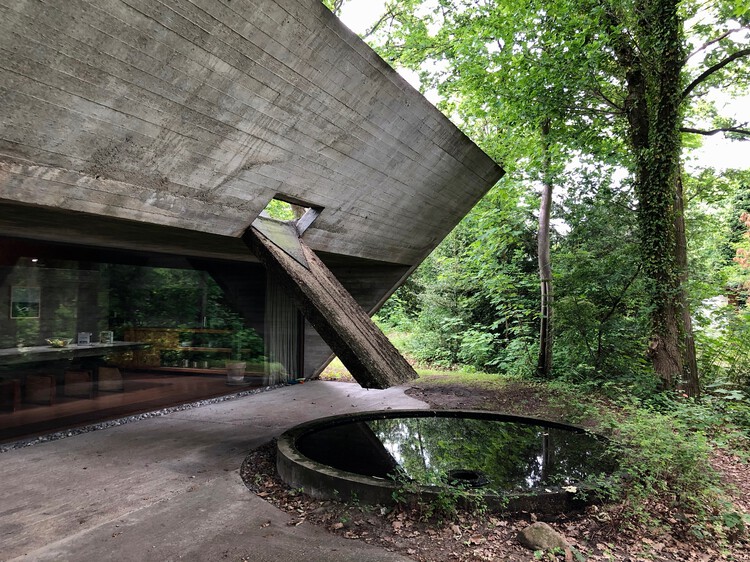
Architectural history often advances through iconic gestures or technological breakthroughs, yet some works remain influential precisely because they resist spectacle. Built between 1972 and 1974 in Sint-Martens-Latem, Belgium, the Van Wassenhove Residence stands as one of those quiet but decisive projects. Conceived as a single, continuous concrete volume set within a wooded landscape, the house challenges conventional ideas of domestic comfort, privacy, and spatial hierarchy. Its presence is direct and uncompromising, yet it avoids monumentality, positioning itself instead as a lived structure shaped by everyday rituals and long-term inhabitation.
The house was designed by Juliaan Lampens, a figure who operated largely outside the dominant architectural narratives of his time. Working mostly in Flanders and often on private commissions, Lampens developed a body of work centered on radical spatial reduction, material honesty, and an almost ethical approach to construction. The Van Wassenhove Residence is frequently described as his most complete work, not because it introduces new ideas, but because it consolidates many of the principles that run consistently through his career.
Using massive s plates, often several centimeters thick and weighing tons, Richard Serra's sculptures convey an almost improbable sense of lightness. This effect does not result from a reduction of mass, but from how that mass is organized: large curved surfaces tilt, narrow passages compress the body, and seemingly unstable elements create a constant sense of imbalance. Serra transforms weight into a dynamic spatial experience.
In architecture, lightness has occupied a central role at least since the modern period. While earlier traditions, such as Greek and Roman architecture, were closely associated with stability, and large churches with monumentality, the twentieth century introduced a decisive shift in how matter is handled, particularly through the separation of structure and enclosure.
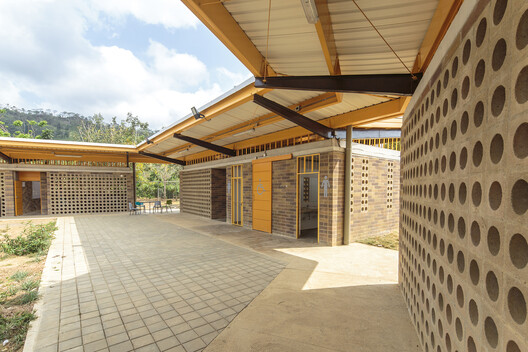
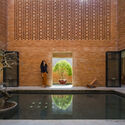
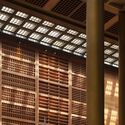
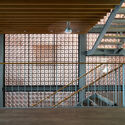
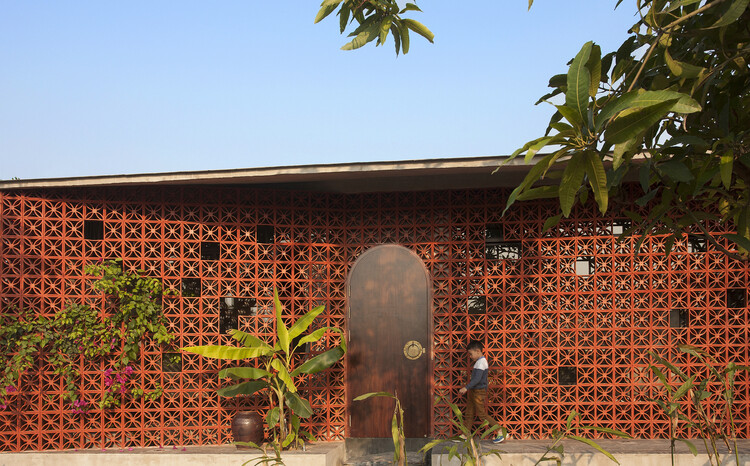
A perforated screen is often treated as an afterthought, something applied to soften light, to decorate a façade, or to add texture where a wall might otherwise feel flat. It is photographed as a surface, drawn as a pattern, and discussed as a craft. But in many buildings across the Indian subcontinent and the Islamic world, the screen was never an addition. It was the wall itself. Remove it, and the building does not simply change in appearance; it loses its ability to regulate heat, move air, and mediate between inside and outside.
This misreading reveals more about contemporary habits than about the screen itself. Architectural thinking has long separated structure from envelope, performance from expression. Within that framework, elements like the jaali or mashrabiya are easy to categorize as ornamental, visually rich but technically secondary. Yet these screens were conceived as integrated systems, where geometry, material, and climate operate together. Their intelligence lies in what they do.
European City Context. Image Courtesy of ReGreeneration
The ReGreeneration project, a Horizon Europe project led by Inetum and supported by C40 Cities, ARUP, Placemaking Europe, and several others, operates as an active collaboration with local governments, private companies, academia, and civil society organizations at the intersection of urban regeneration, green public spaces, and neighborhood-scale design. Its premise addresses how European cities are built and maintained and how they experience a changing climate, arguing that cities must fundamentally change to remain livable under accelerating climate pressures.