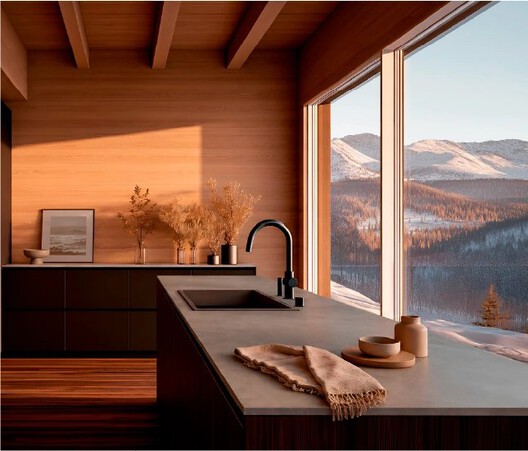
The contemporary kitchen is no longer just a space for food preparation; it has become one of the most dynamic areas of the home. Design decisions can redefine both spatial configurations and the arrangement of individual elements as kitchens become integrated with social areas, incorporate new technologies, and adapt to changing domestic habits. In this way, balancing functionality, comfort, durability, and aesthetics is closely tied to the selection of finishing materials. From countertop surfaces to cabinet opening systems, each design choice contributes to creating kitchen environments that accommodate different activities and ways of living.
More than just a horizontal work surface, the kitchen countertop brings together the human scale, the demands of everyday use, and the technical possibilities of different materials. Its height, depth, thickness, and finish shape the experience of those using the space, while its integration with sinks, appliances, and storage systems directly influences the organization of domestic tasks. At the same time, its aesthetic qualities can define a kitchen's character, establish visual continuity with adjacent spaces, or introduce contrasts through textures, colors, and geometries. In this context, how can the design of a work surface transform the functionality, aesthetics, and spatial experience of a contemporary kitchen?
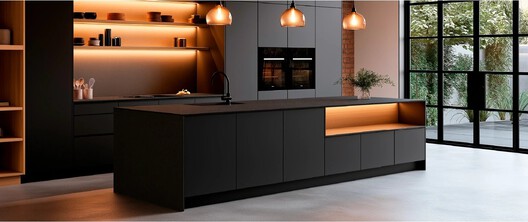
In response to these demands, the development of new materials and technical surfaces is expanding the range of options available to architects and designers. Masisa Countertops, for example, combine a melamine finish with a reinforced Overlay layer over an MDP RH substrate, aiming to meet the demands of everyday use. Their properties include surface resistance to high temperatures—up to 185°C under the EN 438-2 dry heat test conditions—abrasion resistance exceeding 20,000 cycles, moisture resistance, and ease of cleaning. These characteristics address one of the key considerations in kitchen design: how to select surfaces that maintain their performance and visual qualities over time, even with frequent use, while also offering opportunities for architectural integration.
Designing Around the Human Body: Ergonomics and Everyday Experience
The design of a countertop begins with understanding the relationship between the human body and the activities performed in the kitchen. Food preparation, cooking, washing dishes, and using small appliances all involve movements, postures, and circulation patterns that should be considered from the earliest stages of a project. Work surface height, available depth, and the distances between different functional zones can help reduce unnecessary physical strain and improve comfort. Ergonomics is not a secondary consideration but rather a fundamental principle guiding the dimensions and arrangement of kitchen elements.
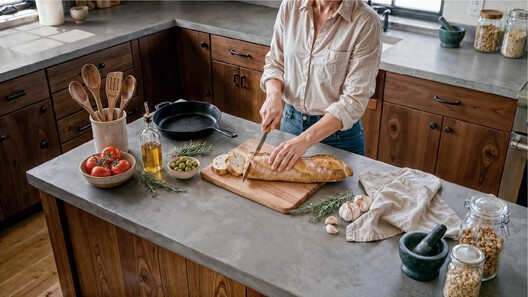
However, a countertop's functionality depends on more than its dimensions and proportions. It is also shaped by how materials perform under everyday conditions. Exposure to heat, contact with liquids, impacts, and constant friction require surfaces that combine durability with ease of maintenance. Selecting materials with specific technical properties makes it possible to anticipate these demands and extend their service life, particularly in spaces where surfaces are subject to intensive use.
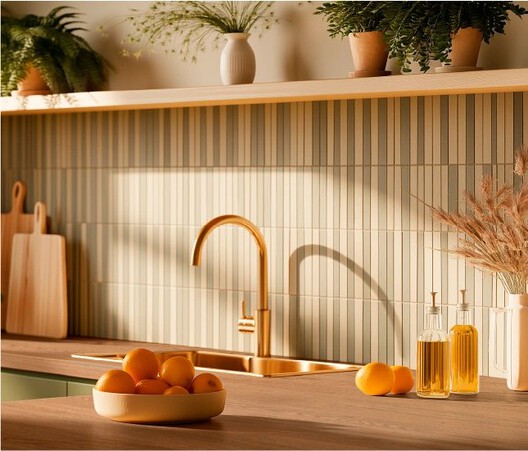
Masisa Countertops range in thickness from 0.94" to 1 3/5" and are available in two sizes: 26" × 9 feet and 26" × 7.3 feet. These dimensions make them suitable not only for kitchen countertops but also for worktables and desks. Their sealed finish does not require additional varnishes or sealants once the surface is complete, and their durability can be further enhanced through proper installation. Cut edges, joints, and exposed sides must be adequately protected against moisture penetration, particularly around sinks and where two panels meet.
At the same time, the evolution of domestic spaces introduces new demands for flexibility. In homes where the kitchen is integrated with the dining or living areas, work surfaces can take on additional functions, becoming gathering places, supporting everyday activities, or extending existing furniture arrangements. This calls for considering the countertop not as an isolated element but as part of a broader spatial system, in which ergonomic and functional decisions also help shape the relationships between inhabitants and their surroundings.
Kitchen Countertops as Architectural Elements
Beyond their functional performance, kitchen countertops offer opportunities to explore the expressive potential of materials. Their surface, thickness, texture, and color contribute to the overall composition of the kitchen and influence the perception of its dimensions. Light-colored finishes can help create a greater sense of spaciousness and brightness, while darker tones or textures inspired by natural materials introduce depth, contrast, and visual continuity with other interior elements. In open-plan kitchens, for example, countertops can become a visual link between the kitchen and adjacent social spaces, reinforcing a sense of integration between them.
The range of available finishes makes it possible to establish different relationships between horizontal surfaces, wall coverings, and furniture. In the case of Masisa Countertops, the selection of smooth matte finishes in colors such as Magma, Golden Cypress, White Sand, Sierra Stone, and Light Stone offers opportunities to develop a variety of interior design languages. The choice can favor cohesive compositions, in which the countertop blends visually with the cabinetry, or contrasting combinations that emphasize its presence as a design element. In this way, materiality becomes a tool for architectural expression, allowing countertops to be combined with melamine-faced panels for furniture within the same space.
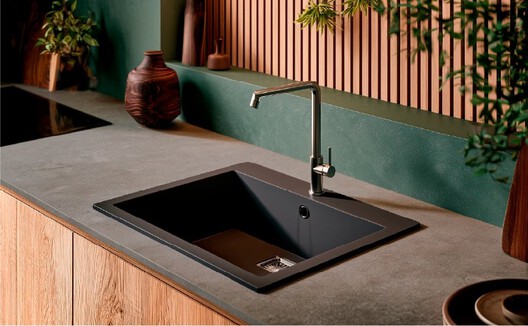
The junctions between individual pieces, connections to walls, edge treatments, and integration of appliances all require coordinated planning that brings design intentions into alignment with the technical properties of the materials. In Masisa Countertops, 1.5 mm PVC edge banding bonded with PUR technology, along with coordinated finishing options, helps achieve visual continuity along exposed edges. Installation guidelines also address mechanical joints, fastening to cabinet structures, and sealing methods designed to prevent water infiltration.
The use of industrially finished surfaces also introduces new relationships between design, manufacturing, and construction. Ease of cutting and the availability of standardized dimensions make it possible to plan individual components and their connections from the earliest stages of a project. However, maintenance recommendations must also be considered to ensure long-term performance. Material innovation must go hand in hand with precision in construction detailing, which remains an essential part of the design process.

Designing a kitchen countertop involves more than selecting a durable surface or an appealing finish. It requires understanding how material properties, human dimensions, construction processes, and the evolving patterns of domestic life can come together in a single element. As kitchens continue to expand their functions and strengthen their connections with social spaces, countertops are taking on an increasingly significant role in shaping interior environments. Their design demonstrates how architectural decisions made at the scale of detail can influence both everyday activities and the spatial identity of a home.


