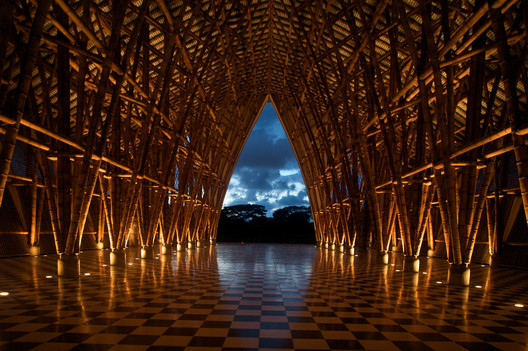
Bamboo construction—locally known as guadua—is, without a doubt, one of the regional techniques that defines contemporary Colombian architecture. As an environmentally friendly resource, it serves as a highly functional and practical building material, easily sourced in Colombia due to its rapid growth.
Farmers, architects, and builders have adopted this "vegetable steel" in many of their projects, which blend seamlessly into the landscape. With proper treatment, it performs exceptionally well across the South American country's diverse altitudinal zones. In addition, it offers varying textures and color tones, bringing a brilliant yet subtle aesthetic to these buildings.

Over the last 35 years, bamboo processing techniques have been refined, allowing its use in structural systems, enclosures, furniture, and even linens. This has piqued the interest of many guadueros both locally and globally. "It is not a material for the rich or the poor, it is for human beings," said Simón Vélez, one of the pioneer architects of guadua construction in Colombia, highlighting why we must leverage this renewable, strong, durable, and sustainable material.

Handling Techniques

China, India, and Colombia are the leading countries in developing bamboo construction techniques. The first two have experimented with its use in structural projects such as suspension bridges and domes, while Colombia has excelled in residential construction and in using the material to lighten concrete slabs in large buildings.
Two species are found in Colombia: guadua angustifolia and guadua latifolia. Within guadua angustifolia (recognized as one of the most widely used), varieties include guadua cebolla, guadua rayada, and guadua macana—the latter being the most commonly used in construction due to its thicker walls.

Guadua is typically available on the market as treated round poles or beams ranging from 1 to 10 meters in length, with diameters usually varying between 4 and 13 centimeters. Before harvesting, the stalks can exceed 5 meters in height, depending on cultivation techniques and the care they receive.
Its connections rely on ties, lashings, and interlocking joints to build structural systems. Additionally, the use of bamboo mats or strips is common for enclosures and roofing, which are made by splitting the poles using various methods.

Various treatments are applied to preserve and color the material, with immersion and heat-curing being the most common methods to prevent insect and fungal attacks. Other countries have studied bamboo coloration to achieve darker tones, playing with the aesthetics of the buildings and exploring other material properties, as is the case with black bamboo.

Applications

Bamboo is currently one of the most practical materials used in modular, lightweight, and adaptable architecture. This has led to construction methods suitable for emergency housing in regions of the country with limited access to building materials. It also facilitates the participation of local communities in the building process. The material's practical nature makes it an extension of the landscape, as the construction systems possible with guadua often mimic the forms of nature.
For those interested in learning more about using guadua as a building material, we recommend two comprehensive manuals detailing its use in Colombia: the Bamboo Construction Manual [PDF] produced by the National University of Colombia, and the Guadua Manual [PDF] developed by the National Training Service (SENA).
Guadua Projects
For reference projects featuring guadua construction, we highlight three works located in different regions of Colombia:
El Guadual Children's Development Center / Daniel Joseph Feldman Mowerman + Iván Darío Quiñones Sánchez

Colorín Colorado: Rural Facilities as Spaces of Reclamation Amid the Colombian Conflict

Chacarrá Assembly House / Ruta 4 taller de arquitectura
This article was written by Yamid Rivera. The translation is powered by AI.


