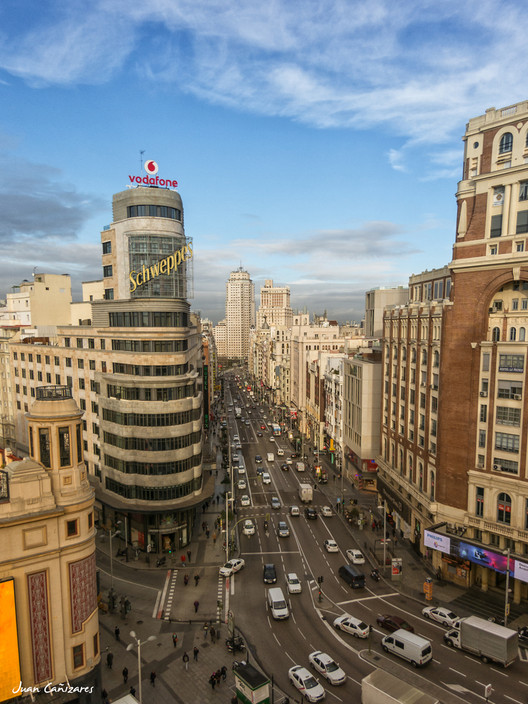
Following last year's designation of the Gimnasio Maravillas, designed by Alejandro de la Sota, the Community of Madrid has declared the Capitol Building an Asset of Cultural Interest (BIC) under the Monument category. This designation continues the region's initiative to protect and promote 20th-century Spanish modern architecture.
Also known as the Carrión Building, the Capitol Building was designed by architects Vicente Eced and Luis Martínez Feduchi. Construction began on April 21, 1931, and the building officially opened on October 15, 1933.
._1-1935__n.º_1_(2).jpg?1523174035 "via Arquitectura (Madrid. 1918). 1-1935, No. 1")
._1-1935__n.º_1_(3).jpg?1523174046 "via Arquitectura (Madrid. 1918). 1-1935, No. 1")
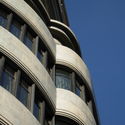
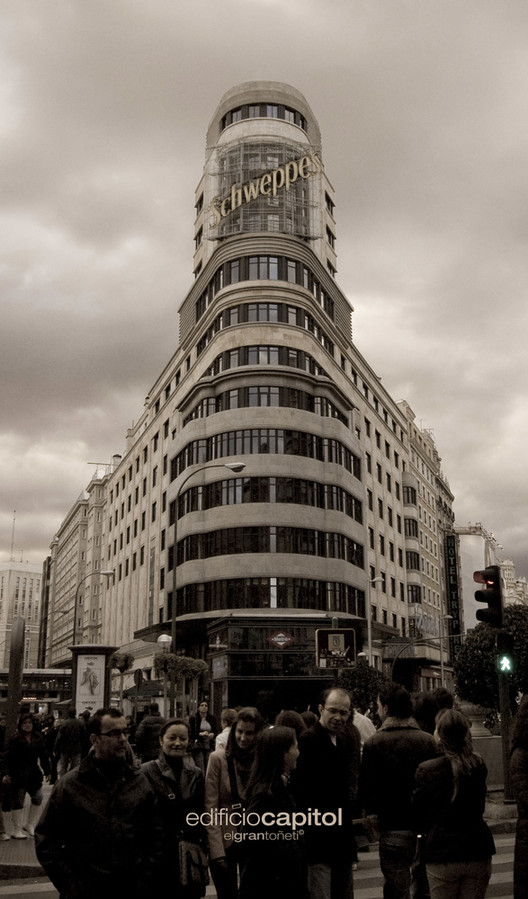
Rising to a total height of 63 meters to the tower's parapet, the 14-story building occupies a footprint of 1,363 square meters. Upon its opening, it housed a complex, forward-thinking, mixed-use program that was ahead of its time, incorporating residential units, offices, and entertainment spaces.
For this project, the architects received the Second Class Medal at the 1934 National Exhibition of Fine Arts—where the first prize was left vacant—and, in 1933, the Madrid City Council Award for the building's custom furniture, designed specifically by Feduchi.

Beyond its status as an iconic landmark of the Spanish capital and a core part of the collective identity of Madrid's residents, the building stands as an outstanding example of Rationalist architecture and the introduction of German Expressionism in Spain.
Architects such as Juan Daniel Fullaondo once declared that the Capitol Building was "objectively more important than all the works designed by the GATEPAC group," while Oriol Bohigas highlighted its significance for "representing the introduction to Spain of German Expressionist influences of clear Mendelsohnian origin."
._1-1935__n.º_1_(2).jpg?1523174035)
Beyond its aesthetic value, this recognition by the Community of Madrid also aims to highlight and promote its technical and tectonic features—areas in which the building was similarly ahead of its time.
Notably, the structural design featured concrete Vierendeel girders for the first time in Spain, which, with a span of 31 meters, were the largest in Europe at the time. Furthermore, the architects utilized the most advanced materials and systems of the era, such as glass, steel, air conditioning, and electric lighting, in a dedicated effort to forge a new architecture for a new society.
Consequently, the Capitol Building has become one of the most significant and representative structures built in Spain during the 20th century. Few landmarks capture the essence of Madrid quite like it, making it an undeniable cornerstone of the region's historical heritage and fully deserving of its designation as an Asset of Cultural Interest.
This article was written by Javier García Librero. The translation is powered by AI.
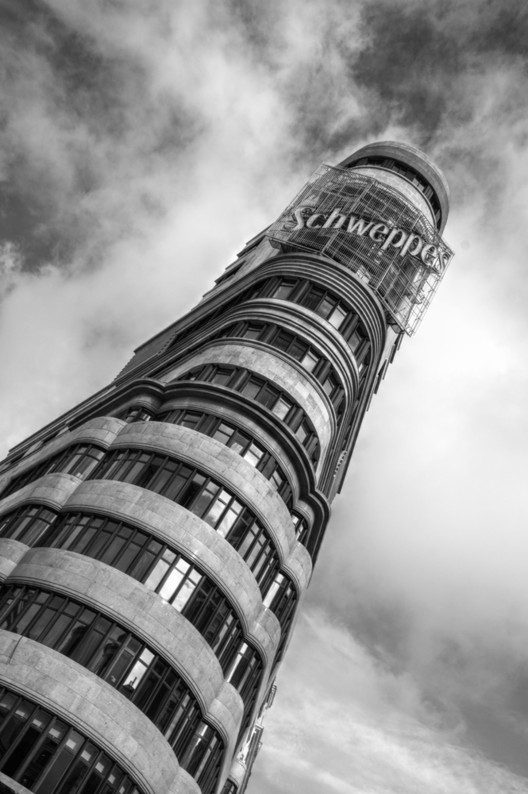


._1-1935__n.º_1.jpg?1523174067 "The Capitol Building, an icon of Madrid's Gran Vía, has been declared an Asset of Cultural Interest")


