'Trenzando' is now underway. Designed by architect Daniela Gutiérrez and built from shipping containers, this traveling cultural center aims to promote decentralization by activating and traveling across the railway networks of northern, central, and southern Chile. 'Trenzando' will bring cultural and technological development programs—including workshops, exhibitions, seminars, training sessions, laboratories, artistic performances, and film workshops—to non-metropolitan communities.
As a mobile platform for science, art, and technology, it functions as a traveling cultural center where cultural and scientific practitioners will collaborate with local communities to exchange knowledge and co-design projects.

Project Description: Chile has over 3,000 kilometers of disused railway tracks. Trenzando is a proposal to reactivate the country's national railway heritage by leveraging its still-operational infrastructure: 170 stations across the northern, central, and southern regions.
Using shipping containers as a spatial medium and the train as its distribution system, 'Trenzando' aims to create a network that fosters regional cooperation and highlights local identities, memories, and heritage by rescuing, exchanging, and circulating content related to Art, Science, and Technology.
The network utilizes the northern, central, and southern railway system—currently active for freight transport—which connects more than 170 towns across Chile.

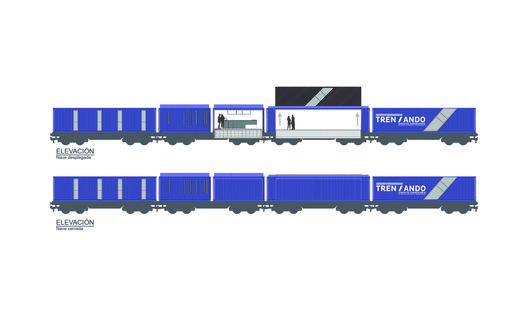
The 'Nave Trenzando' (Trenzando Vessel) is a mobile cultural facility built from five shipping containers. It features residency spaces for ten people, bathrooms, a kitchen, an office, a multipurpose workshop, and performance spaces. The structure is transported by freight train locomotives and parked on the siding tracks of stations in rural towns, where it opens its doors to foster exchange and highlight local knowledge.

This format brings cultural and technological development programs—such as workshops, exhibitions, seminars, training sessions, laboratories, artistic performances, and film workshops—to over 150 cities and towns, mostly rural, that often lack dedicated cultural infrastructure. By optimizing resources, the initiative ensures equal opportunities for hosting activities across all regions, regardless of local permanent infrastructure.

Valuing railway heritage: The Chilean railway network has experienced a significant decline in its role as a regional connector. Although the railway substantially shaped the development of the cities along its routes since its 18th-century introduction—influencing urban layout, demographics, public facilities, social structures, local lifestyles, and economic activities—today the national rail system is overwhelmingly used for freight. While the tracks remain in good condition, the same cannot be said for the stations and other associated structures, many of which are historic heritage sites.

Surveys of nearly eighty stations conducted by the Trenzando team reveal that a large number of them are abandoned, closed due to structural damage (mostly from the February 27, 2010 earthquake), burned, or converted into landfills.
The virtual absence of passenger transport has led to the neglect of these railway tracks. For many towns founded around the lines, the tracks now represent physical division and resource depletion. The centralization typical of Chile is reflected not only in decision-making and resource distribution, but also in how knowledge is generated, shared, and recognized among different regional actors.

With these premises, the 'Trenzando' team explored opportunities to reactivate the railway network, with a particular focus on using this tool for education, heritage preservation, and social innovation. This research led to the design of the Nave Trenzando by architect Daniela Gutiérrez. The infrastructure was built through a 2015 grant from Chile's National Fund for Cultural Development and the Arts (FONDART) under the Infrastructure category, along with contributions from Solmex S.A., the company responsible for fabricating the mobile structure.

The goals of the 'Trenzando' project are to encourage communities to participate actively in regional development; foster innovation by valuing cultural diversity in the creation of knowledge and technology; and preserve and highlight the tangible and intangible heritage tied to the national railway network.

The significance of Trenzando lies in revitalizing the railway system—a historical symbol of regional connectivity now severely neglected—to decentralize development opportunities. It achieves this through regional cooperation, the appreciation of local identity, memory, and heritage, and the transfer of knowledge and technology to non-metropolitan areas.

The outcomes of these collaborative local experiences will serve as data to build the 'Cartografía Trenzando.' This georeferenced digital platform will act as a virtual, parallel narrative of the project, documenting and highlighting the local knowledge, experiences, memories, and landmarks of each community visited by the Nave Trenzando. Using written, audiovisual, statistical, photographic, and archival materials, the Cartografía Trenzando aims to preserve the local histories and tangible and intangible heritage associated with railway activity, which are currently at risk of being lost.

Trenzando collaborates with the State Railway Company (EFE) to access railway infrastructure, as well as with freight transport companies to move the Nave Trenzando using their railcars and locomotives. Additionally, partnerships have been established with public and private organizations experienced in cultural and technological programming to ensure the successful operation of the network. Key partners include the National Council of Culture and the Arts, the Interdisciplinary Neuroscience Center (Universidad de Valparaíso), and the Center for Territorial Intelligence (Universidad Adolfo Ibáñez), among others.

*Project description courtesy of 'Trenzando'. For more information, visit their website here.
This article was written by Fernanda Amaro. The translation is powered by AI.