
Originally titled "Colombian Bamboo: A Strategic Ally for the Sustainability of Tropical Ecosystems," architect Luca Bullaro reflects on the work of architect Simón Vélez and designer Marcelo Villegas with bamboo—often called vegetable steel—through new assembly methods, new connections, and various structural support systems.
Simón Vélez, a Colombian architect recognized for his contribution to sustainable architecture, has earned an international reputation backed by outstanding works across the globe. With over forty years of experience in bamboo construction, he is a tireless traveler, inaugurating projects and exhibitions, and leading workshops and lectures.
Today, he seems to have entered a new phase of his professional life. At one point, Vélez remarked: "I want to focus on social housing, but on my own terms. I want to show that high-quality, affordable housing can be built using a hybrid technique of concrete, steel, and laminated bamboo. We have already opened a factory in Manizales to create the first prototypes."

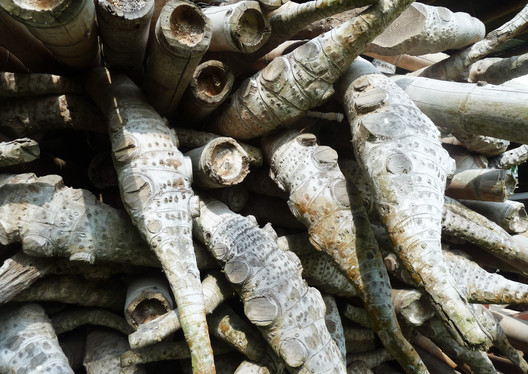
Simón Vélez surprised Italian architecture critics at the 2016 Venice Biennale with an impressive exhibition of his works, presented through clear imagery and models of various scales. One of these was a 1:1 scale dome suspended in mid-air that used the curved roots of bamboo to define its spatial configuration.
Vélez's work has been developed by exploring the qualities of Guadua, a bamboo species native to the Andean forests of Colombia and Ecuador. An extremely fast-growing plant—reaching up to 15 meters in height per year—it achieves high strength after just four years of maturation, earning it the moniker "vegetable steel." Its cultivation and processing are ecologically sustainable, and it is one of the plants that absorbs the most carbon dioxide from the atmosphere.
Used for centuries in the tropical regions of Asia as well, Marco Polo mentions it in his famous book "Il Milione," highlighting its extraordinary strength. In ancient China, powerful bamboo ropes were made to haul boats ashore, build suspension bridges, and construct irrigation piping systems. Thanks to its elasticity, bamboo offers excellent seismic resistance, is lightweight, and is easy to transport and assemble on-site.
With his partner Marcelo Villegas, Simón Vélez has invented new assembly methods, new connections, and various structural support systems that allow for the aesthetic redefinition of bamboo buildings, transforming the material—as Chilean architect José Tomás Franco writes—into a modern, flexible, and multi-purpose resource.
The Industrialization of Bamboo

Recently, the two partners perfected an innovative system to produce standardized bamboo panels that compete with timber. Using these panels, they have begun developing low-cost prefabricated residential building projects. The first prototypes are currently under construction, representing an intriguing challenge to the housing deficit in Colombia's major cities.
The panel production plant is eco-friendly, helping to prevent deforestation as bamboo serves as an excellent alternative to wood. Furthermore, the physical properties of bamboo help improve the environment through the high oxygen output naturally generated by the plantations, as well as the natural purification of nearby streams and springs.
Marcelo Villegas is a designer of contemporary objects, furniture, and machinery; his knowledge and skills have earned him national and international recognition. A few months ago, Bjarke Ingels, founder of BIG—one of the world's most famous and dynamic architecture firms—visited his workshop in Manizales to learn about the creations of this tropical inventor.

Villegas has spent most of his life trying to bring bamboo into mass and industrial use, convinced that it can be a solution to combat severe deforestation. For several years, he has been studying the development of laminated panel production, which today is carried out using cutting-edge technical processes:
Villegas was one of the first—following the example of Marco Montes and Dicken Castro, masters of Colombian Modernism—to promote bamboo culture through two outstanding publications: Tropical Bamboo, published by Villegas and Rizzoli, and more recently, Guadua: Arquitectura y Diseño. In recent years, he has focused on the industrial and sustainable transformation of bamboo into standardized panels, aiming to provide economic, social, environmental, and cultural benefits to Colombian communities.
Before the elegant experiments of Villegas and Vélez, bamboo was considered a poor man's material, especially in a country rich in extraordinary timber like Colombia. Now that a new environmental consciousness is attempting to curb the unchecked deforestation of pristine areas, the use of bamboo emerges as a smart way to preserve the territory.
Large Tropical Roofs
Simón Vélez defines himself as an "architect of roofs": "First, I design a wide roof, and then everything else. My architecture is tropical architecture. In a country where it rains all the time, you have to build roofs with large overhangs, as in the architecture of China and Indonesia."

For the Hanover World Expo, Vélez created a 2,000-square-meter pavilion made of bamboo, recycled cement, copper, and panels made from a mixture of soil, cement, and natural fiber. With 6.5 million visitors, it was the most visited pavilion at the Expo.
The prototype, built in Colombia with active technical collaboration from Villegas, is located in an urban park a few miles from downtown Manizales. In direct dialogue with the nearby lake, lush vegetation, and local wildlife, it appears as a natural Pantheon, characterized by the centrality of its almost sacred space and its elegant radial symmetry.

Its key spatial features are the large ambulatory wrapping around the double-height center and the generous overhang, which poetically connects the central heart with its surroundings while protecting it from rain and the tropical sun.
In Pereira, within Colombia's coffee-growing region, Vélez built the Cathedral of Our Lady of Poverty after the 1995 earthquake—a structure now reconstructed on a small rural peninsula near Cartagena. Here, Vélez implements a poetic reinterpretation of the natural arches found in bamboo plantations. The classic tripartition of the naves and facade is present. Careful, sophisticated proportions—utilizing the square, double square, and golden ratio in plan and section, much like Andrea Palladio, whose architecture continues to deeply interest the Colombian master—help generate a "botanical" reinterpretation of Gothic churches. This results in an exciting dialogue between architecture and landscape, creating a dreamlike atmosphere reminiscent of the spatial visions of Italo Calvino.
According to Colombian critic Eduardo Salas Delgado, Simón Vélez's work has influenced the development of new construction techniques in Colombia and has reached corners of the world where using bamboo as a structural material was once unimaginable. A prime example is the spatial and educational system of the Green School in Bali, which in recent years has become an experimental hub for bamboo construction.

Beyond connecting with the roots of vernacular architecture in the Americas, the intelligent use of bamboo enables the creation of buildings perfectly attuned to the climatic conditions typical of intertropical regions, both in the Caribbean and the Andean zones.
According to the Prince Claus Awards jury, "the combination of innovation, tradition, and environmental sustainability makes Simón Vélez's architecture an important contribution to new contemporary architecture."
The consequences of climate and environmental change are increasingly significant, influencing the cultural and social environments of human beings. In Colombia, thanks to recent experiments with bamboo, an ecologically sound design and construction system is being developed and disseminated, combining scientific innovation with ancient bioclimatic and ecological principles.
This is an important system for supporting the preservation of architectural, botanical, and cultural diversity within vast "developing" territories, which in recent years have undergone rapid transformations that often disregard local ecosystems.
Luca Bullaro holds a Ph.D. in Architecture and is an Associate Professor in the Faculty of Architecture at the Universidad Nacional of Colombia.
This article was written by Yamid Rivera. The translation is powered by AI.


.jpg?1529591233 "Colombian Bamboo According to Simón Vélez and Marcelo Villegas: Assemblies, Connections, and Structural Supports")


