
The winners of the second edition of the Richard H. Driehaus Building Arts Awards, which recognize leading masters in Spain's traditional building crafts, have recently been announced. With a total of 84 nominations received, the traditional building crafts were grouped into four categories, with each category presenting an annual award of €10,000 and a commemorative plaque.
The first category covers arches and vaults, vaulted staircases, stone carving, and other masonry and stone-cutting work. The jury selected Cantería Jaurrieta, from Olite (Navarra), run by Valeriano Jaurrieta and Agustina Rodríguez Orduña, to receive this award.
The second category includes timber framing and wooden structures, furniture, muqarnas, woodturning, woodcarving, door and window joinery, and other carpentry work. The award in this second edition went to Carpintería los Tres Juanes, located in Atarfe (Granada).
The third category comprises tilework, mosaics, plasterwork, stucco, sgraffito, decorative paving, and other traditional finishes. The prize in this category was awarded to Fátima Quesada de la Cuesta, whose workshop, Alizares, is based in Pitres (La Taha, Granada).
Finally, the fourth category covers ironwork, grilles, locksmithing, leaded stained glass, and other traditional metal and glass crafts. Blacksmith Enric Pla Montferrer, based in Alpens (Barcelona), was chosen for this award.
Additionally, to help support the continuity of their work, the jury selects one of the four winners in each edition to receive an additional €10,000 grant to train an apprentice for one year. The apprentice also receives €8,000 in financial support during their training period. From among the four winners, the jury selected Fátima Quesada for this initiative.
Masonry and Stone-Cutting: Cantería Jaurrieta

Cantería Jaurrieta is a small family business based in Olite (Navarra) whose primary activity is stone-cutting for restoration work. Their process combines traditional tools with modern machinery, aiming to reduce production costs without sacrificing quality.
Thanks to their mastery of stone carving, the Government of Navarra has been able to carry out restoration work on stone structures in some of Olite's major monuments, such as its Castle or the Church of San Pedro, as well as many other historic sites in Navarra, including Ujué, Sangüesa, Artajona, Roncesvalles, and the Pamplona Cathedral itself. Gargoyles, tracery, and pinnacles from numerous medieval monuments have found new life in this workshop, whose continuity is vital to preserving this rich heritage.


Woodwork: Carpintería los Tres Juanes
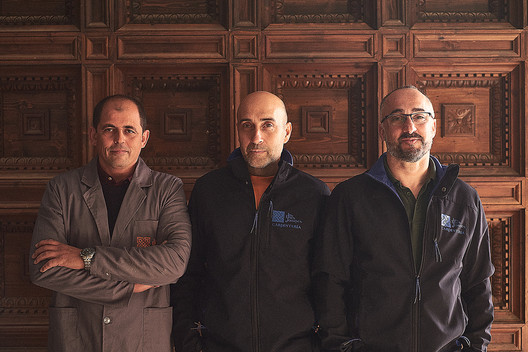
Los Tres Juanes is a company specializing in the Spanish tradition of structural carpentry (carpintería de armar): timber roof framing and coffered ceilings (alfarjes), both structural and decorative, featuring any design of strapwork, carvings, or muqarnas.
From their workshop in Atarfe, in the Vega de Granada region, they have worked on numerous restoration projects for historic timber structures, sometimes alongside renowned architects like Enrique Nuere Matauco or Rafael Manzano Martos. Their portfolio ranges from major Spanish monuments—such as the Buenavista Palace and Villalón Palace (now the Picasso Museum and Thyssen Museum in Málaga), the Monastery of San Pelayo in Cevico Navero, the Church of Santa María de los Reales Alcázares in Úbeda, the Condestable Palace in Pamplona, and the Joaquín Peinado Museum in Ronda—to projects demanding this distinctive style of carpentry in other countries, including the United States, Algeria, and Bahrain.


Finishes and Other Traditional Building Crafts: Fátima Quesada de la Cuesta
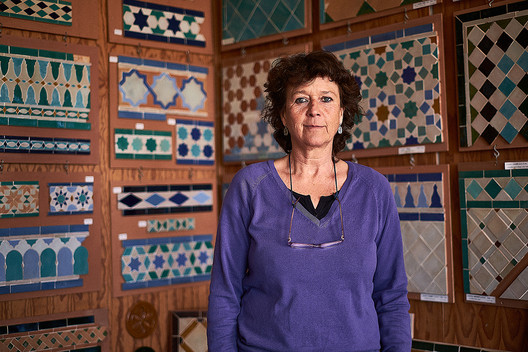
Fátima Quesada de la Cuesta focused her work on reviving the forgotten techniques that produced Nasrid tilework. Since then, she has been creating unique tile mosaics recognized worldwide.
Her projects are custom-designed for each specific surface, considering not only its dimensions but also the color scheme and lighting of the space. These closed compositions feature defined borders, similar to tapestries or rugs.
While preserving the textures and color gradations of this tradition, Fátima crafts the pieces for each composition by introducing updates that allow for rigorous quality control to ensure every piece meets her standards.


Metal and Glasswork: Enric Pla Montferrer

Enric Pla Montferrer is an international reference in artistic ironwork. From his workshop in Alpens, a small town in the Catalan Pre-Pyrenees within the province of Barcelona, he shapes iron into almost any form imaginable.
He is renowned for his delicate metalwork on some of Catalan Modernism's most famous buildings. This expertise led to his current role coordinating all ironwork projects at the Sagrada Família Basilica, where he began working in 2012 on items such as pews, handrails, and stairs. This work has made him a leading authority on Gaudí's ironwork, and he has restored significant pieces, including the wardrobe for the Sagrada Família Sacristy.
The Richard H. Driehaus Building Arts Awards are organized annually by INTBAU (International Network for Traditional Building, Architecture and Urbanism) with the generous support of the Richard H. Driehaus Charitable Lead Trust, and in collaboration with the Spanish Ministry of Development (through the Directorate-General for Architecture, Housing, and Land), the Ministry of Education, Culture, and Sport (through the Directorate-General for Fine Arts, Cultural Heritage, Archives, and Libraries), the Rafael Manzano Martos Prize, and the High Council of Spanish Architects' Associations (CSCAE).
Awardee descriptions provided by the Richard H. Driehaus Building Arts Awards.
This article was written by Javier García Librero. The translation is powered by AI.


