On December 20, the final curatorial review of the first National Essay and Research Competition, Written Architecture 2017, took place at the national headquarters of the Colegio de Arquitectos de Chile.
Organized by Grupo Arquitectura Caliente and co-organized by Ediciones ARQ, the competition awarded the 20 best articles out of 87 submissions in the undergraduate and graduate categories, representing 18 architecture schools across 9 different Chilean cities.
The competition was directed by Gabriela García de Cortázar and featured a jury of 30 prominent academics and professionals on the Evaluation Committee.
Below is the article by Universidad de Chile student Pablo Schmidt, winner of the Graduate Category.
Alternative Methods in the Traditional Construction of Shipwrights in Southern Chile
Record of a Practice
Abstract: Traditional wooden boatbuilding is a craft in a clear state of decline, where the passing of its elder artisans has broken the chain of transmission for the traditional methods and muscle memory that have sustained it as a discipline. The development of methodologies that treat absence and marginalization as unavoidable challenges bypasses the obvious hurdle of illiteracy through strategies that bring the builder closer to the material and how to work with it. This study was conducted through direct observation and hands-on craftsmanship at the San Juan Shipyards in Chiloé, aiming to understand the underlying constructive logic of the trade as a case study. The clear dependence on the discipline's historical development suggests that producing its complex elements requires repeated trial and error, with these iterative processes yielding highly specific, intangible material knowledge.
The true objective was never entirely clear; perhaps the unfolding of events has disproportionately shaped what I write. I never had a seat, a desk, or any steady companion during this time, other than the didactic exercise of critical conversations with an occasional, sensible interlocutor, or simply the company of my own thoughts.
I do not claim to find immutable truths or certainty in my proposals; I merely attempt to direct my energy toward understanding the astonishing complexity of what exists and the imprecision of reality, with the persistent determination to dig my fingers into the wounds of the material.
To set the context: this is a dying craft. Dying because we are referring to a foretold death, one that is widely known and discussed, yet very little can be done to prevent it. But what is it that disappears, such that its absence allows us to say the craft has died? What essentially constitutes a craft?
Paradoxically, shipwrightry on Chiloé Island began its decline with the arrival of development on the archipelago. The construction of land routes inverted the previous relationship of mobility via the sea and resource extraction from the land, turning it into mobility on land and resource extraction from the sea. This simple event, combined with timber overexploitation on the island, led to a gradual estrangement of the population from the vessel itself. Boats were no longer used for transit and became restricted to extractive industries and those employed by them. Today, this shift has reduced the demand for vessels, isolating their production almost entirely within industrial spheres. Previously, a vessel was a direct tool for a village's survival, and knowing how to build it was the means to sustain life.
Traditional wooden boatbuilding is gradually disappearing on two main fronts: the passing or retirement of its practicing artisans, and the industrial sector's replacement of traditional techniques with industrial methods. In this regard, the craft rests on two core pillars: the artisan's knowledge and the traditional method. A vessel cannot be built by someone who does not possess this knowledge, nor does the craft remain the same when the technique used belongs to an entirely different constructive nature.
There are certain implicit rules, guidelines, and variables that cannot be found in any manual or handbook. This information is non-codifiable and cannot be transferred to a sheet of paper. This is evident because, throughout the entire boatbuilding process, no plans, codes, or instructions are used to define curves through a catalog that guarantees efficiency or a specific outcome. Instead, this is achieved solely through the shipwright's muscle memory. Any action on reality involves working with the material, which over time, through the controlled repetition of this action, develops into specific, intangible knowledge. Given enough time and sustained practice, a craft is inevitably formed, even if the practitioner is unaware of or did not intend this outcome. In wooden boatbuilding, everything relies on this iterative, long-term experimentation, testing the qualities of the wood and the operations performed on it, storing that memory physically in a collection of sensations and vague perceptions. Through intuition, shipwrights can compare reality with their expected standard (a standard also built iteratively), using muscle memory to measure what validates or rejects the modified state of the material. Just as in sports, one cannot learn to swim without confronting the body with the reality of water; mastering the sport, or establishing the practice of swimming, is achieved by repeatedly exposing the body to this process. Furthermore, to learn a trade, the apprentice's imitation of the master's actions is essential, as it extracts already refined knowledge.
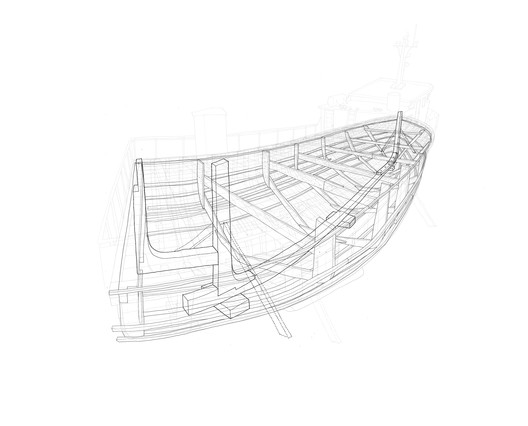
Consequently, drawings of construction processes are merely formal illustrations or diagrams limited to specifying the components and parts of the boat. The actual knowledge required to build a vessel lies in the visual calibration needed to gauge a curve, the tangible sense of the material's resistance to stress, and estimating the flexible limit of a wooden plank by touch. This is also why Daniel Barría, a shipwright from San Juan, Chiloé, considers it essential to have experienced the physical reality of navigation, where the vessel is subjected to harsh weather at sea, pushing the boat to its limit. All of these physical memories are internalized through material interaction. However, illustrating or sketching on paper does allow us to describe—or at least approach—the second relevant component in the establishment of the craft: the method.
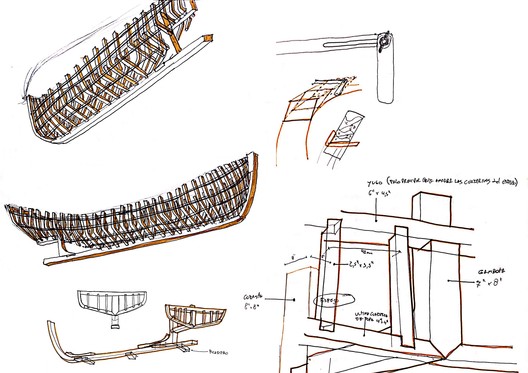
While a craft is shaped by the repeated manipulation of a material, the way these operations are ordered—the procedural rules that define the method—does determine the craft and defines its domain. The material composition and the rules governing its constructive logic are highly relevant to both the process and the final product, representing a way of thinking and working simultaneously. This method becomes particularly significant when considering the marginalized educational background of those who execute and lead the work, many of whom are completely illiterate. How is it possible to achieve highly complex geometries without even being able to read the numbers on a measuring tape?
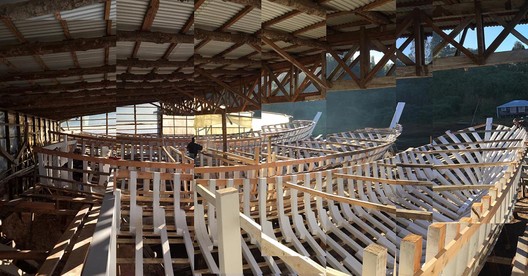
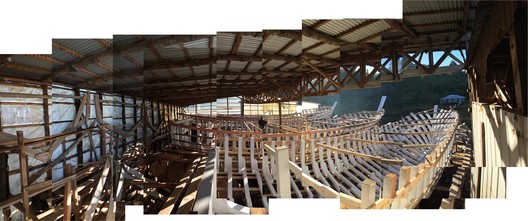
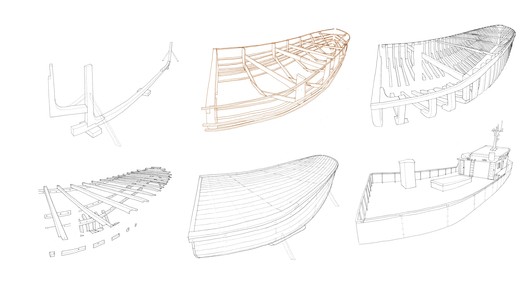
The template method relies on creating the overall volume of the hull through a temporary structure composed of "molds" or "templates" (transverse curvature guides) and "ribbands" or "battens" (slender longitudinal strips). These are the most critical elements throughout the construction process, as they allow builders to measure curvature, provide support points for moving around the work-in-progress, and establish the hull shape to be refined and used to fabricate all the final components.
This template method relies on a specific tool that, once the temporary volume of the hull is established, allows builders to measure the multiple or double curvatures (often diverging from one another) of each part of the boat. The "escantillón" (a bevel gauge) is a compass-like tool used to measure angles. It sets the angle between a metal blade and a wooden stock to materially (rather than numerically) transfer the exact angle of each component, measuring by eye directly from the pre-assembled temporary volume. Sizing a specific section materially allows builders to work with it: transferring, moving, and replicating it on another piece of wood to produce the final parts of the boat. Attempting to develop each piece and its corresponding curves using numerical measurements would be impossible or incredibly tedious. The sheer number of parts is endless, and their positioning is difficult to map out using only measurements. This simple shift from numbers to physical material, born of extreme methodological simplicity, is essential to understanding how an illiterate builder can achieve such complex construction in the most direct, material way possible.
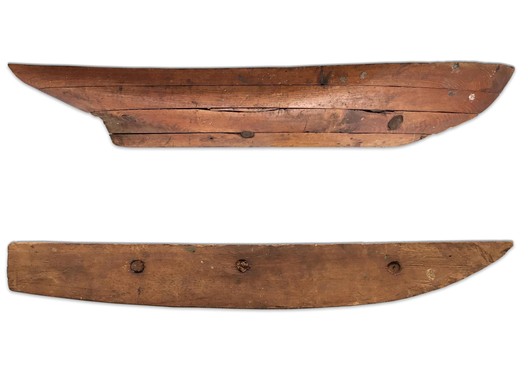
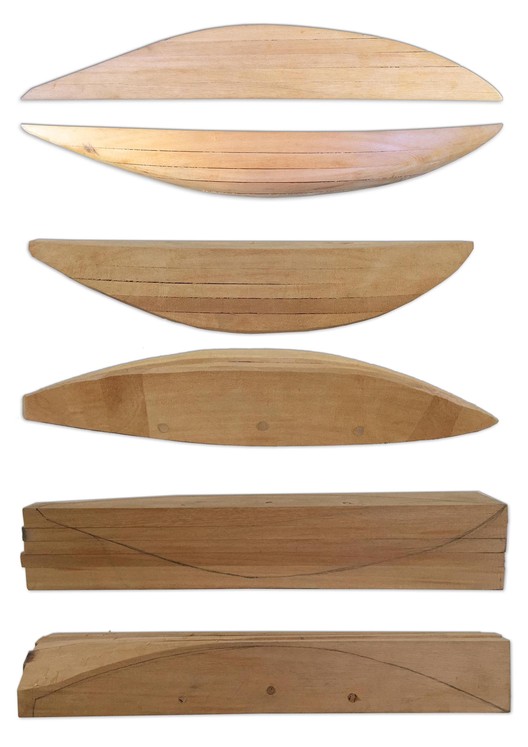
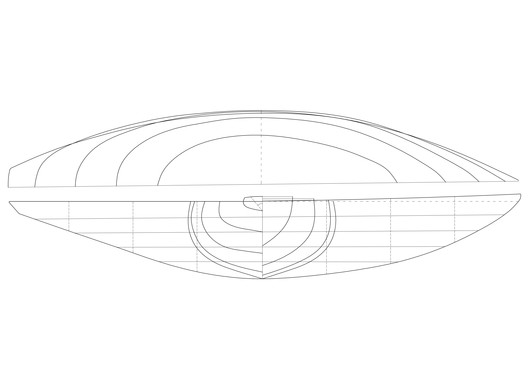
Another boatbuilding method, which is less popular today due to the rise of numerical complexity, is the "half-model and lift" method (historically known as *maqueta y tarima*), which begins by crafting a scale model made of calibrated wooden lifts stacked vertically and held together with dowels. This method allows for different hull designs; by modifying the model, builders can easily adjust the final shape of the vessel. The model is made from a block of dowelled lifts calibrated to a specific scale, allowing it to be disassembled so the curves of each layer of wood can be transferred to a drawing. These models bypass a fundamental boatbuilding challenge in an incredibly simple way.
Symmetry is guaranteed by building only half of the model. This requires mirroring each fabricated piece on the opposite side and provides the model maker with a single, crucial flat surface to rest and work on the model. A major weakness of this method is that because the shape of the actual boat is defined by a scale model, any imperfection in the model is magnified during full-scale construction. Consequently, muscle memory—reflected in the precision and clarity of the builder's work—becomes essential to achieving the expected standard.
The clarity and immense complexity of these methods make it highly unlikely that they were developed through flashes of inspiration or sudden genius. It is impossible to attribute to a single source the countless coinciding decisions that result in an efficiency matching the standards of modern engineering. The history of shipbuilding dates back to time immemorial, and the designs built in San Juan, Chiloé, are the direct descendants of a long, shared lineage shaped by the trial and error of an artificially guided natural selection. This repeated testing subjects every stage of fabrication to structural trials. Over time, this process gradually and quietly refines the design into an increasingly sophisticated vessel—to the point where a naval architect will blindly sign off on the bureaucratic paperwork validating the boat, just like any other industry-standard vessel.
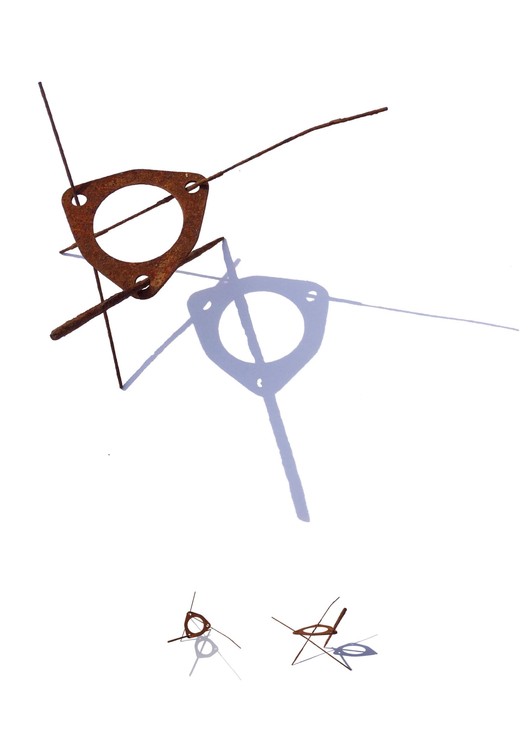
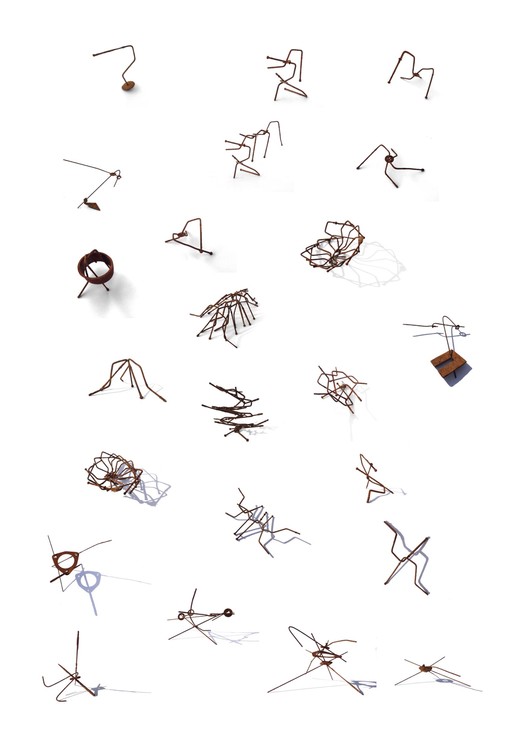
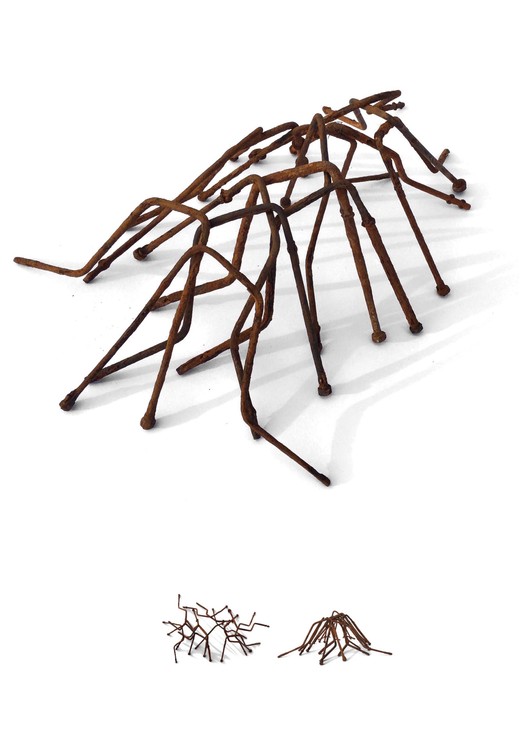
On the shores of San Juan beach, rusted remnants of metal parts left behind by repairs lie forgotten—elements of unknown origin whose previous state has been erased by salt water. As a parallel, applied exploration, I worked with materials repeatedly, subjecting these structures only to their own gravitational mass and occasional gusts of wind and rain that knocked them down more than once. They cost nothing and required minimal time to build. By applying a method of repeated natural and artificial selection, I could generate numerous results, gradually and freely refining the structures. The procedure involved simultaneous tests of structural interlocking, joining pieces using a repeating pattern, and forming composite structures through simple operations with zero material cost. This was not an attempt to imitate or replicate a boat, but rather to extract procedural logics and borrow simple fabrication methods to achieve more complex results. Every time a structure was built, and every time one collapsed, I gained a better understanding of the operation and the material, preserving in my body the memory of confronting the material. The method was ongoing, and its practice sustained; yet, had the work continued, would it have become a craft?

This article was written by Fernanda Amaro. The translation is powered by AI.