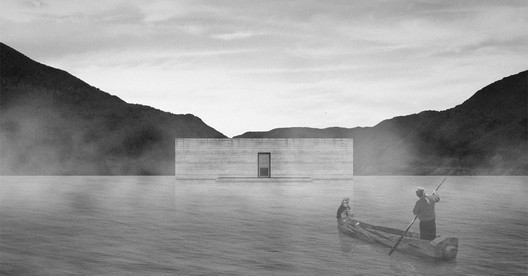
The "Floating Cemetery of Alto Biobío" project, developed by Universidad de Chile architect Fabián Leiva, proposes a memorial for the Quepuca cemetery—one of 14 flooded following the construction of the Ralco hydroelectric plant. The design features a monomaterial concrete volume positioned over the flooded cemetery to establish a vertical communication between the living and the dead, creating a point of connection between them.
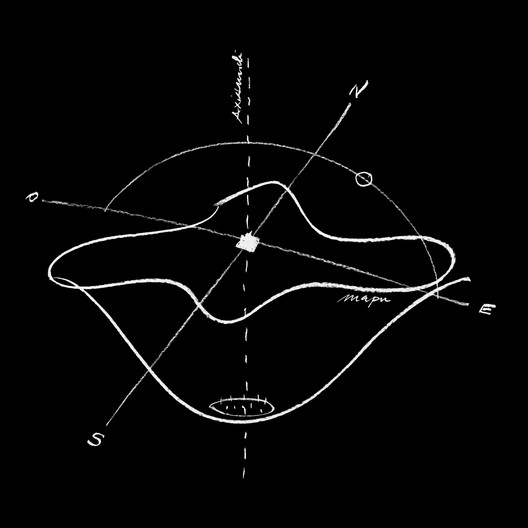
The proposal draws from how Mapuche culture concieves the cosmos as a series of overlapping square platforms connected by a vertical axis, or *axis mundi*—a vertical channel of communication used by the *machi* (shaman) during rituals to transcend the earthly plane and seek counsel from the spirits.
Architect's description:
“The concept of land ownership is completely different from ours: it is not the people who own the land, but rather the land that owns the people. Properties are never measured; they are known, but never in their extent. Each person is eternally bound to their land; regardless of the richness of the adjoining land, no one can move, as they are possessed by it.” (La arquitectura como lugar, Josep Muntañola, pp. 46-47)
1. The Disaster
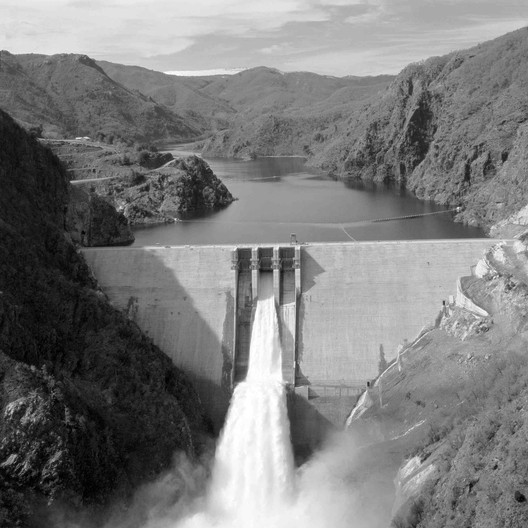
In 1997, despite strong opposition from the local Pehuenche population, construction began on the Ralco hydroelectric plant in the municipality of Alto Biobío. The project brought severe human, ethnic, cultural, and environmental consequences, displacing local inhabitants and flooding their ancestral lands and sacred sites within a region of remarkable ecological value.
Despite this, construction was completed in 2004 with government approval, reaffirming the repeated marginalization of Indigenous peoples by the state and private corporations. A total of 98 families were relocated after the dam's construction; however, an outstanding issue remained: the community cemetery. Prior to filling the reservoir, the community was in talks with both the government and the company to establish a new cemetery and relocate the bodies—a measure that was ultimately included in the compensation package. Yet, none of this happened. On a fateful day in May 2004, the company unexpectedly closed the dam's floodgates, claiming that an unexpected rise in the Biobío River forced their hand, leaving around 700 bodies submerged under 80 to 100 meters of water.
.jpg?1517582713)
From then on, the struggle focused on recovering the bodies from the Quepuca cemetery, one of the 14 flooded by the dam. However, after conducting on-site studies, underwater archaeologists and the Chilean Navy reached the same conclusion: extracting the bodies was impossible, leaving the community helpless in the face of the issue.
Consequently, the community's connection to the cemetery was relegated to the shores of the reservoir. Nevertheless, the community still gathers periodically to perform traditional prayers (*rogativas*) at the site, guided by the belief that the spirits request them. Although the connection to the cemetery has been irreparably damaged, time has shown that it remains alive; regardless of the years that pass, the cemetery is still remembered and visited.
2. The Reparation
This is where architecture can achieve what no other discipline can: rebuild something as abstract and immaterial as a bond by creating a space that allows residents to feel connected to their ancestors, who are now buried beneath earth and water. It serves as a meeting point between the living and the dead, a threshold or doorway connecting both worlds to enable communication. Simultaneously, it stands as an eternal indictment of an utterly unscrupulous act that prioritized economic gain over human lives.
Within Mapuche culture, the cosmos is conceived as a series of overlapping square platforms connected by a vertical axis, or *axis mundi*. This vertical channel is used by the *machi* during rituals to transcend the earthly plane and seek counsel from the spirits. Consequently, in this culture, transitioning between the different planes of the cosmos occurs through a vertical relationship.
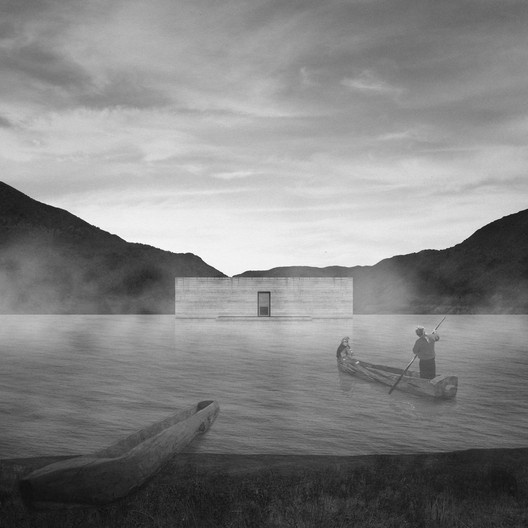
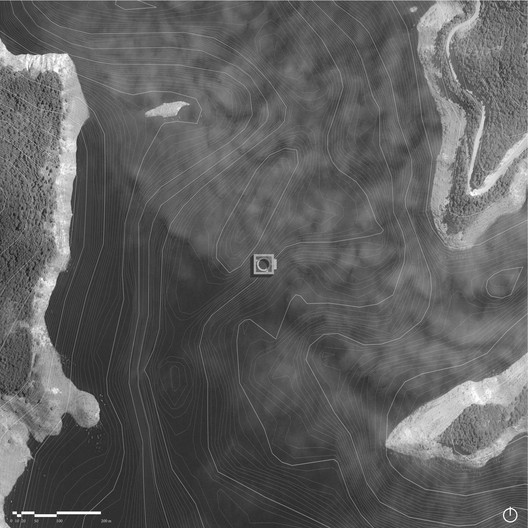
For this reason, the project proposes a memorial positioned as a volume directly above the flooded cemetery, establishing a vertical line of communication and a point of union between the living and the dead. This positioning also brings visibility to the issue, ensuring it is not forgotten, standing as an eternal testament to what occurred and a form of reparation for those affected.
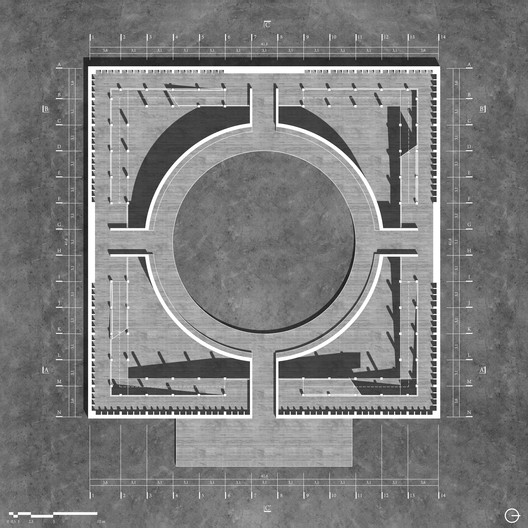
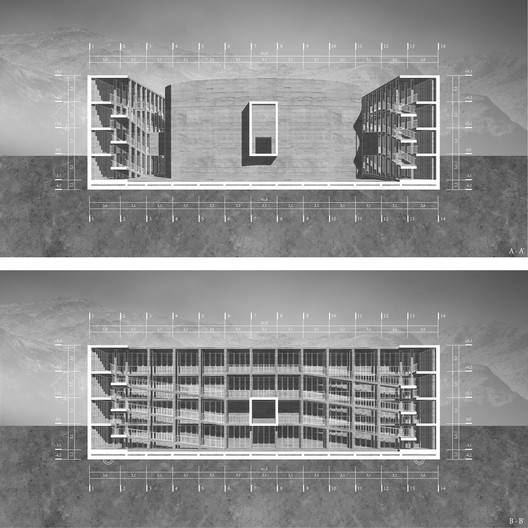
The design consists of a simple, pure volume that ensures buoyancy and stability, with its center hollowed out to create a central space dedicated to commemorating those buried beneath the water. A central opening to the water below marks the exact location of the cemetery, while the structure opens toward the east—the direction of the rising sun, representing goodness and divinity in Mapuche culture.
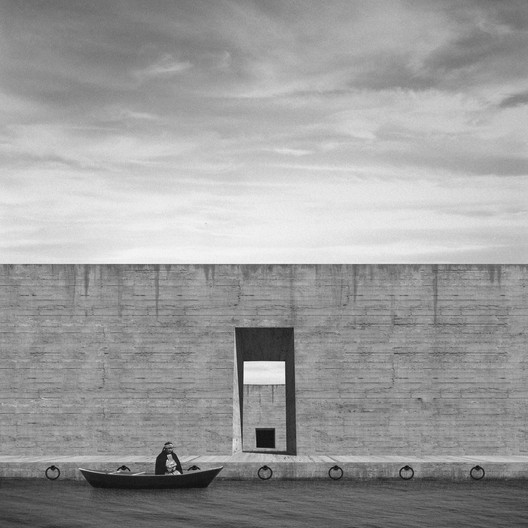
A void between the central space and the perimeter of the volume provides buoyancy. Additionally, the project accommodates the continuation of a traditional funerary rite: the repatriation of the *chemamull* (wooden anthropomorphic statues) of those who, due to the flooding, could not be buried alongside their ancestors as tradition dictates. The memorial adapts and extends this rite. Composed of galleries wrapping around the perimeter of the volume, the space houses the *chemamulles* of those displaced from their intended burial sites, creating an intimate space for remembrance where families can visit those who passed away after the flood, bringing their spirits back to the resting place of their ancestors.
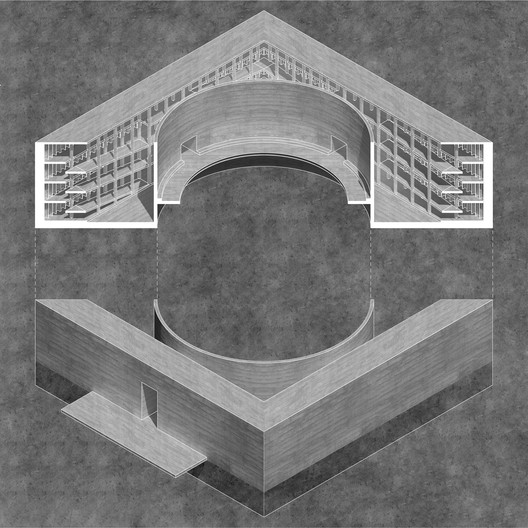
Given the unique conditions of the site, a monomaterial concrete volume is proposed to ensure long-term durability without the need for maintenance. This allows the structure to age naturally over time, standing indefinitely to fulfill its purpose of memory and assembly.
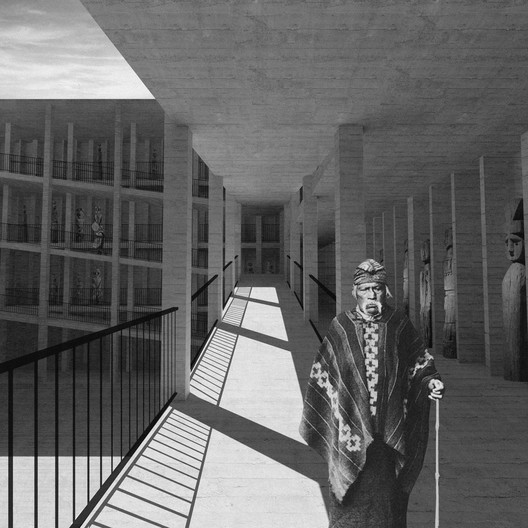
To execute the project, construction is planned during the months when the reservoir is at its lowest level. The construction of the structure's shell would begin on the exposed dry land; as the reservoir level rises, it would float the structure, allowing it to be positioned and anchored in place using cables secured to the reservoir walls. This methodology facilitates rapid dry-land construction, allowing the interior finishes and details to be completed on the water without urgency or disruption to the Ralco power plant operations.
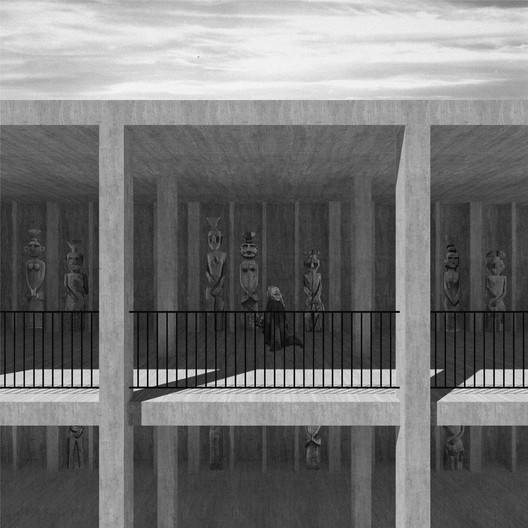
In this way, the project seeks to realize a work whose complexity lies not in its formal or material characteristics, but in the sensitivity with which it approaches an seemingly irreparable issue. The community has a highly specific way of conceiving death, the cosmos, and the communication between its different planes—a connection that can only be realized through an understanding of its deeply spiritual nature.
Name: Fabián Leiva Cortes
University: Universidad de Chile
Thesis Project: El Cementerio Flotante de Alto Biobío. Arquitectura a la memoria del cementerio inundado.
Location: Alto Biobío, Biobío Province, Biobío Region
Advisor: Albert Tidy
Year: 2018
This article was written by Fernanda Amaro. The translation is powered by AI.


.jpg?1517582713 "Alto Biobío Floating Cemetery Is Inspired by Pehuenche Culture")
.jpg?1517582661 "Alto Biobío Floating Cemetery Is Inspired by Pehuenche Culture")