"Architectural competitions represent the combination of the art of choosing and the craft of being chosen," says Roberto Fernández about an area of our discipline that is widely recognized as an excellent platform for firms and independent professionals to present their ideas as true manifestos. Meanwhile, in academic circles, competitions often serve as tools for formal, conceptual, and graphic experimentation.
These types of commissions undoubtedly inspire not only architecture and urban planning professionals but also the public as a key player in their evaluation. Whether or not these proposals are built, they demonstrate that we must constantly champion innovation, recognizing the immense effort behind these results. With this in mind, we have selected six award-winning projects that reflect the value of architectural competitions in Colombia.
Design Competition for the Los Grillos Kindergarten / Arquitectura y Espacio Urbano
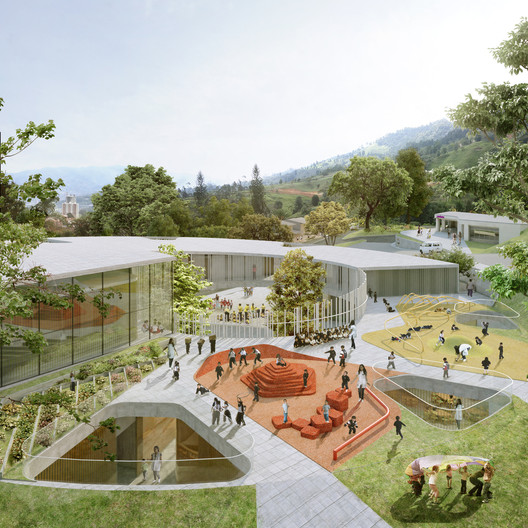
Award: First Place
Location: La Estrella Natural Reserve, Antioquia
This proposal sought to reflect on the kindergarten as a space for childhood, centered on the well-being of families and society. Guided by this concept, the project was envisioned as a space to initiate educational and socialization processes, designed for sharing and learning through play, recreation, and gathering, while remaining open to families as an essential component of the community.
Ideas Competition for the Future Juan Amarillo Park / Colectivo 720
Award: Third Place
Location: Juan Amarillo Park, Bogotá

Located in the Juan Amarillo wetland in Bogotá, Colectivo 720's proposal was defined by its authors as an "integral renaturalization of the alluvial habitat." The project creates systemic interactions at the landscape, architectural, urban, social, cultural, and environmental levels, integrating ecosystem development through the main ecological structure of the Juan Amarillo River and its area of influence. The systems shaping this macro-project are structured around thresholds, landscapes, the main ecological structure, public space, and the "water culture."
Design Competition for the Jaime Rentería Early Childhood Development Center (CDI) / Taller Piloto Arquitectos + ECS Arquitectos + AC Arquitectos + TAHO Taller Horizontal
Award: Second Place
Location: Cali

Early Childhood Development Centers (CDI) in Colombia are typically oriented toward psychosocial development and physical activity, while incorporating life skills and values that prioritize holistic development, collaborative work, and creativity. The second-place winners aimed to conceptualize all these elements by incorporating infrastructure that promotes ongoing play, exploration, and skill-building—key aspects of early childhood that will help shape future athletes.
Design Competition for the Argelia II School and Bicycle Center / Arquitectura en Estudio + Nomena Arquitectos
Award: Second Place
Location: Bogotá

The project is conceived as a single building integrating two dissimilar programs: a spine and four perpendicular volumes. This layout improves the urban-natural relationship by incorporating flexible settings that adapt to the diverse learning and community needs of children and citizens. The authors envisioned a space that would consolidate Bogotá's status as a pioneer in education and sustainable mobility, driven by public and private initiatives.
Tercer Milenio Park Competition in Bogotá / DARP
Award: Third Place
City: Bogotá

This proposal was highlighted by the jury for its compelling organization of the urban structure in relation to its context, seeking to reconnect the park to the city's urban, historical, and environmental fabric through a recreational and sports program as a central axis. The authors noted that the complexity of the area—located in the heart of Bogotá—required a structure capable of adapting over time and engaging various social and institutional stakeholders.
SuperCADE Manitas Competition / David Macias
Award: Third Place
Location: Ciudad Bolívar, Bogotá

SuperCADEs function as an integrated service system where citizens can complete over 200 public administrative procedures. Based on this model, this architectural proposal sought to create an urban landmark for community and social integration in one of Bogotá's poorest peripheral neighborhoods. It leverages the impact of the future aerial tramway—TransMiCable—which will connect directly to the project at one of its stations.
This article was written by Yamid Rivera. The translation is powered by AI.