

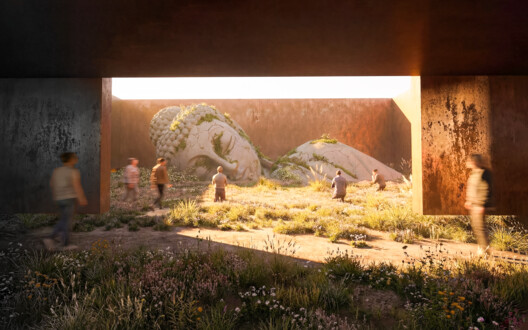
Buildner has announced the results of its Museum of Emotions Competition Edition 7. The Museum of Emotions is an annual international design competition that tasks participants to explore the extent to which architecture can be used as a tool to evoke emotion.
The brief calls for the design of a conceptual museum with two exhibition halls: one designed to induce negative emotions; the other designed to induce positive emotions. Participants are free to choose any site of their liking, real or imaginary, as well as choose the scale of the project. The meaning of 'positive' and 'negative' is up for interpretation: What two emotions might a designer consider contrasting? How might an architect conceive spaces which elicit fear, anger, anxiety, love or happiness?
The Museum of Emotions is a 'silent' competition: participants must communicate ideas without text, and must use imagery alone. No form of text, whether design descriptions, annotations, or even diagrammatic labels, is permitted.
Museum of Emotions No. 8 is open, and two weeks remain until the registration deadline. The next edition of this competition, the Museum of Emotions Competition Edition 8, is launched with a 10,000 € prize fund and an advanced registration deadline in two weeks, on 18 June 2026.
Buildner's other ongoing competitions include: the MICROHOME 2026, with a 100,000 € prize fund seeking innovations for small-scale housing, and the Mujassam Watan Urban Sculpture Challenge aimed at finding innovative sculptures reflecting Saudi Arabia's heritage, modern achievements, and future ambitions.
Architectural Emotions: Book Publication
To put additional focus on this topic, Buildner has published the book Architectural Emotions, which delves into the intricate relationship between architecture and the spectrum of human emotions. It explores how spaces can profoundly influence our feelings, from serenity and joy to anxiety and melancholy, through the use of light, layout, materials, and more. The projects exhibited in this book are curated from submissions received over several editions of the Museum of Emotions competition. They reflect an array of ideas submitted from architects and designers from around the globe.
Projects:
First Prize Winner + Buildner Student Award
Project title: Nevertheless
Authors: Minseok Choi and Jang Sieon from Sangmyung University, South Korea
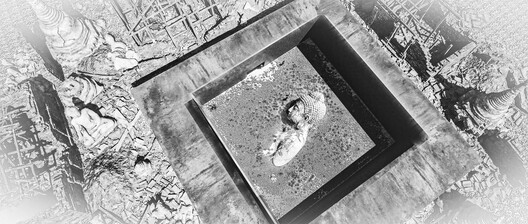
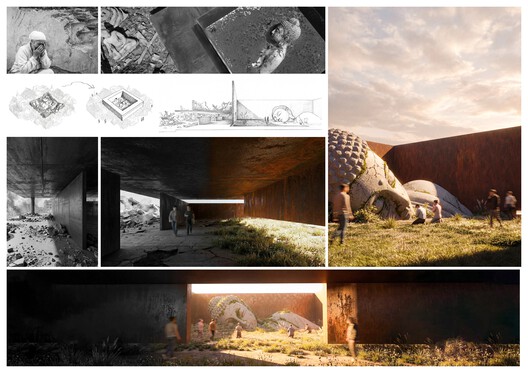
This proposal stages an emotional journey through rupture, preservation, and renewal, framed around the fractured remains of a fallen sacred figure. Set within a walled, excavated landscape, the project juxtaposes chaos and stillness: rubble and collapse on one side, controlled geometry and contemplative enclosure on the other. A singular planar wall operates as both spatial divider and symbolic threshold, separating destruction from reflection. Visitors move through compressed, dimly lit passages before emerging into an open courtyard where fragments of a monumental Buddha rest within a softened terrain of grasses and light. The sequence choreographs a shift from devastation to quiet optimism, transforming cultural loss into a site of collective memory and renewed meaning. Rather than reconstructing what has fallen, the project preserves the fragment as a catalyst for emotional awareness, inviting reflection on faith, history, and the invisible layers of trauma embedded in place.
Second Prize Winner
Project title: The Dark Side of the Moon
Authors: Kaiwen Wei, from the United States
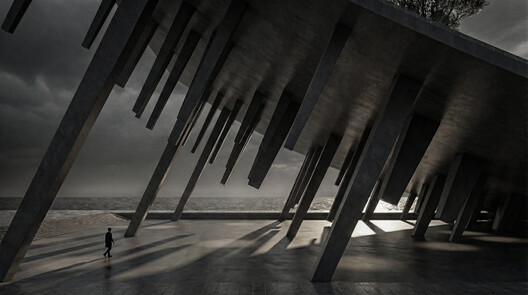
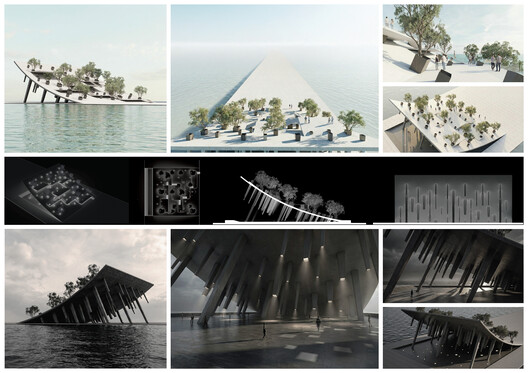
A single tectonic gesture defines the project: a monumental slab lifted and tilted from the sea, creating two radically different spatial worlds within one continuous form. Above, the inclined plane becomes a white, open plaza populated with trees, seating elements, and an elevated promenade that extends toward the horizon. This luminous terrain reads as calm and civic, almost infrastructural in its clarity. Below, the same surface transforms into a cavernous undercroft punctured by elongated columns and shafts of light. Some of these vertical elements are hollow, allowing daylight to filter down from the planted surface above, linking the two realms visually and atmospherically. The project stages a deliberate emotional divide between serenity and tension, lightness and compression, offering visitors a choreographed journey from open sky to shadowed interior.
Third Prize Winner
Project title: Big Reset
Authors: Ceyda Ilhan and Beyza Ilhan, from Turkey
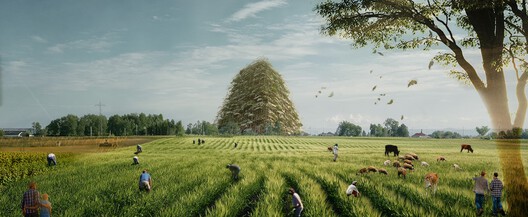
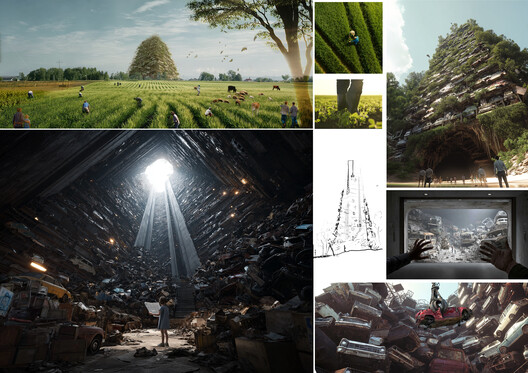
Rising from an agricultural landscape, the project takes the form of a monumental mound that at first reads as a lush, cultivated hill. Its exterior is overtaken by vegetation, blending into the surrounding fields and suggesting a narrative of ecological recovery. Only gradually does the artificial nature of the mass become apparent: beneath the green surface lies a vast accumulation of discarded objects, layered into a conical structure that can be entered. A vertical shaft of light penetrates the interior, drawing visitors upward through a cavern of compacted cars and consumer debris. The journey transforms the mound into both archive and warning, staging a confrontation with the material residue of contemporary life. What appears from afar as a symbol of renewal reveals itself as a tomb-like chamber of consumption, where familiar fragments of everyday culture are preserved, monumentalized, and made unsettlingly present.
Highlighted Submissions
Project title: EN(D)TRY
Authors: Success Chiziterem Maduka and Dhayita Mriyanggani, from the United States
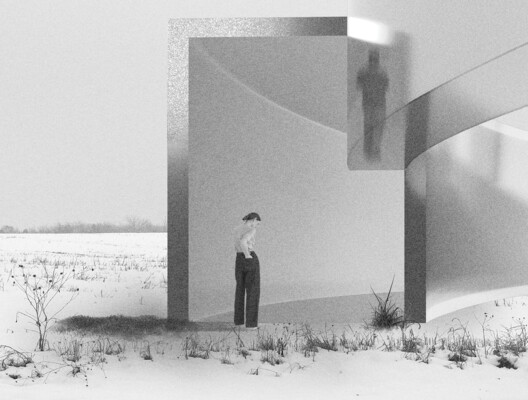
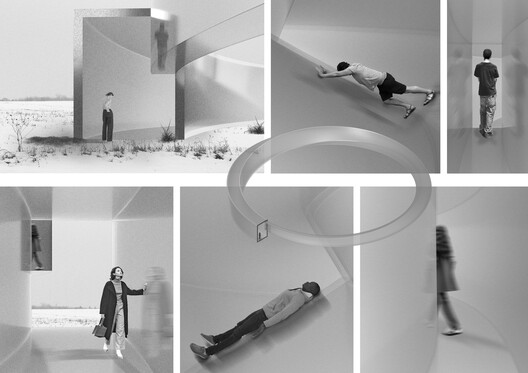
"EN(D)TRY" unfolds as a continuous spatial loop inspired by the logic of the Möbius strip, proposing an architecture without a fixed beginning or end. Set within a quiet, open landscape, the project transforms a single continuous interior into a sequence of shifting emotional conditions shaped through bodily movement, compression, and perception. What begins as an open and luminous threshold gradually tightens into a constricted tunnel where the visitor is forced to crouch, lean, and physically negotiate the space. The architecture refrains from prescribing a singular emotional response, instead creating conditions in which anxiety, curiosity, exhilaration, and vulnerability coexist simultaneously. Transparent and translucent surfaces heighten this tension, dissolving boundaries between enclosure and exposure while amplifying awareness of the body moving through space. At the culmination of the journey, a glazed overlook positioned above the point of entry reframes the entire experience through retrospection, transforming the return path into an altered psychological reading of the same architecture. Through repetition, inversion, and physical disorientation, the project positions emotion not as a fixed narrative, but as something continuously constructed through memory, movement, and passage.
Project title: Resonance
Author: Aleksei Volkov, from the United States
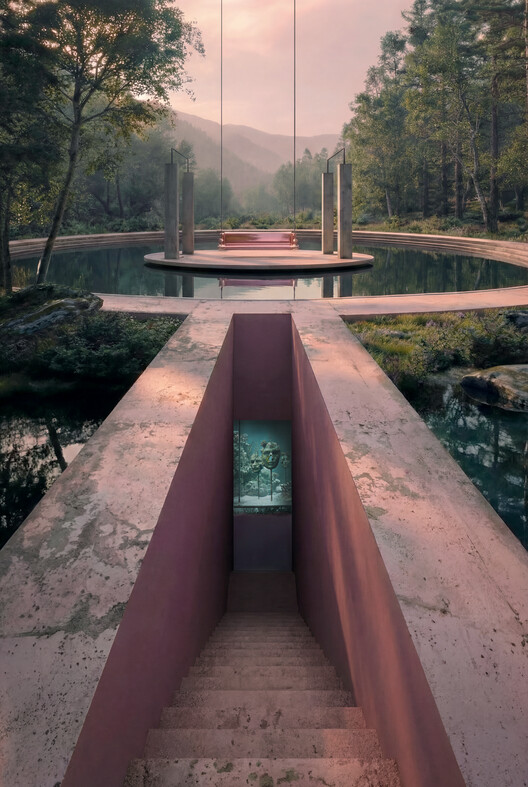
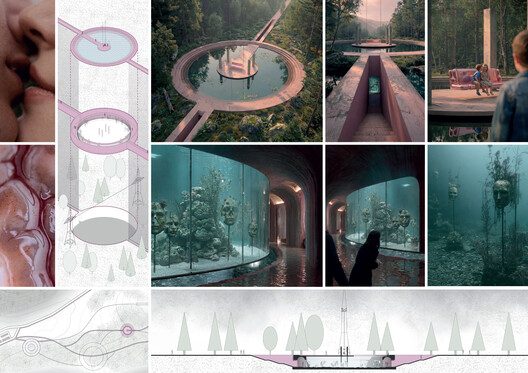
"Resonance" constructs a symbolic journey through the layers of human consciousness, using architecture as a spatial metaphor for repression, confrontation, and emotional catharsis. Set within a secluded forest landscape, the project begins as a serene circular pavilion framing a still body of water and a solitary suspended swing; an image of calm that conceals a darker interior condition beneath the surface. A narrow incision in the ground draws visitors downward into an underground chamber where the atmosphere transforms completely. Flesh-toned biomorphic walls, shallow water-covered floors, and dimly illuminated circulation routes create a heightened sense of vulnerability and psychological immersion. At the center of the subterranean hall, a vast cylindrical reservoir contains submerged sculptural masks representing suppressed emotions and unresolved trauma. Suspended within murky water like archaeological remnants or funerary artifacts, the faces remain visible yet unreachable, generating a persistent tension between exposure and concealment. The architecture choreographs a linear and inescapable sequence in which visitors must move alongside these submerged figures before ascending once again toward daylight. By framing emotional confrontation as a physical act of descent and return, the project transforms the museum into an experiential narrative about memory, self-awareness, and the uneasy coexistence between social identity and inner darkness.
Project title: Veil of Shadow, Grove of Light
Author: Chung-Yu Chen, from the United States
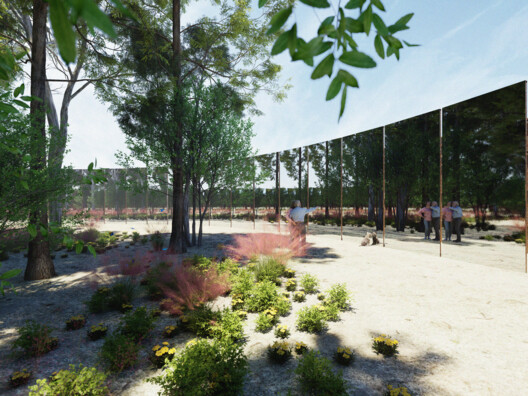
"Veil of Shadow, Grove of Light" transforms the memorial into a circular landscape of concealment, reflection, and gradual revelation. Defined by a continuous mirrored perimeter enclosing a dense grove of trees, the project establishes a sharp contrast between exterior abstraction and interior immersion. From the outside, the pavilion appears as a reflective and almost immaterial ring that dissolves into the surrounding landscape, obscuring the space within and heightening a sense of mystery and detachment. Entry occurs through narrow compressed passages framed by dark structural elements, producing a deliberate transition from exposure to enclosure. Inside, the atmosphere shifts entirely: a quiet forest clearing unfolds beneath filtered light, soft vegetation, and winding paths, creating an environment of stillness and introspection. The project avoids monumental symbolism in favor of environmental experience, using reflection, shadow, and landscape as its primary architectural materials. By juxtaposing the tension of the enclosed threshold with the openness of the internal grove, the proposal stages a spatial sequence in which emotional release emerges gradually through movement, light, and immersion in nature.
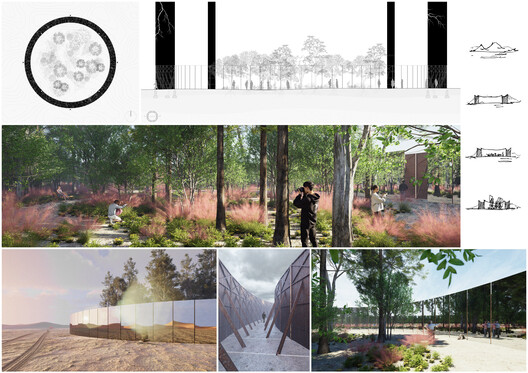
Project title: Portal
Author: Zeynep Nevbahar Bilgeman, from Canada
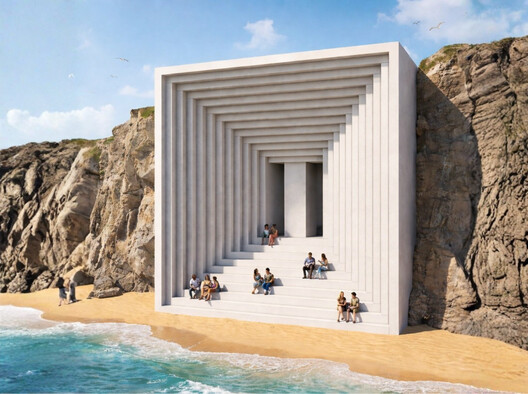
"Portal" transforms a simple cubic volume into an architectural sequence of compression, descent, and emotional release. Embedded within a coastal cliff overlooking the sea, the project stages a gradual journey inward through a spiraling system of stepped platforms that draw visitors downward toward an uncertain destination. At the center of the void, a monolithic square prism containing an elevator acts as a fixed vertical anchor, intensifying the sensation of enclosure and psychological tension as the surrounding steps tighten around it. From above, the composition reads almost as a carved vortex; an abstract geometric incision embedded into the landscape. The emotional atmosphere shifts dramatically upon reaching the lower level, where the confined descent abruptly opens toward the horizon and the expansive seascape beyond. What initially functioned as circulation becomes inhabitable terrain: the same stepped surfaces that once induced hesitation and unease transform into places of rest, contemplation, and stillness. Through minimal geometry, repetitive framing, and carefully choreographed movement, the project uses architecture itself as an emotional instrument, translating fear, anticipation, and release into a singular continuous spatial experience.
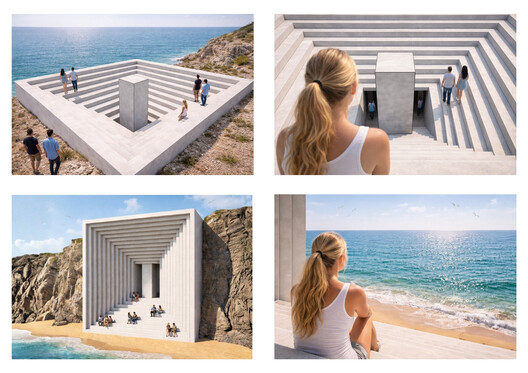
Project title: Memento
Authors: Silvia Oana Cristea, Daniela Maria Roman, Maria Alexandra Cărămidă, from Romania
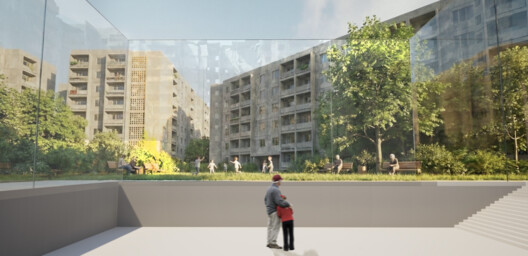
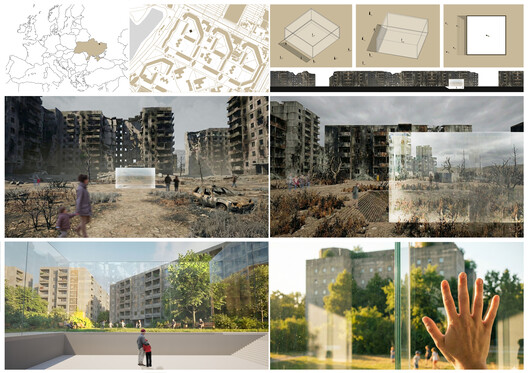
"Memento" frames emotional contrast through the opposition between destruction and preservation, positioning architecture as both witness and reconstruction of collective memory. Set within the ruins of a war-damaged urban landscape, the project introduces a minimal glass cube that reflects the devastated surroundings while remaining almost immaterial within them. Rather than competing with the context, the intervention allows the ruined city itself to become the primary emotional and architectural protagonist. The transparent enclosure operates simultaneously as memorial, threshold, and device of reflection, capturing fragments of the scarred environment while suggesting the fragile persistence of civic life. The emotional transition intensifies through a monumental descent below ground, where visitors move away from the destroyed landscape toward a protected interior space shaped by memory and projection. Here, images of the city before destruction are suspended above, forcing visitors to lift their gaze upward toward an imagined future rather than remain fixed on loss. Through restraint, reflection, and spatial contrast, the project transforms architecture into an act of quiet resistance, staging a dialogue between absence and continuity, devastation and hope.
Project title: Imprints of Metamorphosis
Author: Adam Klobušník, from Slovakia
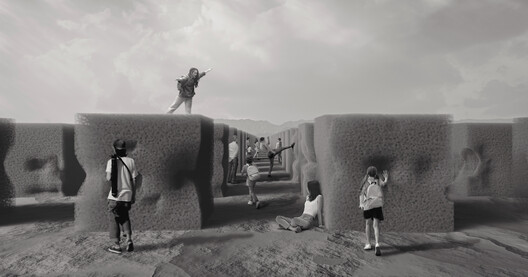
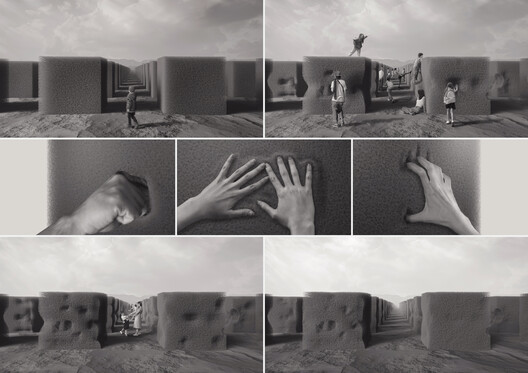
"Imprints of Metamorphosis" transforms emotion into a tactile and continuously evolving material condition, using sponge-like architectural volumes as metaphors for memory, instability, and psychological transformation. Set within an abstract and seemingly infinite landscape, the project abandons conventional oppositions between positive and negative emotions in favor of a cyclical understanding of emotional experience. Large porous cubes populate the terrain like inhabitable artifacts, their soft and responsive surfaces recording traces of physical interaction over time. Visitors punch, scratch, press, and embrace the material, leaving marks that either slowly disappear or remain permanently embedded within the surface. The architecture therefore functions not as a static container for emotion, but as an active emotional archive shaped collectively through touch and bodily engagement. The repetitive field of cubes, extending endlessly toward the horizon, creates a surreal atmosphere in which scale, distance, and permanence become uncertain. Through material responsiveness and gradual transformation, the project frames emotion as something unstable and accumulative; a process of continuous imprinting rather than a fixed state.
Buildner is welcoming entries to the Museum of Emotions Competition Edition 8. Visit the website here for more information and to register before June 18, 2026.


