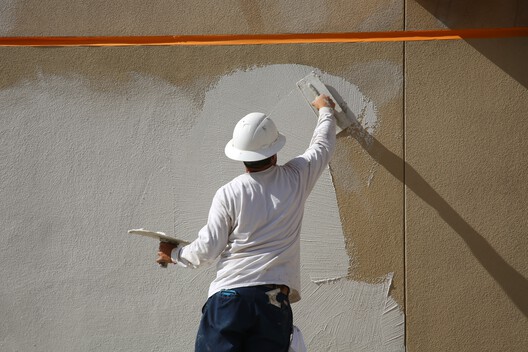
In an industry defined by engineering tolerances and performance certainty, interior finishing still relies on a process that introduces variability into every project. Even experienced applicators often depend on judgement-based mixing—estimating water ratios and adjusting by feel until the material appears workable. While skill reduces variability, it does not eliminate it. The result is inherent inconsistency that transfers directly onto the finished surface.
Site-mixed cement and gypsum-based dry powder fillers have long been the default for leveling and skimming. They appear economical and familiar, but the model systematically introduces rework and quality risk. Water ratios vary between applicators and between batches, altering viscosity, open time, shrinkage, porosity and overall performance—often within the same building. Under critical lighting, these variations manifest as visible joints, patchiness and uneven absorption, leading to remedial skim coats and repainting.
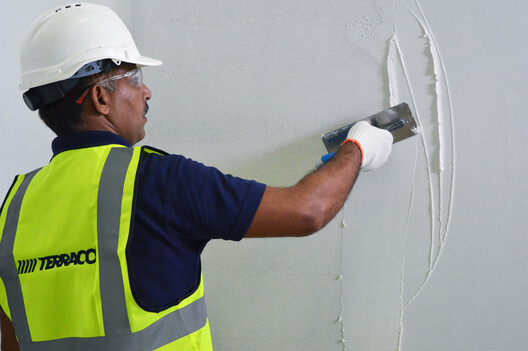
For more than four decades, Terraco, a global manufacturer of finishing materials, has focused on eliminating variability at source by replacing site-based judgement with factory-controlled systems.
What is happening to dry powder fillers today mirrors the evolution of concrete over the past century. For decades, concrete was mixed on-site by construction crews using bagged cement, aggregates, and water measured by hand—a practice still common in developing markets. The quality of each batch depended entirely on operator skill, material consistency, and site conditions. As construction projects scaled and quality requirements tightened, the industry recognized that site mixing was fundamentally incompatible with consistency, speed, and structural reliability.
The solution was ready-mixed concrete (RMC): concrete mixed off-site in controlled batching plants and delivered ready-to-pour. The transformation was dramatic. By 1930, only a handful of ready-mix plants existed in the United States; by 1958, there were over 3,600; today, the global RMC market is valued at USD 815 billion (2024) and is projected to reach USD 2.4 trillion by 2034, growing at 8.6% CAGR. Ready-mix concrete now dominates construction precisely because it eliminated the variability and risk of site mixing, delivering factory-controlled quality, consistent strength, and predictable performance across every batch.
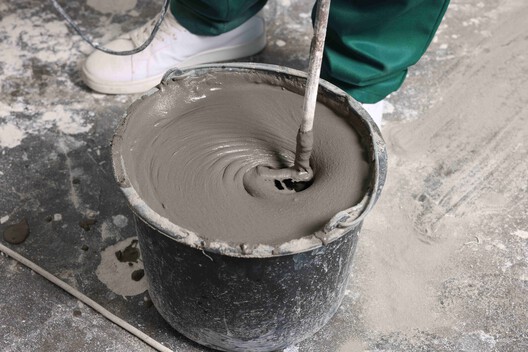
The drivers behind that transformation—quality control, program certainty, and efficiency—are identical to those now reshaping interior fillers. Site-mixed dry powder fillers are the equivalent of 1920s site-mixed concrete: variable, labor-intensive, and dependent on jobsite conditions. Ready-mixed systems like Handycoat represent the same evolutionary leap: factory-controlled formulations that eliminate mixing variability, reduce rework, and deliver consistent results from the first pail to the last.
What the Data Shows
Future Market Insights values the ready-mix joint compound market at roughly USD 5.5 billion in 2024, rising to USD 9.2 billion by 2035 at a 5.2% CAGR. More telling than the headline number: over 55% of drywall finishing projects globally already rely on ready-mix formulations.
This is not a marginal preference shift; it is a structural re-engineering of how finishing materials are produced, specified, and applied. This shift is driven as much by risk reduction and lifecycle cost control as it is by performance.
Where Site Mixing Fails Quality Control
Powder-based finishing has one structural flaw: quality control ends at the factory gate. Once a bag leaves the production line, performance depends on who opens it, the water quality used, mixing duration, and the ambient conditions of the day. Water ratios estimated by feel produce inconsistent shrinkage. Hand-drill mixing varies with paddle, speed, and duration. Temperature and humidity then compound the problem. The Drywall Finishing Council's technical guidance shows drying time can increase by roughly four-fold at 12°C when relative humidity climbs from 50% to 90%. Batch-to-batch drift through the day widens the spread further. The downstream result is a familiar list of callbacks: joints that open weeks after handover, fastener heads telegraphing through paint, and"picture framing" around repaired areas.
Markets That Have Already Shifted
South Korea provides a clear example of how quickly this transition can occur. Specifications there once favored site-mixed powders, with ready-mixed compounds reserved for higher-end projects. Through sustained engagement with specifiers, contractors, and applicators, ready-mixed systems moved from a premium option to a baseline requirement across major developments. Today, mainstream interior finishing in Korea is effectively a ready-mixed market.
Similar transitions are visible across multiple regions. As labour costs rise, health and safety requirements tighten and project timelines compress, the limitations of site mixing become harder to justify. Once stakeholders experience factory-controlled consistency, reverting to traditional methods is unlikely.
Handycoat and the Industrialization of Finishing
Handycoat, Terraco's range of ready-mixed jointing and skimming compounds, exemplifies this shift from site-based variability to factory-controlled performance. Every pail leaves the factory pre-mixed and quality-checked, allowing for tight tolerance across raw materials, processes, and product properties. In practice, this delivers several distinct advantages:
- Factory-controlled quality. Consistent viscosity, open time, and drying characteristics across every container ensure batch-to-batch variation is eliminated rather than managed.
- Faster finishing cycles. On Terraco's internal comparative testing, Handycoat skims complete up to four times faster than cement-based alternatives and twice as fast as gypsum-based compounds due to optimized formulation properties.
- Reduced defect risk. Balanced binders, balanced vapor permeability, and controlled flexibility reduce hairline cracking, edge failures, and joint reappearance—particularly in high-movement partitions and prefabricated assemblies.
- Cleaner sites and better working conditions: The dust issue starts before sanding. Dry cement-based finishing products must be opened, poured, gauged with water, and mechanically mixed on-site—steps with recognized potential to release airborne dust. The dustiness of powdered bulk materials is a well-established workplace exposure issue, measured under European test framework EN 15051 (which evaluates inhalable, thoracic, and respirable dust fractions). Ready-mixed acrylic fillers and skim coats change the process: the powder-handling and gauging stage is moved from the jobsite to the factory. While they do not remove the need for sensible sanding controls, dust extraction, and PPE, they do remove one of the least controlled dust-generating steps from site finishing.
- Low-VOC and IAQ alignment. As a water-based, solvent-free system, Handycoat is fully compatible with modern low-VOC paint technologies and supports projects targeting LEED and equivalent certifications.

The Market Has Already Decided
Ready-mixed compounds now account for more than half of global drywall finishing, and adoption continues to accelerate. Market data from coatings and joint compound sectors points in the same direction: controlled, factory-produced systems outperform site-mixed alternatives on quality, program certainty, and risk management.
For architects, consultants, and developers, the question is no longer whether this transition will occur, but how quickly it will take hold—and who will be prepared. Terraco has spent more than four decades building that capability, translating factory control into consistent on-site outcomes. The era of site-mixed finishing is not gradually fading; it is actively being replaced.


