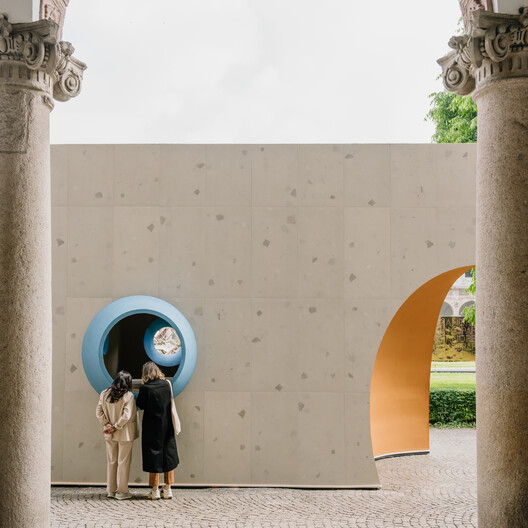
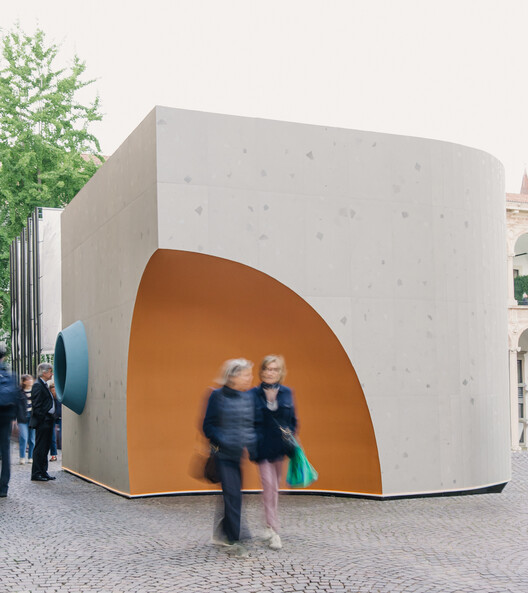
Can one of architecture's oldest materials still inform how sustainability and manufacturing are approached today? What shifts when ceramic is viewed beyond its surface, as a process shaped by light, water, and clay? At Milan Design Week 2026, VitrA, a brand producing bathroom and ceramic surfaces and working across sanitaryware and tiles, and international design practice Snøhetta explore these questions through Ceramics Forged in Light, an immersive installation created for the INTERNI MATERIAE exhibition. Positioned within a broader discourse on material experimentation and circular production, the project treats ceramic as an architectural material defined by continuous transformation, shaped through light, water, heat, reflection, and reuse.
Fired clay has been used in construction for over 9,000 years, evolving from vernacular craft into one of the most widely applied materials in the built environment. Its durability, water resistance, thermal performance, and adaptability have made it a staple for facades, sanitaryware, flooring, architectural surfaces, and structural systems. Today, new manufacturing technologies are extending these possibilities as architects and manufacturers confront the environmental implications of material extraction and production.
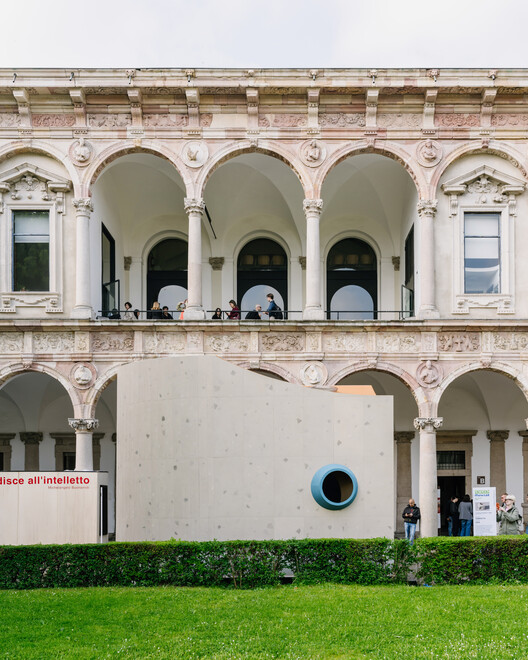
Ceramic Production Explored through Space
Within this context, Ceramics Forged in Light frames ceramic as part of a continuous cycle of transformation. The installation translates industrial processes into a spatial experience, using raw materials, light, and water to reveal how ceramic is formed, stabilized, reused, and reintroduced into production systems. Grounded in the interplay of water, fire, earth, and air, the installation frames ceramic as a material in constant negotiation with elemental forces.
Overhead openings filter natural light into the space, evoking ancient bathhouses where stone, water, and shadow continuously reshape perception. Light acts as a spatial proxy for firing, entering, and shifting across ceramic surfaces throughout the day. The space becomes less exhibition than an environmental condition, where material perception is recalibrated through reflection, humidity, and shadow. At the center, a reflective pool amplifies ceramic basins and surfaces, shifting their appearance through movement and proximity. Its surface serves as both a mirror and a threshold, subtly distorting depth and binding the surrounding elements together.
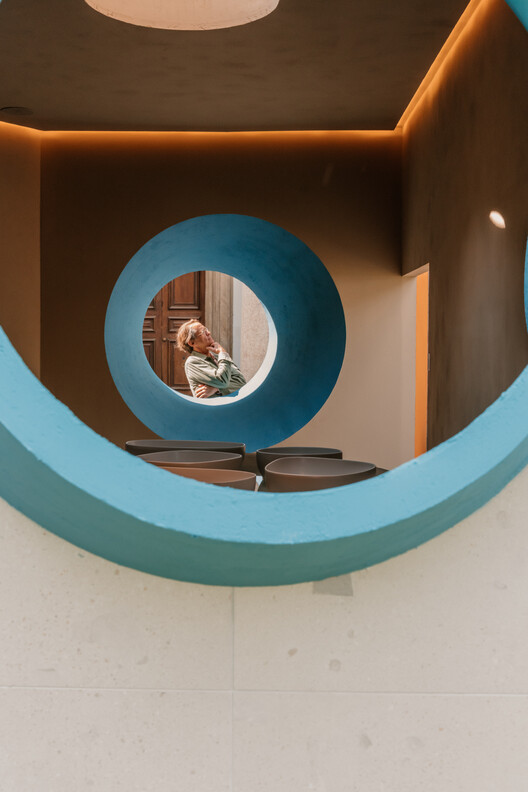
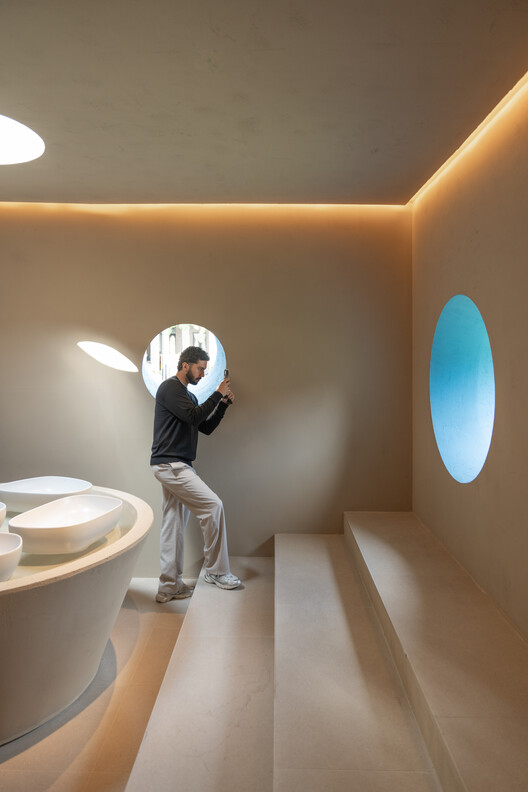
The installation responds directly to INTERNI's 2026 theme, MATERIAE, which frames material not only as an object, but as a process, relationship, and condition. Snøhetta's spatial approach reinforces this idea by dissolving boundaries between architecture, interior, landscape, and product design. The installation unfolds as a slowed spatial sequence in which perception shifts gradually. Within this framework, ceramic surfaces register time through reflection and environmental change.
Circular Manufacturing Approach in Ceramic Production
Ceramic production has traditionally depended on resource-intensive extraction, firing, and water consumption. Across the industry, however, circular production models such as those developed within VitrA's manufacturing systems for recycled washbasins and 100% recycled tiles are beginning to reshape how materials are sourced and reused. Production waste is collected and processed through chemical balancing, sedimentation, dewatering, and storage before being reintroduced into production streams. Industrial wastewater is recovered and reused within facilities, while recycled ceramic granules are integrated into porcelain tile production without affecting technical performance or dimensional consistency.
In such tile production systems, up to 90% of production waste is reintegrated into manufacturing cycles. While these processes are invisible on a finished surface, they fundamentally alter the material's lifecycle. By embedding recycled content into production systems and recovering industrial flows, energy consumption in the tile product group is reduced by up to 74%, while, according to Life Cycle Assessment (LCA) results, environmental impact per product in the bathroom product group is reduced by up to 30%. In recycled washbasin production, recyclable material is treated not as waste but as part of a continuous cycle of recovery and transformation, in which discarded material is reintroduced into long-lasting, environmentally responsible design systems. The installation points toward a broader shift in architecture: a move away from linear material consumption toward regenerative production systems.
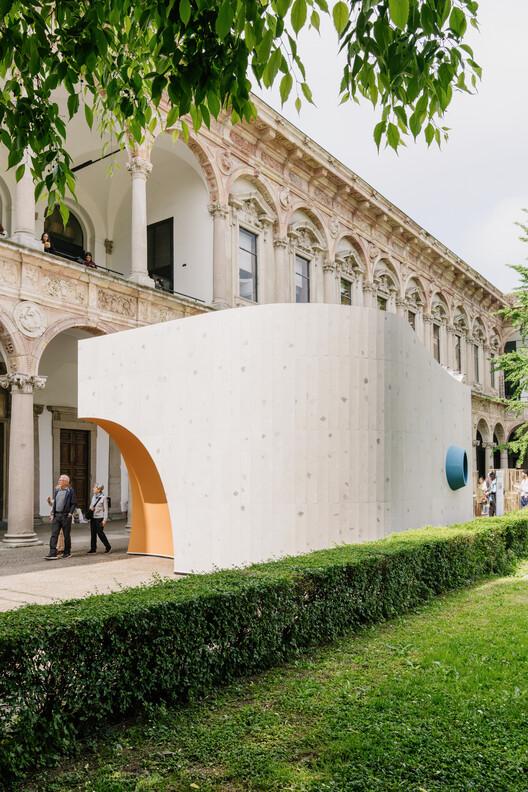
This tension between permanence and transformation sits at the core of the installation. Ceramic is one of humanity's oldest engineered materials, yet it continues to evolve in response to new environmental and technical demands. Through Ceramics Forged in Light, the material is repositioned as something active: shaped through cycles of heat, reuse, erosion, reflection, and adaptation.
As architecture continues to interrogate the environmental cost of construction, installations like those presented at INTERNI MATERIAE suggest that the future of material innovation may lie less in inventing entirely new substances and more in refining systems, processes, and relationships already embedded in architectural production.