Water has always occupied a unique position in architecture: elemental yet elusive, functional yet symbolic. It is both a material and a medium that shapes cities, structures rituals, and influences how space is perceived. Across cultures, water is understood not only as a source of life but as a carrier of meaning, associated with purification, renewal, and continuity. Its presence in the built environment often extends beyond utility, becoming a device through which architecture engages the senses and constructs atmosphere.
Water as an Element of Spatial Design, Memory, and Perception
From a phenomenological perspective, concerned with how space is perceived and inhabited, water becomes an architectural tool that shapes human perception. It reflects light, carries sound, and responds to movement and climate, constantly transforming and, in doing so, altering how users experience their surroundings. Whether through the stillness of a reflecting pool, the movement of a narrow channel, or the sound of running water, it can guide circulation, frame views, and create moments of pause. This ability to mediate between the physical and the perceptual has made water a recurring element in architectural design, from sacred spaces to contemporary bathrooms.
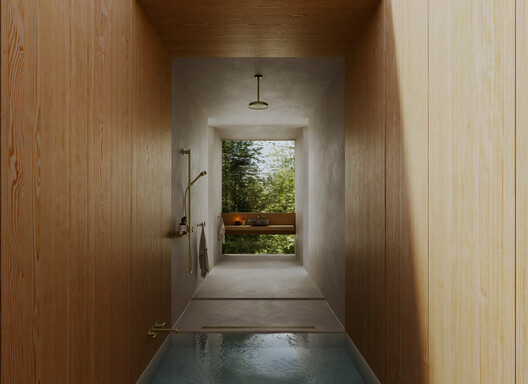
It is within this broader exploration of water as an "experience" that AXOR's collaboration with designer Haihua Zhang takes shape. The Waterway bathroom concept, developed for the 'Escape the ordinary' campaign, draws from deeply personal memories of Suzhou, China, an ancient city structured by canals where daily life unfolds in close proximity to water. Here, water is formative, shaping movement, perception, and memory. This sensibility becomes the conceptual foundation of the project, bringing architecture, body, and environment into a more immediate relationship within a light- and water-filled space. As Zhang recalls:
On summer evenings, a group of us little boys would often walk from our homes through long, narrow alleys to the river to play in the water.
A Mediator Between Experience and the Environment
The project also reflects broader cultural perspectives rooted in China, where water is central to balance and environment. Within the framework of wuxing, or five phases, water represents a phase associated with potential, inward movement, and regeneration, often linked to winter and cyclical change. Aligned with yin, it embodies softness, receptivity, and a quiet but persistent strength. These ideas have historically informed spatial practices which water mediates between human presence and the natural world.
This relationship is further articulated through feng shui, which situates architecture within a dynamic balance between the environment, the body, and the cosmos. Based on the interaction of the five elements—water, wood, earth, fire, and metal—feng shui considers how spatial organization supports well-being. Within this framework, water operates as both a physical and energetic element, guiding flow and contributing to a sense of equilibrium within a space.
Translating Waterways into Interior Spaces
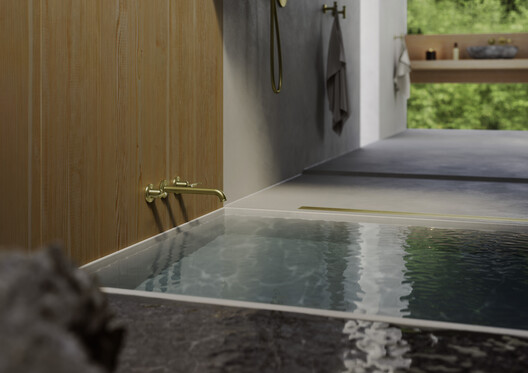
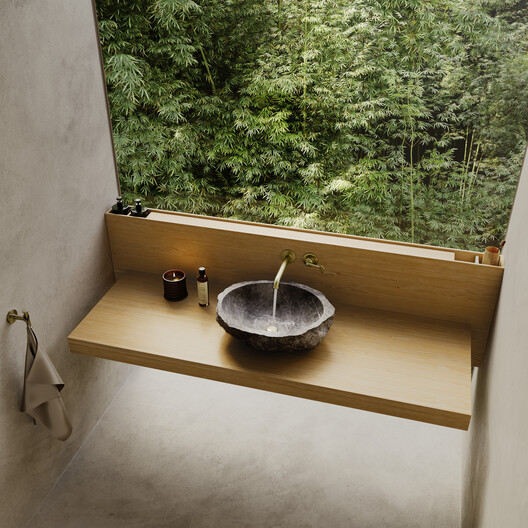
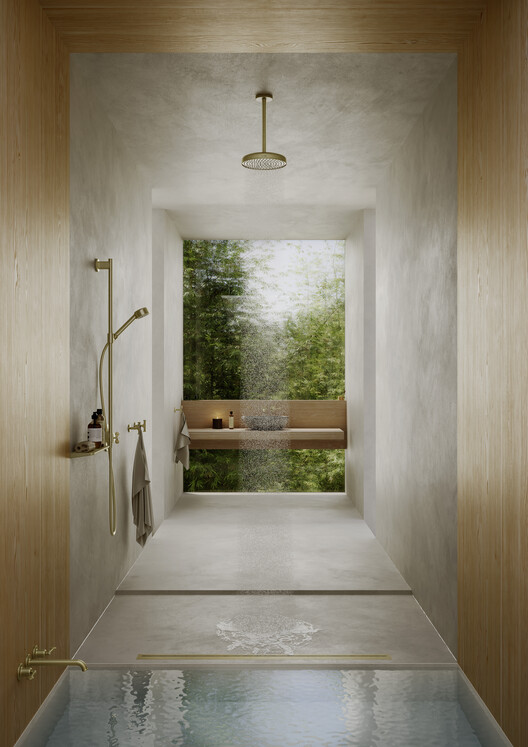
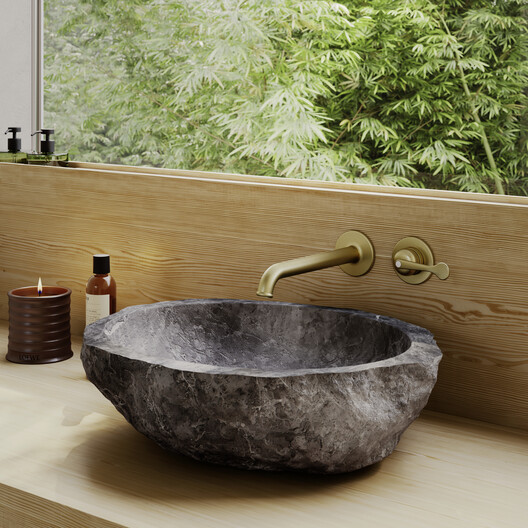
Waterway reflects these principles into a contemporary interior landscape. The bathroom is conceived as a sequence of spaces defined by water, light, and material. The layout unfolds linearly, echoing Suzhou's narrow canals. Each zone, such as the sunken, square bath, the open shower, and the floating washbasin oriented toward a bamboo grove, extends across the width of the plan, encouraging a slow, deliberate progression. Movement becomes part of the experience and daily routine: to reach the basin, one passes through shifting reflections and across textured surfaces. As Zhang envisions:
It's a space where both body and mind can slow down, return to nature, and reconnect with the state of life and the spatial atmosphere we long for.
Spatial Continuity across Material Contrast
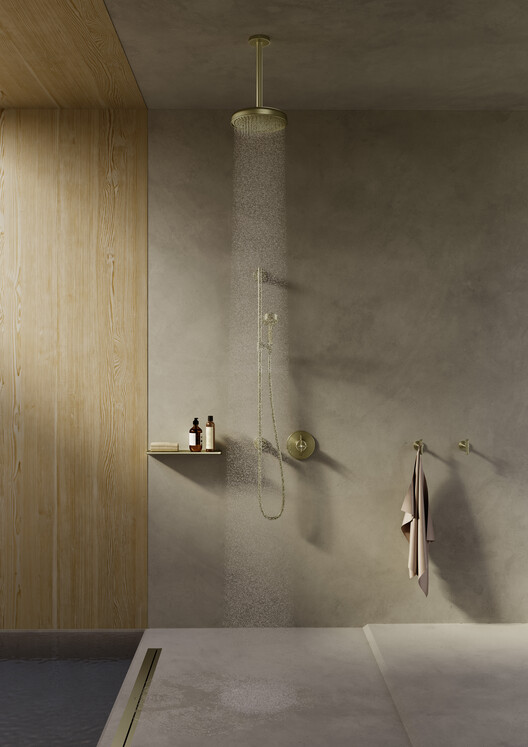
Material choices reinforce this atmospheric continuity. Koshi wood introduces warmth, texture, and scent, while microcement conveys architectural clarity. Water, paired with light from an operable skylight, creates rippling reflections that subtly shift the atmosphere throughout the day, reinforcing a mindful spatial rhythm.
Within this setting, fixtures in Brushed Brass from Barber Osgerby's AXOR Archivio collection are integrated into the overall composition. By referencing familiar, archival forms with contemporary clarity, they contribute to a coherent design language across the shower, bath, and washbasin. For the shower, Zhang pairs a hand shower and cross-handle thermostat for two functions with a 240 1-jet overhead shower; for the bath, a three-hole wall-mounted mixer with lever handles underscores the room's architectural clarity. And for the washbasin, the designer proposes a two-hole wall-mounted basin mixer combined with a custom stone basin.
What emerges is not simply a bathroom, but an architectural narrative that reconnects everyday rituals with the deeper cultural and sensory dimensions of water. By linking personal memory with spatial principles, Waterway reflects a shared concern found in both traditional Chinese thought and contemporary design practice: the search for balance between human life, the built environment, and the natural world. Water remains a powerful architectural tool, not only for its utility, but for its ability to structure space and create a closer connection between the body and its surroundings.


