

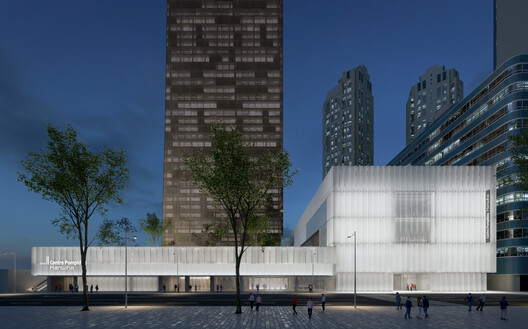
The French museum and cultural institution Centre Pompidou is opening a new Korean branch in collaboration with the local Hanwha Foundation of Culture. Well known in the architectural field for its French headquarters, designed by Renzo Piano and Richard Rogers and recently closed for renovations, the Centre Pompidou is expanding its international presence with a new venue, adding to its sites in Spain, Belgium, China, and the United Arab Emirates. The Korean building is a 12,000 m² renovation project at the base of the 63 Tower skyscraper, led by Wilmotte & Associés. Located on Yeouido Island, along the banks of the Han River, and at the heart of Seoul's financial district, the Hanwha Seoul Pompidou Center is conceived as both an exhibition venue and a meeting point where education and art converge, offering adaptable spaces to host a broad range of activities.
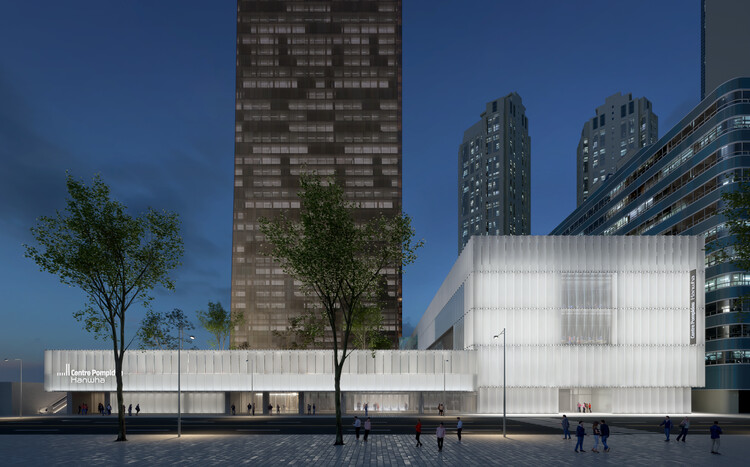
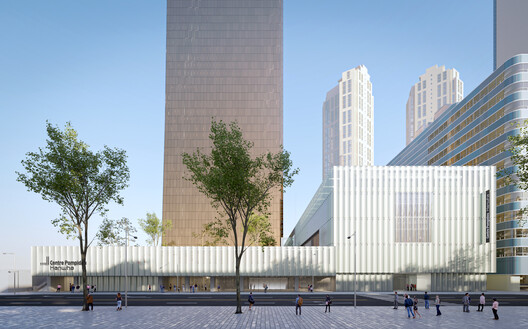
The Centre Pompidou's satellite venues in France and abroad aim to expand access to its collections and reinforce its role as a leading institution in artistic cooperation and creation. The institution seeks to transcend the boundaries of its Paris site through permanent, temporary, and international venues, reaching wider audiences, exploring new urban and cultural contexts, and experimenting with different presentations of modern and contemporary art. In Seoul, the new center follows two main objectives: to present major exhibitions drawn from the Centre Pompidou's collections and to actively contribute to artistic education and the development of emerging creative practices in Korea. The project adopts an "architecture of subtraction" within an existing building, carving into the tower's steel structure to create flexible exhibition spaces at its base that can accommodate diverse forms of artistic production.
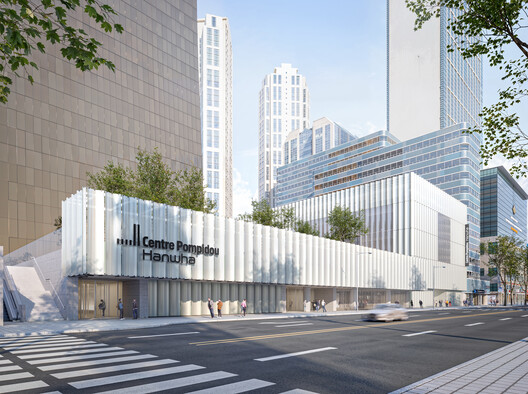
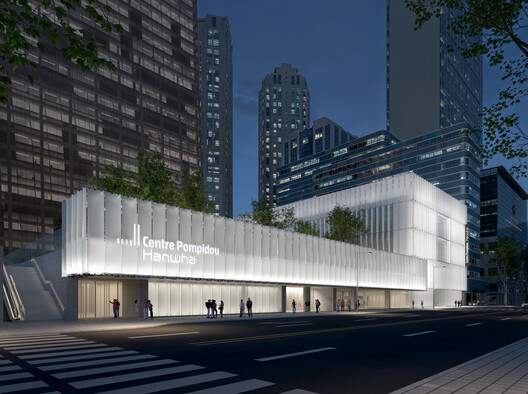
The renovation is concentrated in the podium spaces of the tower, originally used for conferences, exhibitions, weddings, and professional events. The intervention extends horizontally across five levels, occupying the full 150-meter width of the site. A new lobby organized around a large lightwell provides visitors with a strong first impression, illuminating the interior and offering views toward a sculpture garden on the first floor. The garden is paired with a multifunctional space designed for encounters, events, and contemplation. On this "promenade level," visitors will also find an auditorium and a double-height cafeteria suitable for educational activities. On the fourth floor, a restaurant and a private terrace offer views of Seoul's skyline.
Around the central hall, a double-height volume to the west houses a 1,400 m² platform for temporary exhibitions from the Centre Pompidou's collections, while to the east, Korean artistic production is showcased across two levels totaling 1,650 m². These spaces are connected by a large central void that creates new visual perspectives and fosters dialogue between works. The new podium façade appears as a line of light perpendicular to the tower, with the extension taking the form of a translucent, luminous volume. The double-skin façade is composed of large curved laminated-glass modules, each spanning the height of a full floor. On the second and third floors, two transparent layers bring daylight into the Centre's offices and public concourse areas.
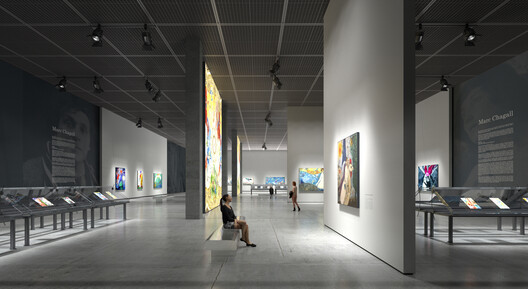
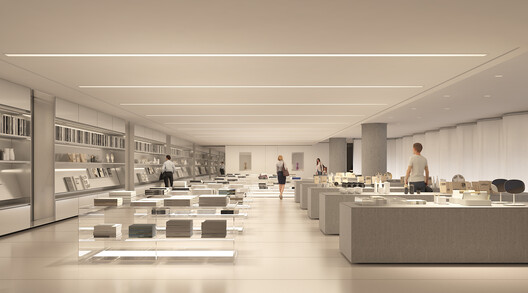
The interior design of the Hanwha Seoul Pompidou Center follows the rhythm established by the façade. Materials such as grey limestone and light-grey terrazzo form the structural backbone of the building, complemented by curved translucent glass along the circulation routes. The interplay of light reinforces the spatial continuity and symmetrical composition, contributing to a cohesive identity. The museum is scheduled to open to the public on June 4, 2026. Other recent developments in major cultural institutions include the opening of Peter Zumthor's David Geffen Galleries at the Los Angeles County Museum of Art (LACMA); a new design by BIG in collaboration with William Rawn Associates (WRA) and HASTINGS Architecture for the Tennessee Performing Arts Center (TPAC); and the opening of Kéré Architecture's Goethe-Institut in Senegal, the first purpose-built Goethe-Institut on the African continent.


