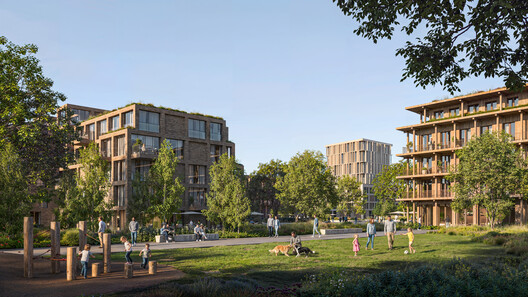
A team led by French architecture practice Coldefy, comprising CITYFÖRSTER, Sporaarchitects, TREIBHAUS.LAND, Marko & Placemakers has won the competition to design a masterplan for Rákosrendező in Budapest, with visualizations by ZOA Studio. The project is developed for the Budapest Capital Asset Management Centre, acting on behalf of the Municipality of Budapest. The design outlines a 15-year scheme to transform a brownfield site long regarded as the city's "rust belt," located on the eastern side of the Hungarian capital. The regeneration plan includes over 10,000 apartments, new transportation links, and commercial and civic spaces, forming a comprehensive urban redevelopment strategy aligned with 15-minute city principles.
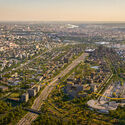
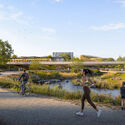
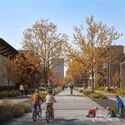
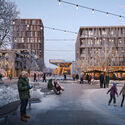
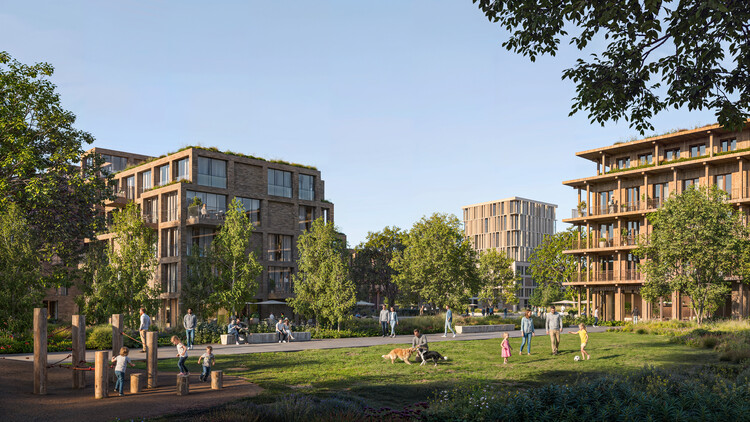
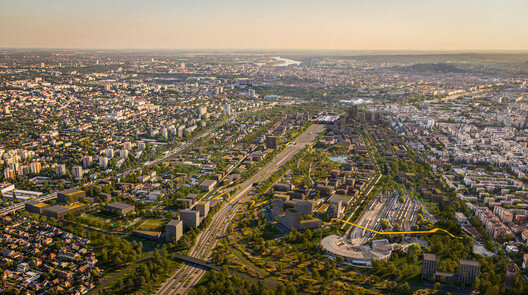
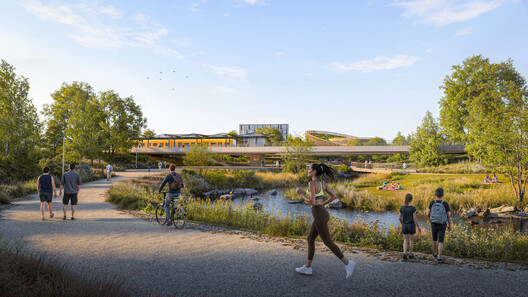
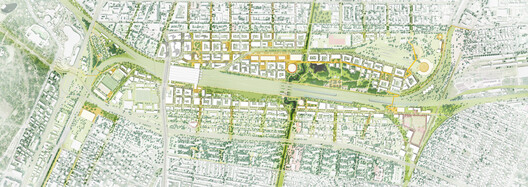
The design prioritizes landscape and ecological continuity, combining blue infrastructure (water-based networks), green infrastructure (natural spaces), and a 15-hectare Forest Park connected to the broader site through linear parks. It also proposes the renaturalization of the Rákos Stream as a meandering waterway, with public space along its reshaped banks formed by accessible terraces, paths, and rest areas. Beyond rewilding, these parks are intended to activate public life across six new sub-districts, each with its own character and linked through a continuous loop of public spaces. Each district is conceived as being anchored by its own urban center, echoing the structure of neighborhoods in Budapest's historic inner city.
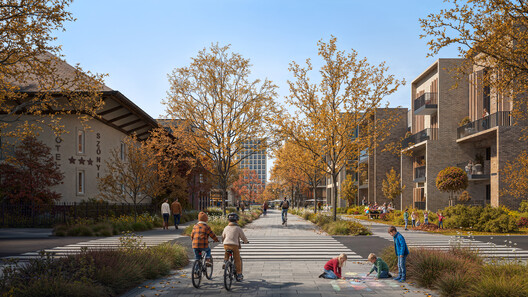
The central Forest Park is connected to a new Railway Park across an existing rail line. This second park incorporates meadows, event spaces, and a central lake. The existing Rákosrendező railway station is reimagined as a multimodal hub that anchors the masterplan's central urban district and connects to an extended metro line, a new tram line, and a network of active mobility routes. The redesigned station links the eastern and western sides of the site while positioning the area within Budapest's regional and long-distance transit network. A strong emphasis on public transport is expected to support the creation of largely car-free residential streets and squares, countering car-dependent development patterns.
Related Article
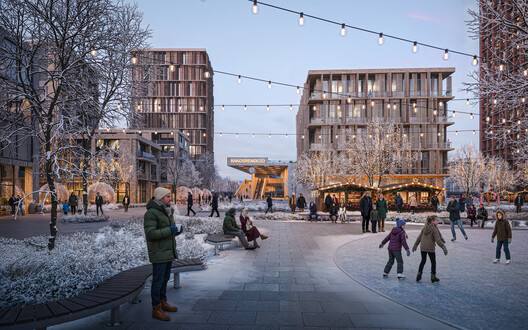
7 Unbuilt Masterplans Reimagining Urban Futures Through Ecology and Collective SpaceThe proposal also includes the adaptive reuse of former railway buildings and depots as a cultural center, incorporating a municipal library and a railway museum. In front of the Rákosrendező station, a new plaza functions as a year-round civic space for markets, cultural events, and public gatherings, featuring new trees, water elements, and shaded areas. This urban core is intended to transition into mid- and low-rise residential areas structured around a network of vegetated spaces on both sides of the railway. The surrounding area accommodates a high-density mix of offices, hotels, retail, and services. Beyond the Rákos Stream, a fragmented landscape is reconfigured into an accessible sports area with outdoor fields, recreational facilities, and an additional metro station. The project was highlighted by the competition jury for "a livable residential environment" and "the exceptional quality of its public space system."
Other recent masterplan and urban design announcements include a new masterplan for Nigeria's capital, Abuja, titled "City Walk," designed by Benoy as a mixed-use district integrating hotels, offices, residential, retail, cultural, educational, and healthcare facilities. Skidmore, Owings & Merrill (SOM) also revealed images of a landmark project in Alatau, a new city along the Almaty–Qonaev highway planned as an international investment hub for Kazakhstan. Earlier this year, Battersea Power Station appointed the strategic urban design practice Studio Egret West to evolve the original masterplan for the remaining 16 acres of the 42-acre riverside neighborhood in southwest London, and Foster + Partners unveiled the master plan for a large-scale development planned around the recently completed Dr. Antonio Agostinho Neto International Airport in Angola.


