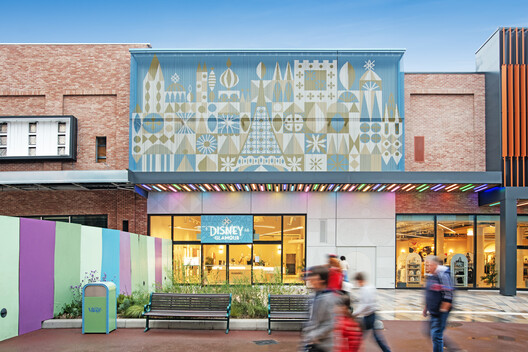
In highly-curated environments such as Disneyland Paris, architecture operates under a different set of expectations. Buildings are not only required to perform, they must also communicate, often instantly. Within this context, the facade becomes a visual marker that can serve as a threshold, mediating light, air, and perception. One strategy that has gained traction in this setting is the use of semi-opaque envelope systems. Neither fully transparent nor entirely enclosed, these facade systems introduce depth and variability.
Unlike conventional cladding, opaque threshold systems perform as filters. They temper solar exposure, enable natural ventilation, and provide privacy without severing visual continuity. These features are valuable in urban and commercial contexts, where buildings balance environmental responsiveness with experiential impact. Such systems also become carriers of narrative, embedding cultural references, patterns, or imagery into the architectural skin.
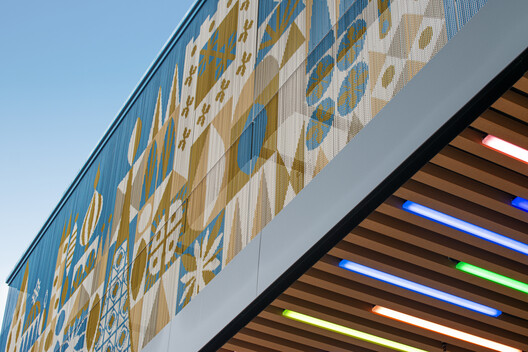
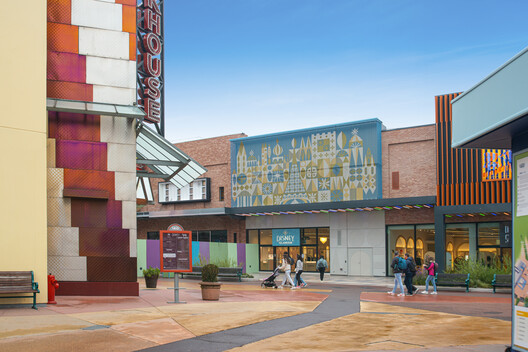
The Disney Glamour store, designed by SRA Architectes – Etienne Jacquin and inaugurated in March 2025 within Disney Village, exemplifies this approach. Located within a dense, retail district characterized by strong visual competition, the project does not rely on scale or formal complexity. Instead, its presence is established through surface treatment.
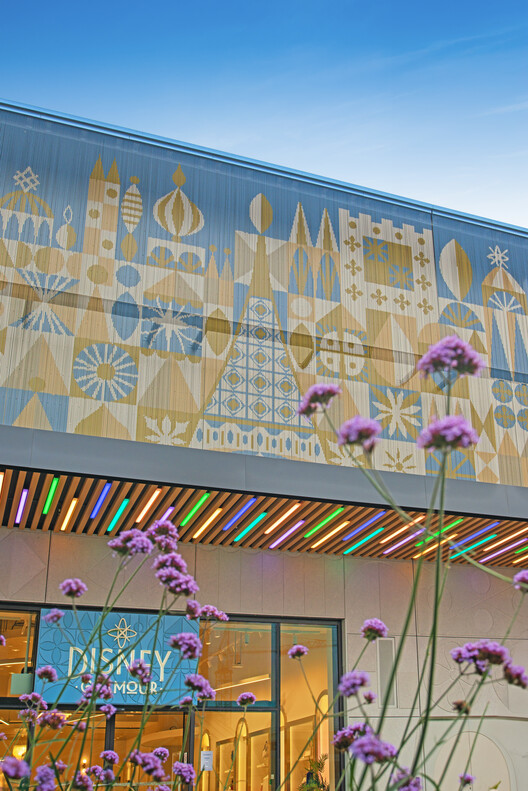
Developed using Kriskadecor's KDO Fixed System, the facade reinterprets the visual universe of "it's a small world," one of the resort's most prominent attractions and a defining work by Mary Blair. Blair's graphic vocabulary, defined by a vibrant chromatic palette, geometric compositions, and an abstracted treatment of architecture, has shaped generations of Disney environments.
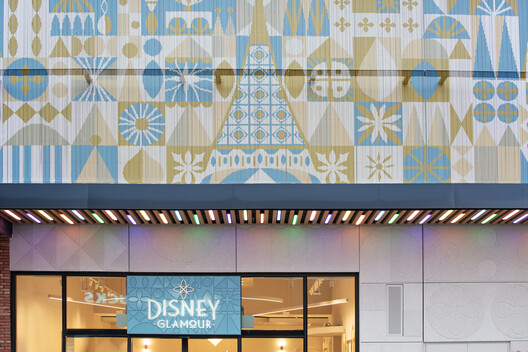
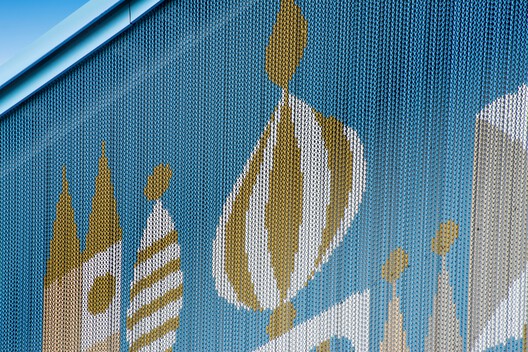
Here the facade translates Blair's approach into an architectural medium and a contemporary tribute. Thousands of epoxy-coated aluminum chains form a pixel-like matrix, creating a layered surface that resembles a collage of silhouettes—temples, minarets, and other global motifs—echoing the original attraction's rhythmic composition. The use of five carefully selected RAL colors, including bright whites, deep blues, and warm golds, reinforces this connection while allowing the facade to shift subtly with changing natural light.
Materiality and Environmental Performance
The project demonstrates the capacity of lightweight systems to address both environmental and structural demands. Measuring approximately 14.66 by 5.8 meters, the facade covers a substantial area while maintaining a minimal structural footprint. The aluminum chains, which are epoxy-coated for durability, are tensioned within a fixed framework, creating a continuous yet permeable plane.
The duality defines its performance. From the outside, the facade reads as a solid, cohesive surface, reinforcing the building's presence within the dense visual environment of Disney Village and contrasting with the surrounding brick facades, adding texture, color, and privacy. From the inside, however, the system ensures outward visibility and contributes to passive environmental control. Promoting natural ventilation and reducing direct solar gain, it helps regulate internal temperatures without relying solely on mechanical systems. At the same time, its tested resistance to high wind loads, exceeding 210 km/h, ensures long-term stability in exposed conditions. Its color stability is also tested through extended UV exposure, up to 10,000 hours under adapted UNE-EN ISO 11341:2005 protocols.
Material choice is central to this approach. Aluminum, a lightweight and corrosion-resistant material used in Kriskadecor's chains and profiles, enables large-scale applications while remaining fully recyclable. Its adaptability, stability, and hardness, achieved through anodizing and coating processes, also support a wide range of colors, densities, and sizes, enabling the facade to function as both technical infrastructure and an expressive surface.
Art Translated into System
The Disney Glamour reflects a broader shift in commercial architecture, moving beyond applied branding to integrated visual systems. Instead of applying artworks onto finished surfaces, chain-based facades embed imagery directly within the material logic of the building. Patterns, gradients, or figurative compositions can emerge through density, color variation, and layering.
For architects, seeking to work with more abstract or artistic expressions, such systems offer flexibility. From monochromatic textures to high-resolution graphic compositions, the facade becomes a customizable field that accommodates diverse design intentions without compromising performance.
Applications Beyond the Facade
The lightweight, flexible nature demonstrated in the Disney Glamour project can be applied to more than just exterior facades. Opaque threshold systems are used across a range of interior building types and scales. In public and cultural buildings, similar systems serve as visual identifiers and ceiling features. In workspaces, they appear as space dividers or wall treatments that maintain openness while subtly defining boundaries. In hospitality environments, immersive atmospheres are created through layered lighting, color, and movement. In temporary installations, they offer lightweight, adaptable structures that can be assembled and disassembled efficiently. In each case, the system's ability to mediate between spaces and thresholds allows it to respond to both functional and experiential demands.
What connects these applications is not the material alone, but a way of viewing the transitions through architectural spaces as a sequence of thresholds rather than a set of divisions. The facade becomes one layer among many, each with its own opacity and function, each contributing to the building's overall performance and perception.
In this sense, opaque threshold systems are not defined by how much they conceal, but by how precisely they filter. They offer a way to design buildings that are less about separation and more about modulation and structures that respond to their surroundings while remaining open to interpretation.