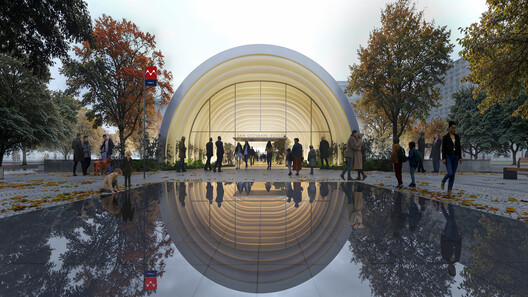
UNS's design proposal for Turin's new Metro Line 2, developed in collaboration with Settanta7, Mijksenaar, Frigorosso, 3BA, and WSP, has been selected by an international jury of experts chaired by Dominique Perrault. The proposal is based on the idea of "flow," a concept that has historically shaped the Italian city, from the Po and Dora rivers to the 18 kilometers of arcaded porticoes that structure how residents and visitors move. The project envisions Line 2 as a new "urban river," guided by three design principles to facilitate this flow: branding, transit experience, and scales of identity. With 32 stations planned in total, the initial design phase includes 10 stations, among them Mole Giardini, San Giovanni Bosco, and Carlo Alberto.
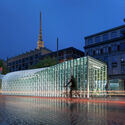
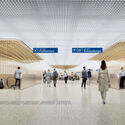
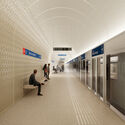
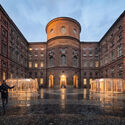
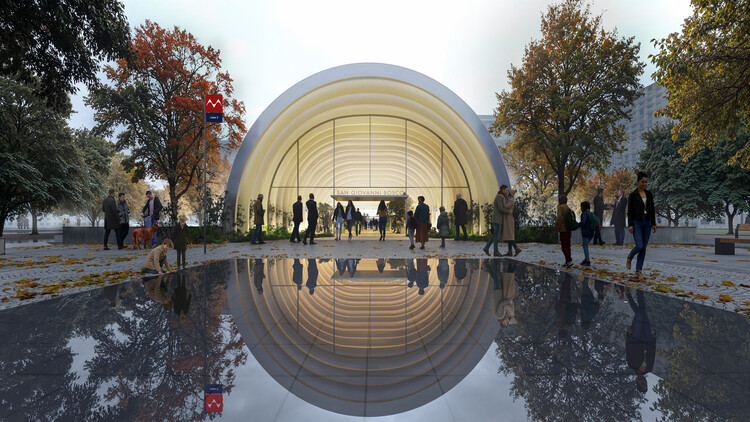
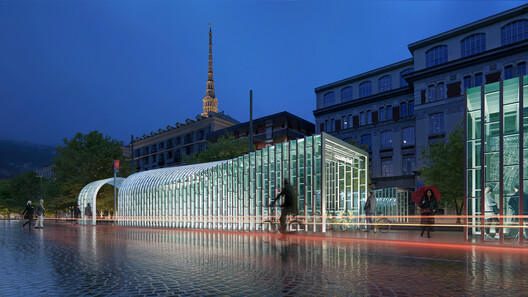
The project draws on the city's porticoes, its industrial heritage, and its more recent association with culture, creativity, and gastronomy. Based on the concept of "transition," the design reflects the contrast between Turin's sober façades and its richer, more detailed interior spatial experiences, combining traditional and contemporary architectural languages to engage with the city's history. Recognized for its reimagining of the subway as an act of city-making, the jury emphasized how the design strengthens the relationship between mobility, public space, and the urban context. They also noted its potential to shape how users move, work, and live through a design "that will stand the test of time."
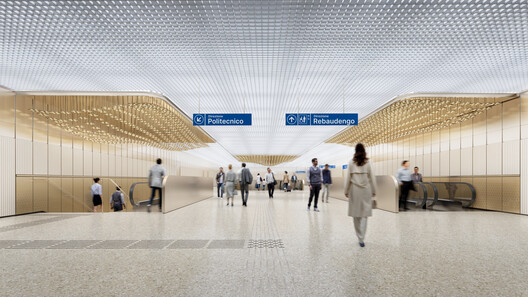
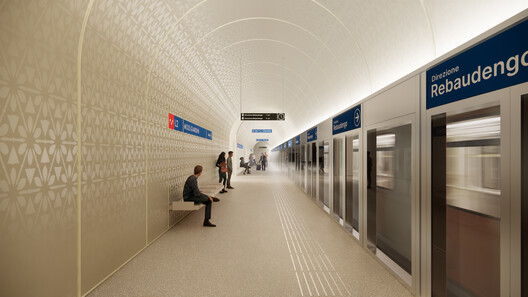
The architects developed a modular architectural language that adapts scale, proportion, and program to different station sites without losing clarity, while maintaining a consistent visual and spatial logic across all 32 stations. To ensure coherence, UNS defined three identity criteria: Network Identity, which translates the concept of the "urban flow experience" into a unified language of signs, geometries, materials, colors, and messaging; System Identity, which coordinates urban elements extending into surrounding neighborhoods; and Station Identity, which allows each location to respond to its specific context through art, landscape design, and local references.
Related Article
Mobility Justice: Urban Equity in an Era of InnovationThese three layers of identity enable the metro to function as a coherent network while giving each station its own character, establishing a distinct public presence, and clearly communicating disruptions during construction. The system's brand language draws on Turin's mountains, porticoes, and waterways to create a recognizable graphic and spatial logic, while the color palette transitions from warm yellows and ochres to greens and blues across all public-facing elements. This language is applied not only to signage and spatial communication but also to campaigns, stationery, merchandise, digital platforms, and the project's tone of voice. As a spatial communication system, it supports effective wayfinding, while station-specific identities create distinct points of reference, making each stop easier to recognize and navigate.
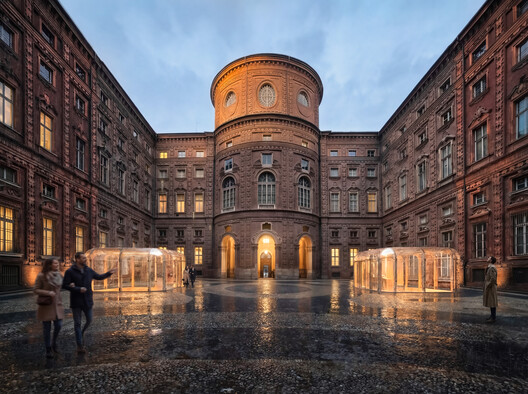
For Turin's new Metro Line 2, we wanted to create more than a transport system. We wanted to design a new civic connection for the whole city, one that brings Turin's history and its future into direct conversation. What is especially important is that this metro is truly public in spirit: it feels open, safe, and welcoming, with stations and entrances that extend the public realm so that, in places, the park meets the metro and infrastructure becomes part of the city's shared social space. ― Ben van Berkel, UNS
The stations' interior design conceives the metro system as a continuous public experience shaped by movement, orientation, material quality, and locality. Underground spaces are designed to offer a warmer identity, becoming contemporary "jewel boxes" that transform transit into a sensory experience. This identity extends across the full passenger journey, from ticket purchase and online trip planning to approaching and entering the station, navigating within it, reaching the correct platform, and boarding the train. The journey is analyzed as a connected sequence of digital and physical touchpoints. Materials selected for finishes include aluminum and porcelain stoneware, while diffused lighting and terrazzo-inspired flooring link historical memory with contemporary infrastructure.
Other recent urban design project announcements include the start of construction on Settanta7's Bosco della Musica regeneration project, a new campus for the Conservatorio Giuseppe Verdi located in a former industrial area in southeastern Milan that is currently transforming. The Spanish laboratory for urban innovation, Concéntrico, has also announced the program for its upcoming edition in Logroño this June, where 26 teams, including Pritzker Prize laureate Smiljan Radić, will intervene in the city's public space with projects ranging from climate-responsive structures to ephemeral activations. Earlier in March, RSHP won a competition to redevelop the Rives-Défense site in La Défense, Paris, envisioning the transformation of an 8-hectare area at the western edge of the district into a low-carbon mixed-use neighborhood.


