This week, architecture presents new visions of the future across a geographically diverse landscape, with landmark projects and renewal initiatives emerging in Saudi Arabia, Taiwan, Bahrain, Germany, Italy, Australia, Morocco, and Burundi. New platforms for discussing urban futures highlight decolonization and the climate crisis as central priorities for contemporary architectural practice. At the same time, contrasting perspectives on urban regeneration are reflected in both the demolition of recent landmark structures and the large-scale transformation of industrial sites. On another note, the Olympic Games continue to act as catalysts for architectural production, as seen in the proposal for a new sports center in Australia for Brisbane 2032. This momentum coincides with major international infrastructure developments in Africa, including a new airport terminal in Morocco, as well as projects that rethink spaces for research and public engagement, such as a new building for the German Language Forum.
Disciplinary Reflections for a Decolonized Future and a Planet in Transition

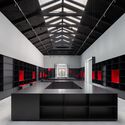
Across this week's announcements, major and new international platforms highlight a growing disciplinary shift toward more inclusive, adaptive, and critically engaged architectural futures. The first Pan-African Biennale positions itself as a new forum for African-led narratives, advancing a decolonized approach to architectural thought and practice rooted in local knowledge and transnational exchange. In Europe, the UIA World Congress of Architects 2026 Barcelona announced a program structured around six thematic "Becomings," framing architecture as an evolving field responsive to planetary transitions, from ecological change to social transformation. Meanwhile, in the context of the upcoming opening of the 61st Art Biennale, La Biennale di Venezia unveiled the renovated Central Pavilion at the Giardini, in a quest to reaffirm the role of institutional spaces in shaping contemporary discourse while updating its physical and curatorial framework.
Related Article
The First Pan-African Biennale Establishes a Platform for a Decolonized, African-Led Architectural Future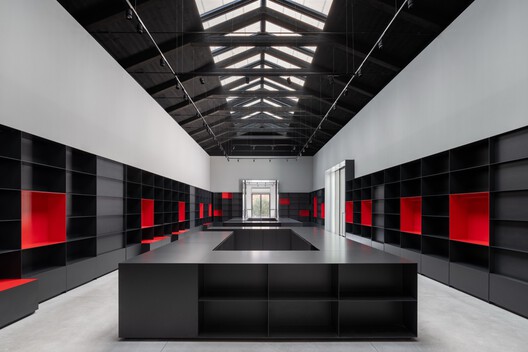
Demolition and Regeneration: Two Urban Transformation Projects in Bahrain and Italy
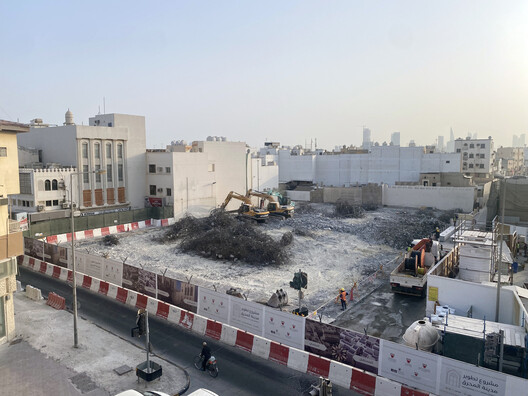
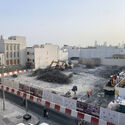
This week's developments also foreground contrasting yet interconnected approaches to urban transformation. In Muharraq, Bahrain, a series of car park structures designed by Christian Kerez as part of the Pearling Path heritage site are being dismantled, marking a critical reassessment of recent architectural interventions within a UNESCO World Heritage context and raising questions about preservation, authorship, and the evolving priorities of urban heritage management. Meanwhile, in Milan, Settanta7 advances the Bosco della Musica project, a large-scale regeneration initiative that reclaims a former industrial site to create a new campus for the city's Conservatorio Giuseppe Verdi, integrating educational, cultural, and public functions within a reconfigured urban landscape. Both cases show how the removal of existing structures and the redevelopment of underutilized areas serve as opposing mechanisms to renegotiate cultural value, spatial identity, and propose long-term urban futures.
Landmark Architecture Projects in Taiwan, Saudi Arabia, and Burundi
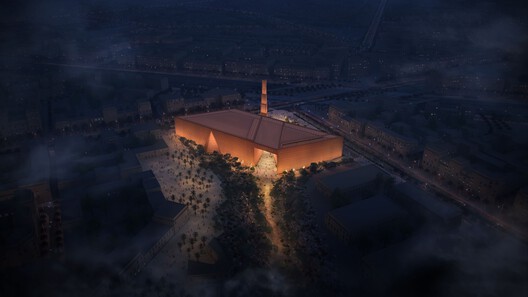
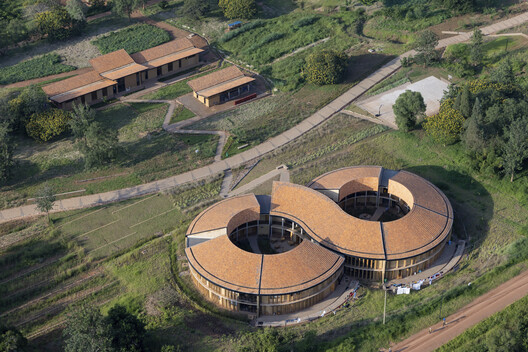
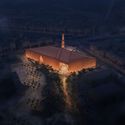
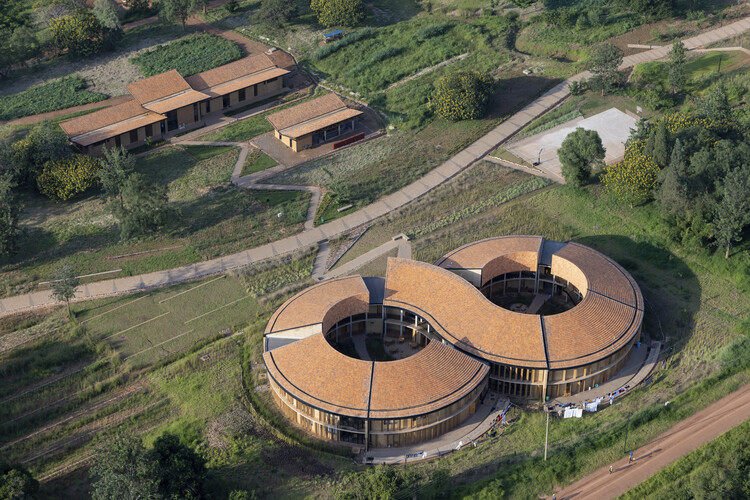
Three distinct project announcements brought together contrasting architectural approaches shaped by urban density, cultural continuity, and material resourcefulness. In Taipei's Xinyi District, OMA's Metropolitan Village advances toward completion as a 23-story "vertical village," where stacked and interlocking volumes, differentiated façades, and a porous ground level negotiate the surrounding urban fabric while accommodating hybrid living and working environments. In Saudi Arabia, X Architects' Grand Mosque for the Diriyah Gate development draws on Najdi architectural traditions and the site's landscape to organize spaces of worship, gathering, and movement within a spatial framework that responds to both heritage and large-scale urban development. Meanwhile, in Burundi, Kéré Architecture's Ineza Clinic healthcare center is conceived as a series of pavilions distributed across a sloped site, employing locally sourced materials, passive environmental strategies, and community-based construction to create a climate-responsive and socially embedded model of care infrastructure.
On the Radar
RSHP Designs H-shaped Mohammed V Airport Terminal with Modular Construction and Undulating Roof
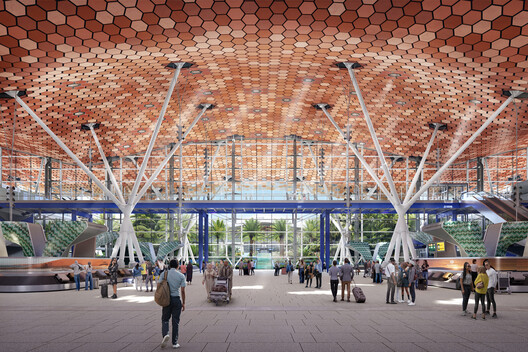
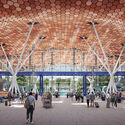
RSHP's design for the new terminal at Mohammed V Airport in Casablanca is part of a major infrastructure initiative launched by the National Office of Airports (ONDA). Conceived as a high-capacity hub handling up to 20 million passengers annually, the terminal adopts an H-shaped plan to optimize aircraft access, passenger flow, and connection efficiency in line with international standards. The architecture is defined by a modular construction system enabling rapid, component-based assembly, while its undulating roof embeds a geographic Atlantic reference within the building's formal expression. The interior features an ochre-toned soffit structured with a hexagonal pattern and punctuated by rooflights, referencing traditional Moroccan materials such as bejmat and terracotta zellige, and allowing daylight to enter the building. Organized across three primary levels, the terminal combines operational clarity with spatial amenity, incorporating interior green areas, retail and hospitality zones, and panoramic views over the airfield. The project extends beyond the terminal building to include a new parallel runway, control tower, and aviation infrastructure. The new terminal is expected to be integrated with Morocco's high-speed rail network to strengthen multimodal connectivity. Preparatory works for the project were completed in 2025, the construction was awarded in 2026, and initial operations are targeted for 2029 as part of Morocco's broader "Airports 2030" vision.
HENN's Hybrid Museum and Research Hub in Mannheim Bridges Language, Architecture, and Public Space
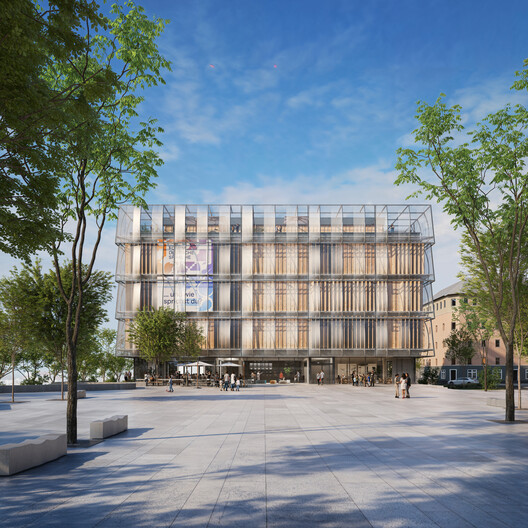
HENN's Forum Deutsche Sprache (German Language Forum) project in Mannheim was awarded first prize in 2021, with construction set to begin in 2026 and completion expected in 2028. The building is conceived as a 4,700 m² hybrid museum and research facility defined by its spatial openness, layered envelope, and integration of public and institutional programs. The building is organized around a largely glazed ground floor, which supports an open forum that functions simultaneously as a lobby, exhibition interface, and gathering space. Above this base, three projecting upper volumes extend outward, generating a sense of suspension. The exhibition sequence is structured vertically, beginning at the top level and descending through interconnected floors, where interactive environments are interwoven with integrated office spaces, allowing research activity to remain visible within the public realm. A concrete skeleton structure remains exposed throughout, with beams and columns subdividing the interior into distinct zones that accommodate different exhibition themes. This structural clarity is complemented by a multilayered façade system composed of alternating timber frame elements and post-and-beam assemblies fitted with adjustable wooden louvers, all set behind a fixed ETFE outer layer that enhances environmental performance and formal depth.
Populous Designs Climate-Responsive Moreton Bay Indoor Sports Centre for Brisbane 2032
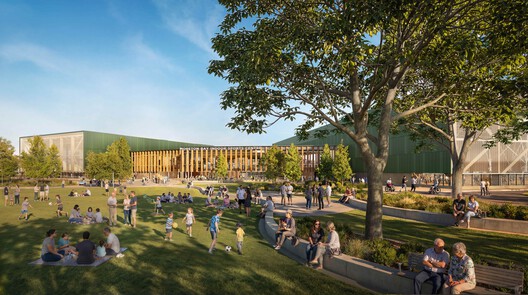
Populous' Moreton Bay Indoor Sports Centre, appointed as part of the Brisbane 2032 Olympic and Paralympic Games infrastructure program, is conceived as a high-capacity indoor arena defined by its integration of indoor and outdoor spatial systems. The building accommodates 12 multi-use courts within a flexible layout designed to support a range of sports, while expanding to a capacity of 10,000 spectators during major events. The project prioritizes passive design strategies, with an emphasis on capturing natural breezes and daylight to shape interior comfort and spatial quality. This approach is reinforced by the extension of activity beyond the enclosed volume, where outdoor green spaces operate as complementary gathering areas for recreation and public use. The inclusion of amenities such as a café and athletic facilities further supports the building's role as a multifunctional environment, while its position within a broader precinct framework consolidates it as a central destination structured around collective use. Construction is anticipated to begin in 2027, and the completion is to be aligned with the 2032 Games.
This article is part of our new This Week in Architecture series, bringing together featured articles this week and emerging stories shaping the conversation right now. Explore more architecture news, projects, and insights on ArchDaily.


