Having thrown a stone today, Eshu kills a bird of yesterday. The Yoruba proverb tells both a story of reparation and of ancestrality by joyfully bending spacetime conventions and accessing subjects from the past with present actions. The saying offers a poetic entry point to broader West African traditions and to the practice of Scottish-Nigerian artist and architect Dele Adeyemo. Named one of the winners of the ArchDaily 2025 Next Practices Awards, Adeyemo's work brings together ecology, spirituality, dance, and territory, examining how embodied cultural practices can generate alternative spatial possibilities within and against the architecture of racial capitalism.
Born in Nigeria and raised in the United Kingdom, Adeyemo has been visiting Lagos for many years. Through this engagement, he has developed an extensive body of research on collective movement practices that predate capitalism and offer distinct, often imaginative spatial intelligences operating alongside dominant systems. ArchDaily spoke with Dele about his artistic and pedagogical practices, and how he identifies design sophistication where architects often perceive deficiency.

Arguing that masquerade and other forms of embodied choreography organize space, he describes dance as a bridge between material and spiritual worlds, connecting the visible and the invisible. In this interview, Dele reflects on the ecological pressures generated by urban growth, the contradictions of racial capitalism, the lifeworlds of coastal communities, and how these dimensions converge in his artistic work.
Related Article
20 Practices Shaping the Future of Architecture: Winners of the ArchDaily 2025 Next Practices Awards
Romullo Baratto (ArchDaily): You've been working in Lagos for quite some time now. Could you speak about this long-term engagement and how it frames your work?
Dele Adeyemo: My interest in Lagos began personally. I'm Nigerian, grew up in the UK, and I have been returning for many years. Initially, my curiosity was almost touristic. Like many in the diaspora, I found myself documenting street life, markets, and everyday spaces, making short video clips of these moments. But gradually that curiosity evolved into a more methodical architectural inquiry.
My PhD focused on Africa's urban transition more broadly, with Lagos as one of its key case studies. Through that research, and particularly through relationships with artists and dancers, I began to access parts of the city I might not otherwise have encountered. I was invited into lagoon-side communities, especially Oworonshoki, and it was through those interactions that my understanding deepened.
What became clear is that these communities are entangled with indigenous lagoon practices, like fishing, sand filling, subsistence economies, but also with rich cultural traditions. Dance, for example, is not simply entertainment; it is a form of community-making. Masquerade is not merely performance; it is a spiritual practice that connects people to the earth, to ancestors, to intergenerational knowledge. Through engaging with these communities, I began to see that the lagoon is not just a geographic feature. It is an ecological, social, and cosmological lifeworld shaping how space is produced and inhabited in Lagos.

RB: Your research focuses on what you call the Black Radical Spatial Imaginary, tracing the contours of Black social life and its movements. Could you please explain this concept?
DA: Before speaking about the Black Radical Spatial Imaginary, it's important to situate it within the idea of the Black Radical Tradition, a concept developed within Black studies and articulated most clearly by Cedric Robinson in the book Black Marxism. The Black Radical Tradition, at its core, recognizes that radical politics — anti-colonial politics, liberation struggles, resistance to racial oppression — are embedded in the cultural practices of ordinary black people. In other words, radicalism is not located in theory alone; it is located in everyday life.
When I speak of the Black Radical Spatial Imaginary, I am extending that idea into the realm of space. I am suggesting that everyday black cultural practices do not only produce politics — they also produce space. They generate spatial forms and spaces of liberation.
In my research, I locate this spatial production in dance and embodied movement. In Lagos, what I call the Black Radical Spatial Imaginary emerges through collective movement: dance gatherings, performance, ritual. When people come together in these embodied practices, they are not merely occupying space; they are shaping it. They create spaces of enjoyment, solidarity, and social engagement, often in areas marked by extractive urban development or infrastructural neglect.

But these practices are not only contemporary responses to urban precarity. They are rooted in a much longer genealogy. They carry forward cultural logics that predate colonialism and capitalism. In the context of Lagos, the Black Radical Spatial Imaginary names the ways in which embodied cultural practices, especially dance, generate alternative spatial possibilities within and against the architecture of racial capitalism.
RB: Your project Wey Dey Move operates at the intersection of rapid urban growth in West Africa, ecological crisis, and pre-colonial spiritual practices. How do these layers converge in your work more broadly?
DA: Perhaps it's helpful to approach your question through an example: In the film Sinners, there's a moment when a character recounts a painful story under conditions of racial oppression. As he speaks, grief escapes his body as a kind of cry, a raw, almost involuntary sound. That cry transforms into rhythm. In that moment, we witness something like the birth of the blues.

What interests me there is that the sound exceeds the violence that produced it. It is not simply a reaction; it becomes a transmutation, resistance. And blues, as we know, is not only music — it is spiritual, soulful. It connects to a form of intelligence beyond the purely rational or visible. That gesture that transforms grief into rhythm and collective expression is central to the Black Radical Tradition. It is about accessing knowledge beyond the tangible. It is a cosmological relationship: a connection between the material world and forces that exceed it.
Through my own engagement with Yoruba heritage and spiritual practice in Lagos, I've come to understand that aesthetic practices, like dance, are precisely about creating this bridge between worlds. Dance connects the material and the ancestral, the visible and the invisible, the living and the spirit. It is through that bridge that society and space were historically organized in pre-colonial West Africa.
Colonialism and slavery did not destroy this knowledge. They were suppressed, enveloped by the colonial plan, but they did not disappear. As West African cities modernized, these cosmotechnical practices were absorbed into urban life. They persist within it. In Lagos, modernization plans, whether colonial or contemporary, operate under the assumption that becoming a megacity requires erasing these other modes of organizing life. In reality, those modes continue to exist, and they often undermine the ontology of racial capitalism. They produce ways of organizing society that are not primarily extractive.


This is where urban expansion, environmental pressure, and cosmology converge in my work. Take the lagoon-side communities: Architecture there is not produced through speculative planning or profit-driven development. It emerges from collective ritual practices, like fishing, sand mining, performance, and masquerade. These practices form a parallel economy, operating alongside but not reducible to the formal economy. Architecture, in this context, is not imposed from above. It coalesces from movement.
When we look at the lagoon, the mangroves, urban expansion, and spiritual cosmology, they are not separate layers. They are entangled movement systems. And from their entanglement, different spatial possibilities emerge; possibilities that exceed the extractive paradigm of racial capitalism.
RB: You suggest that dance organizes space. Is it possible for these embodied choreographies to operate at a scale that challenges conventional urban planning practices?
DA: The question of scale is always difficult. Capitalism constantly asks: how can this model be scaled? That's the entrepreneurial logic. But the Black Radical Tradition does not operate that way. It is not about producing an alternative hegemonic system. In fact, what makes it powerful is that it is not centralized or controlled by a singular authority.

As designers, we are often trained to think in terms of top-down organization. But what if the work is not to impose a model, but to recognize what is already happening? In West Africa, movement culture — dance, performance, gathering — is a mass phenomenon. It is not marginal. It responds directly to the needs and conditions of everyday life. These practices already organize space. They already generate social infrastructure. The challenge is that formal development often undermines these movements. Large-scale urban projects frequently erase the communities and spatial practices that sustain them.
So the difficulty is not whether embodied choreography produces space — it does. The difficulty is how to design in relation to it, rather than against it. Collective movement establishes territories of belonging, rhythms of gathering, modes of circulation, and forms of social coordination. It produces spatial order — but not through a master planner. It emerges relationally.
This is not a speculative future alternative. These practices have existed since pre-colonial times and continue today, even within the megacity. The question is whether we can recognize them as legitimate spatial intelligence, and whether architects are willing to work with that intelligence instead of displacing it.
RB: This intelligence seems to collide directly with extractivist logics that have subjugated much of the Global South for centuries. In that sense, could the lagoon and its ecology offer a counterpoint to the extractivist production of space?
DA: I see the city as the result of innumerable movement rituals coalescing and synchronizing. One way of understanding the urban environment is through the singular perspective of capital. But there is another way to see the city: as the outcome of countless entangled movements. Some are planned by capital; others emerge from everyday life.

Urbanists might describe these as circulation systems. Others might speak of metabolism. Henri Lefebvre spoke of rhythmanalysis and the production of space. What I'm suggesting is that dance is a crystallization of some of these rhythms. It makes visible the embodied patterns through which space is continually produced.
In Lagos, what becomes particularly clear is how central informal movements are to the life of the city. In fact, they are essential not only to urban life, but to capital itself. Capital accumulates wealth through formal channels, but that accumulation depends on enormous amounts of informal labor.
Take Oworonshoki, the lagoon-side community I've been working with for several years. It preserves lineages of pre-colonial organization through dance and subsistence fishing. These practices allow people to exist partially outside full capitalist incorporation. Yet within the same community, residents also engage in artisanal sand mining. That sand feeds directly into the construction industry and speculative real estate development. The developments that rely on their labor are often the very ones that threaten their displacement. In a sense, the system consumes itself.

This is what I mean by racial capitalism. From its origins, capitalism has depended on forms of labor positioned outside its own formal structures, on exploitation within informal economies. Without those zones of extraction, the formal economy cannot function. The high-value products of the developed world depend on raw materials and labor acquired at extremely low cost elsewhere. In Lagos, this interdependence is spatially visible. The exploited bodies, the exploited ecologies, and the infrastructures of accumulation coexist within the same geography. Modernization promises improved living standards, but its mechanism is exploitation. So when we ask whether the lagoon offers a counterpoint, I would hesitate to frame it as an oppositional system. Rather, it reveals something fundamental: capitalism depends on ways of being that it neither fully comprehends nor controls.
From a modernist perspective, we tend to believe that institutions, such as schools, courts, prisons, and ministries, produce society. But in West African cosmology, society was historically organized through ritual performance and embodied social relations. These were the institutions. In that sense, dance is not merely expressive. It is infrastructural. It produces community and space.
This is a different spatial paradigm. It does not seek to replace the dominant system with another centralized structure. It persists alongside it. And because it cannot be easily controlled, state institutions operating within colonial planning logics often perceive it as a threat.
The lagoon, then, is not simply a counterpoint. It is a reminder that other spatial intelligences continue to exist within the heart of the megacity.
RB: Dance is clearly central to your research, but your practice also engages film, drawing, sculpture, and installation. How do these other art forms relate to your work? Are they simply representational, or tools that actively shape your inquiry?

DA: My installations are deeply inspired by the material culture of West Africa, particularly Yoruba culture. It is an extraordinarily rich artistic tradition. My interest, however, is not simply formal. I'm drawn to the artifacts that support and embody movement rituals: masquerade masks, divination objects, and fishing technologies. These are not merely aesthetic objects; they are cosmotechnical devices. Their design encodes both a movement practice and the cosmology that underpins it.
Take the divination board — the ọpọ́n Ifá — as an example. Traditionally, it is a carved wooden tray filled with sand (iyẹ̀rọ̀sùn). The bàbáláwo performs divination by inscribing marks into the sand while reciting verses of the Odù. It is a ritual practice for navigating uncertainty, accessing ancestral knowledge, and interpreting the conditions of the present. What fascinates me is that this centuries-old practice contains a highly sophisticated binary system — a form of computation embedded within ritual. It is, in a sense, a machine for accessing knowledge beyond the material dimension.

When I design installations inspired by the ọpọ́n Ifá, I am not simply referencing its form. I am engaging its cosmology. I am asking what it means to treat space as multidimensional, as something that connects material reality to ancestral, ecological, and spiritual knowledge. Under capitalism, land is reduced to a commodity. It is something to be divided, owned, traded. But if space is understood as multidimensional, then the act of drawing arbitrary property lines on a plan begins to feel profoundly inadequate.
Film, sculpture, and installation are not secondary to the research. They are extensions of it. They allow me to materialize cosmologies, to stage spatial experiences that challenge the extractive ontology of modern planning, and to invite audiences to encounter space differently; not just intellectually, but physically and cosmologically.

RB: You mentioned the ọpọ́n Ifá, and I think this connects directly to another project of yours, The Cosmogony of (Racial) Capitalism. Could you talk about this other work?
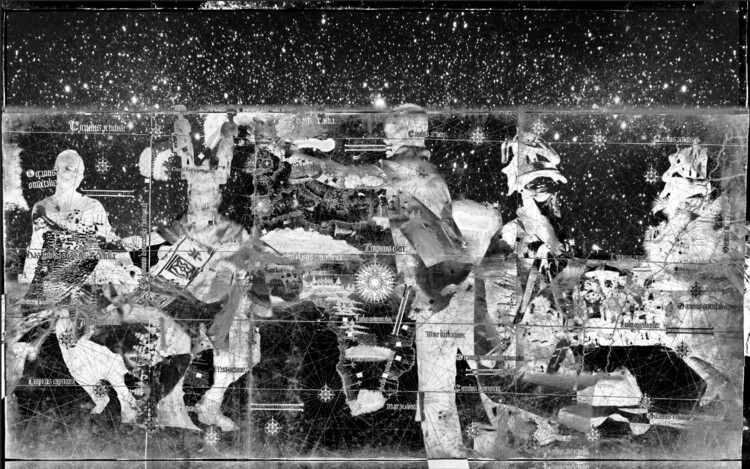
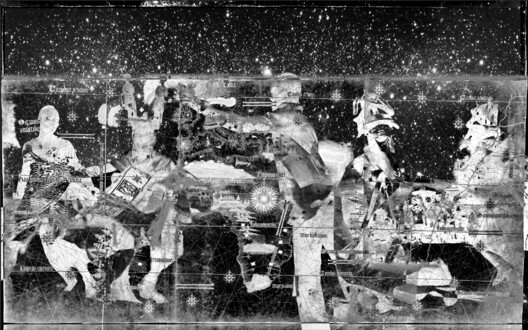
DA: In this project, I developed what I call a trans-cosmological cosmogram, which is essentially a drawing tool, an architectural instrument, designed to hold multiple cosmological perspectives within the same frame. I juxtapose the Cantino planisphere — an early European map that frames territory as something to be captured and exploited — with spatial diagrams embedded in West African material culture.

One important symbol within the drawing is the cross. In Western cartography, the cross often means a spot marked in space, a point of extraction or conquest. In many West African cosmologies, however, the cross represents the intersection between material and immaterial realms. It marks the crossing of dimensions. Accessing that intersection requires ritual movement — through divination, through dance, through embodied practice.
This is precisely what colonialism and capitalism sought to suppress. If people have access to dimensions of existence that exceed material control, then they cannot be fully governed through extraction alone.
Much of my work, then, is about recovering the meaning of West African material practices as forms of resistance in sustaining alternative ways of knowing and being. Dance and performance are central because they keep those cosmologies alive. And the installations attempt to materialize a multidimensional understanding of space — one in which the material, ancestral, ecological, and social are inseparable. And in doing so, they gently destabilize the extractive, planar logic through which capitalism understands land.

RB: You've recently concluded your PhD at Goldsmiths and are now teaching through the Obel Fellowship. How does your research in Lagos inform your pedagogy?
DA: For me, research is never purely textual. It emerges from embodied experience, interviews, reading, and theory, but it must return to the body. When research is reorganized artistically, through drawing, installation, film, it requires people to move through it, touch it, inhabit it. That produces a different kind of understanding: not only intellectual, but physical and even spiritual.
When I was teaching at the Royal College of Art, I introduced the cosmogram as a way of mapping a site differently. Architecture students are trained to produce site plans that reflect capitalist apprehensions of territory, such as ownership, zoning, infrastructure. The cosmogram invites them to hold multiple ways of knowing a site within the same frame. Each place has its own cosmology that exceeds capitalism.
What was remarkable is that students applied this tool in entirely different contexts — in the UK, India, China — and reinterpreted it according to local conditions. It allowed them to recognize tensions and entanglements within a site that would otherwise remain invisible.

Later, through the Obel Foundation teaching fellowship in Lagos, the work became more pragmatic. The architectural ecosystem there is deeply oriented toward real estate development and short-term profit. There is little institutional space for alternative knowledge systems. So I took students to Oworonshoki — often described as a "slum" — and we learned from the community. We observed how dance, ritual movement, fishing practices, and indigenous construction techniques generate spatial intelligence. Even if essential infrastructure is lacking, there is an extraordinary sophistication in how social space is produced.
Students are often trained to draw a boundary around a site and assume demolition within it. Visiting Oworonshoki challenged that reflex. They began to see design intelligence where they had previously seen deficiency. Spaces like Oworonshoki should not be understood through what they lack, but as reminders of what modern society has lost and continues to lose.
What is troubling, however, is that after students proposed projects that preserve community structures, the Lagos State Government later demolished those spaces. This reveals the multiple scales of struggle involved.
RB: The demolitions are certainly tragic; however, these cultural expressions — in Oworonshoki and elsewhere — have endured the bulldozer for centuries, both materially or conceptually. In a way, your practice is part of that continuity. Even if the physical community is altered or erased, the effort to foreground its spatial intelligence resists.
DA: Yes, and I think that's precisely why working beyond traditional architectural tools becomes important. The deeper question for me is: What kind of society becomes imaginable beyond capitalist social relations? What kind of world? What kind of existence? In West Africa, these ways of being continue to exist alongside the megacity. They have not disappeared. That continuity represents potential. These practices persist, and because they persist, other futures remain possible.

This article is presented by Buildner. As sponsor of ArchDaily's 2025 Next Practices Awards, Buildner—the world's leading architecture competition organizer—helps architects get what they enter competitions for: recognition, opportunity, and progress.
Exercise your creativity now: the Buildner UNBUILT Award 2026 is open to all, with a €100,000 prize fund. Submit your unrealized designs and celebrate your creativity now.