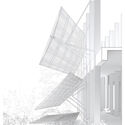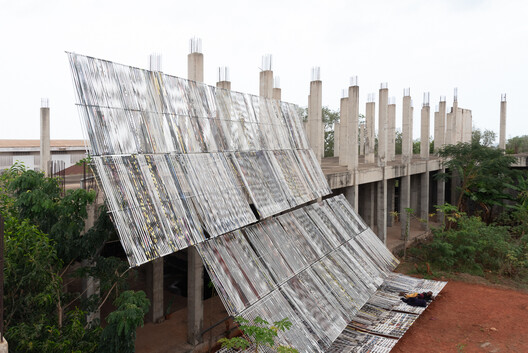
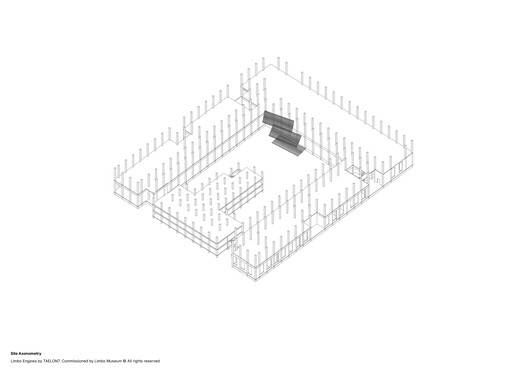
The recently opened Limbo Museum in Accra, Ghana, inaugurated a two-part architectural installation by TAELON7 on March 12th, led by architect Juergen Benson-Strohmayer. The installation was commissioned by the museum in partnership with Art Omi, a not-for-profit arts center in New York's Hudson Valley. The project is the first commission of a collaboration between the two institutions and will be installed in both locations, Accra and New York. Titled Limbo Engawa, the modular, lightweight structure dialogues with the formerly abandoned Brutalist building housing the museum, transforming its skeletal concrete structure and its surrounding land into spaces for use, care, and encounter. The project reflects on the boundaries between unfinished urban architecture and the landscape, foregrounding the labor and stewardship often invisible in both urban and institutional contexts, and asserting that even incomplete or overlooked sites are vessels of civic possibility.
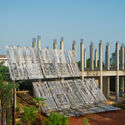
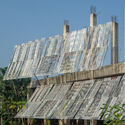
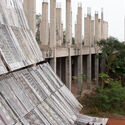
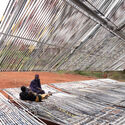
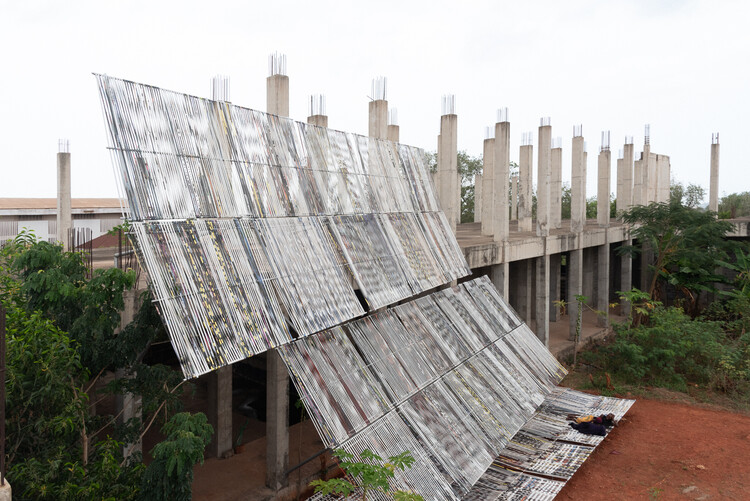
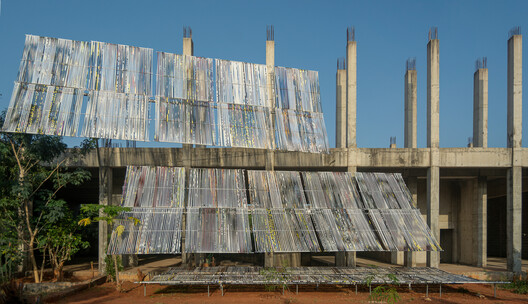
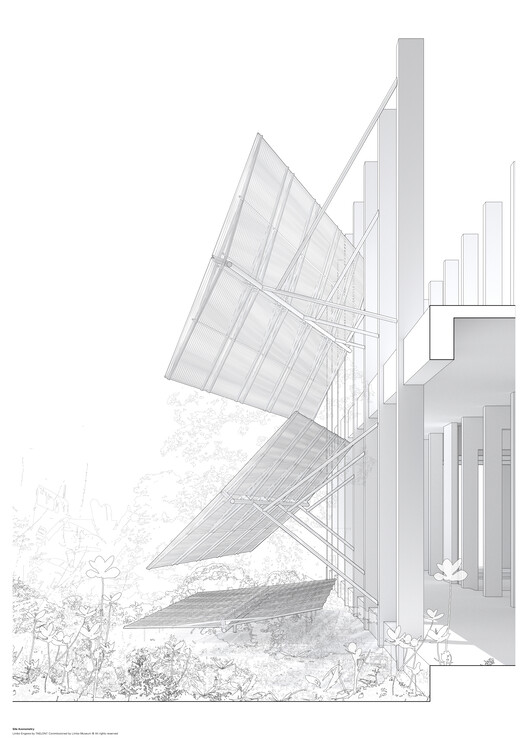
The installation is designed as a modular system of lightweight components that can be carried by a single person and assembled on site. Oversized daybeds, inspired by the woven beds commonly found on construction sites and within unfinished buildings in West Africa, provide shade, filtered views, and spaces for sitting or lying down to foster interaction among farmers, caretakers, and museum visitors. It uses steel profiles and construction techniques familiar from roadside kiosks and billboard structures, combined with salvaged billboard material cut into strips and woven onto the frames. Individual frames are aggregated to form larger canopy and seating elements, allowing the system to adapt to different sites and configurations. The construction method blends local African construction techniques with adaptable design strategies.
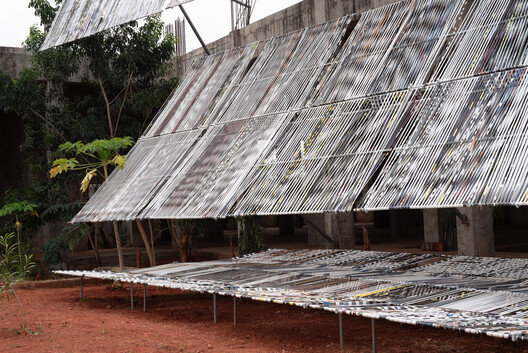
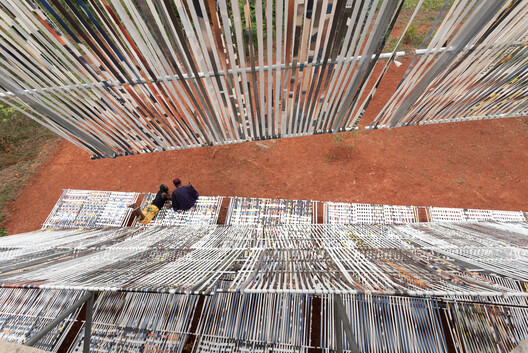
The Japanese term engawa describes transitional zones between interior and exterior, private and communal space. Today in Ghana, Limbo Engawa interprets this concept in the design of a lightweight assembly that mediates between large, unfinished structures and the active cultivation of the land around them. By introducing human-scaled elements into oversized and often abandoned megastructures, the installation calls for them to be reframed as places of use, care, and encounter. The project synchronizes with the museum's foundational concept, drawing on the fact that incomplete buildings are often seen as abandoned while surrounding land is dismissed as leftover, especially in rapidly urbanizing cities. The installation points to the false emptiness of abandoned structures and surrounding lands, which, on the contrary, are often inhabited or temporarily occupied, while the surrounding ground is cultivated, producing food and sustaining livelihoods within the city. It uses architecture to mediate between formal structures and informal land use, creating a new scenario for the intersection of urban form, everyday labor, and civic life.
The first iteration of the structure opened in Accra, installed within the museum's unfinished concrete structure and the cultivated land around it. Later this year, it will take on a second form at Art Omi in upstate New York as a freestanding pavilion. Rather than a traveling exhibition, the Limbo Engawa installation engages in a dialogue between two institutions, exploring how architecture can operate differently in distinct institutional, cultural, and geographic contexts. In Accra, it engages directly with the reality of incomplete urban architecture and the people who are already familiar with and care for the place. Once in New York, the system will change landscape and season, operating as an infrastructural gesture: temporary, mobile, and open-ended. Rather than presenting a finished object, "it proposes architecture not as a monument, but as a tool for inhabitation, care, and exchange within spaces that exist, quite literally, in limbo."
Other recent architecture exhibitions include "Revisiting Shoei Yoh," a revision of the Japanese architect's work in pioneering contemporary timber construction and his early contributions to computational design, at the Contemporary Art Museum of Kumamoto; "Concours Beaubourg 1971: Une mutation de l'architecture," an exhibition showcasing alternative designs presented in the competition for the current Centre Pompidou; and the upcoming edition of ABERTO 5 in São Paulo, an itinerant art exhibition held this year at Casa Bola, the futuristic spherical house by Eduardo Longo. OMA recently revealed images of an ellipsoidal pavilion for mushroom production designed for Fundación Casa Wabi in Mexico, and the Spanish festival Concéntrico 2026 recently announced three selected urban installations from its international open calls.