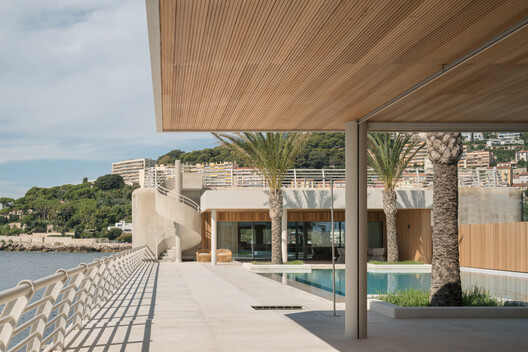
Set along the outer breakwater of Port de Cap-d'Ail, located next to Monaco, the Beach House occupies a threshold between land and sea. Surrounded by water and docked boats, the building sits in close dialogue with the harbor, exposed to the shifting light, reflections, and atmosphere of the Mediterranean. Within this setting, the house reads almost like another vessel moored along the harbor wall.
When architect Dave Rowles began work on the project, however, the residence offered little of this character internally. The former private home had been stripped back almost entirely, leaving a raw concrete shell. The renovation, therefore, began with a fundamental question: how can an interior capture the qualities of its surroundings? Rather than competing with the powerful maritime context, the design focused on creating a calm, material-driven interior that frames and amplifies the beauty and experience of the surrounding landscape crafted from oak, cedar, marble, and stainless steel details. In collaboration with barth, a company specializing in interior craftsmanship, Rowles transformed the concrete structure into a cohesive interior, where natural materials, light, and refined detailing define both the interior and exterior spaces.
Translating the Atmosphere of the Sea into Interior Architecture
The design strategy was guided by the idea that the interior can echo the experience of being on a boat, surrounded by water, through spatial organization, material continuity, and carefully controlled views. Boat interiors are typically compact yet highly integrated, where furniture, walls, and circulation operate as a single system. This principle became central to the home's transformation as Rowles explains:
The sensation you feel when you're in the house is that of a boat. We tried to emulate the kind of nautical sensation to bring the atmosphere from the Riviere, the nature of cruising into something that is stationary on the water.
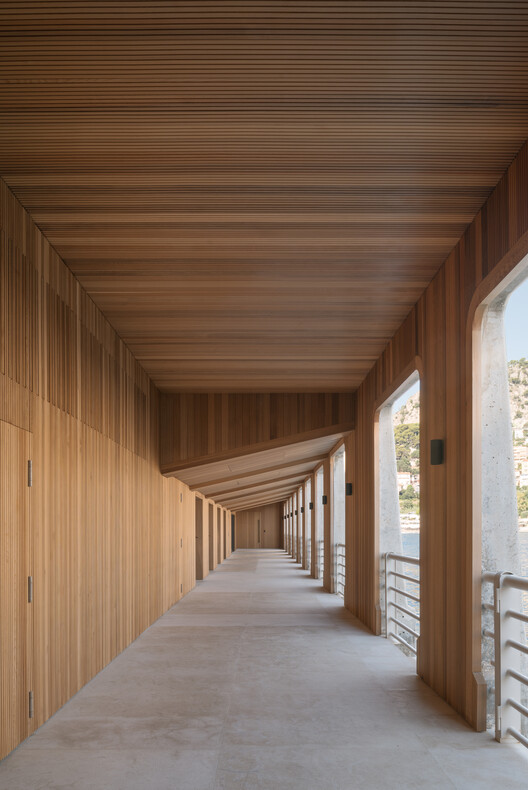
Wood plays a decisive role in this architectural language, emphasizing warmth, tactility, and timelessness. Cedar and oak surfaces extend continuously, forming a warm envelope within the previously raw concrete structure. In the entrance sequence, a long cedar-lined corridor immediately establishes the tone upon arrival. Walls, ceilings, doorframes, and concealed doors merge into a continuous wooden surface, creating a calm and immersive passage that mediates between the exterior arrival and the interior living spaces.
Continuity and Movement through Craftsmanship
Built-in furniture forms an integral part of the project. Developed in collaboration with barth, it supports the realization of the architectural concept through careful technical detailing. Here, the furniture is not an independent layer placed within finished rooms. Instead, it becomes an extension of the architectural framework itself, structuring space, guiding movement, and defining how the interior is inhabited. Rowles expands:
Craftsmanship was paramount to the success of this project, and it's in the punctuation of everything that's what makes it so beautiful.
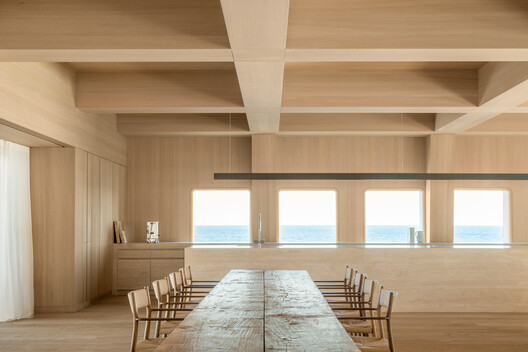
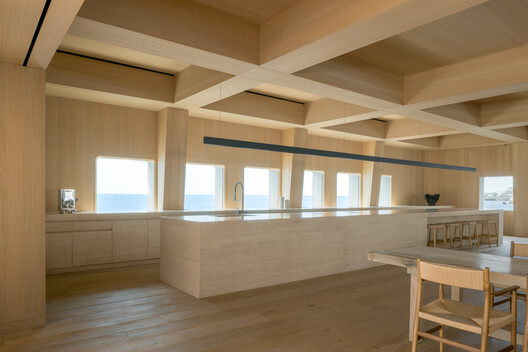
A defining example is the ten-meter-long kitchenette that runs along the main living space. Conceived as a freestanding architectural element, the unit functions simultaneously as a kitchen, a gathering point, and a spatial anchor. Clad in Alpi Verdi marble, its elongated form reinforces the house's linearity while establishing a visual dialogue with the horizon beyond the windows. The countertop seamlessly incorporates the washbasin, maintaining the piece's monolithic character, while indirect lighting beneath the unit visually lifts it from the floor.
This integration of architecture and furniture continues in the sleeping areas. Custom oak-veneer bunk beds, integrated cabinetry, and carefully proportioned storage elements reflect the compactness typical of maritime interiors. The combination of veneer and solid wood balances material efficiency with tactile quality, ensuring that each element contributes to a coherent spatial system.
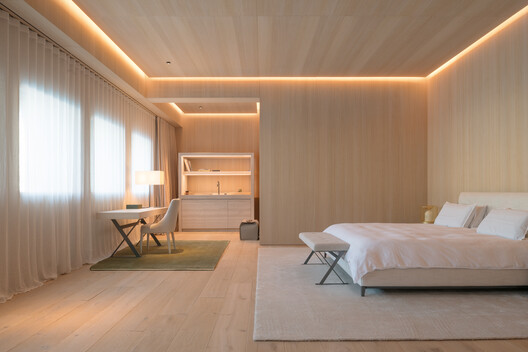
Built-In Furniture as a Continuous Envelope
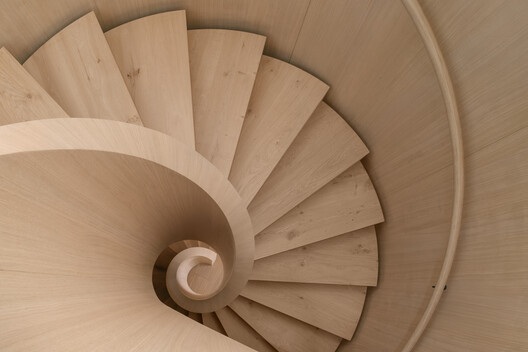
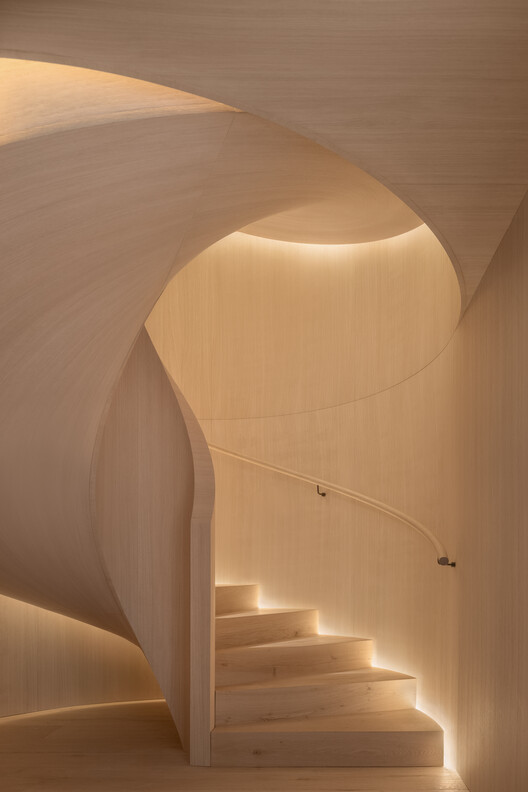
Movement through the house unfolds as a continuous sequence instead of a series of isolated rooms. The central sculptural staircase introduces curvature into the otherwise rectilinear structure, guiding vertical circulation while softening the geometry of the concrete shell. From here, the interior gradually opens toward the main living areas, where large windows frame views of the harbor. With water visible on multiple sides and boats docked nearby, the house begins to evoke the sensation of inhabiting a vessel moored at the edge of the port. This interplay between enclosure and openness, between the protective intimacy of the cedar-lined passages and the expansive views outward, captures a spatial quality closely associated with life at sea.
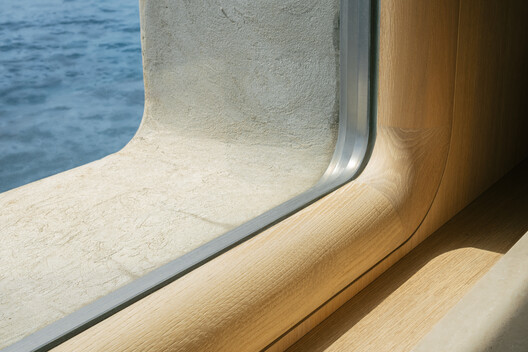
Underlying the project is a strong emphasis on craftsmanship and technical execution. Barth's contribution is evident in the precision of joinery, the integration of concealed doors, and the use of advanced fabrication techniques such as CNC milling for window frames and custom components. These processes allow the tactile warmth of natural materials to coexist with a high level of technical refinement.
Even utilitarian spaces maintain this architectural consistency. The laundry area features laminated cabinetry and open storage niches arranged in a clear, structured composition, while stainless steel elements introduce a restrained technical contrast to the warmth of the surrounding wood. In the wellness area, an aspen-wood sauna creates a contemplative atmosphere. The soft material palette and hidden lighting reinforce the sense of retreat, while a generous opening maintains a visual connection to the outside environment.
The resulting interior draws directly from its maritime setting. Continuous wooden surfaces echo the warmth of coastal environments, while elongated views and integrated furnishings evoke the spatial logic of a boat interior. Anchored along the breakwater yet visually immersed in the harbor, the house translates the experience of the sea into a domestic architecture defined by craftsmanship, material depth, and spatial continuity.