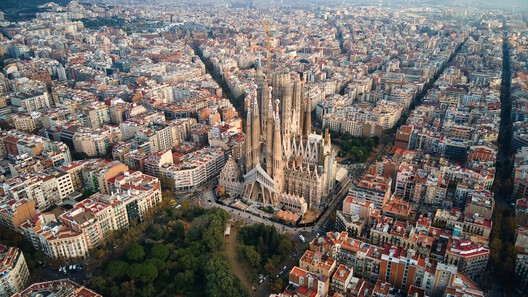
The final piece of the central tower of Barcelona's Sagrada Familia has been laid in place, bringing the church to its maximum height of 172.5 m. La Sagrada Familia, one of architectural history's most notorious unfinished buildings, became Antoni Gaudí's defining project in 1883, when he transformed a neo-Gothic design into one of the best-known structures of Catalan Modernisme. One hundred and forty-four years after construction began, the upper section of the 17-meter-high, four-sided steel and glass cross was winched into position at 11 a.m. on Friday, February 20, completing the tower dedicated to Jesus Christ. This milestone confirms the project's final stage of construction, which, back in March 2024, was announced as one of the most anticipated completions of 2026, commemorating the centenary of Antoni Gaudí's death.
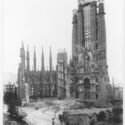
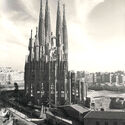
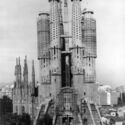
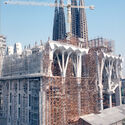
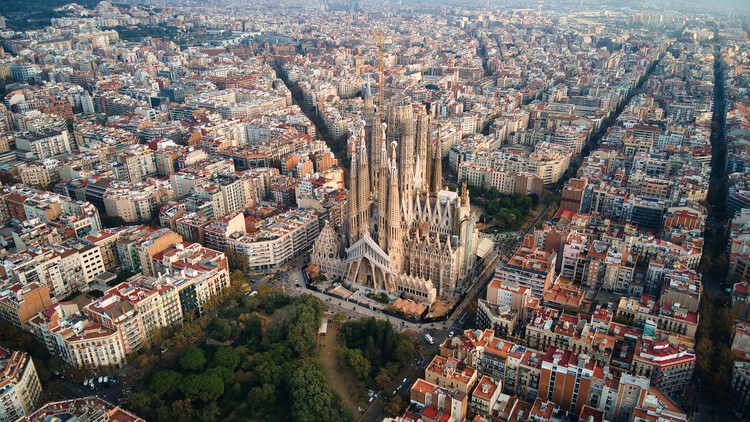
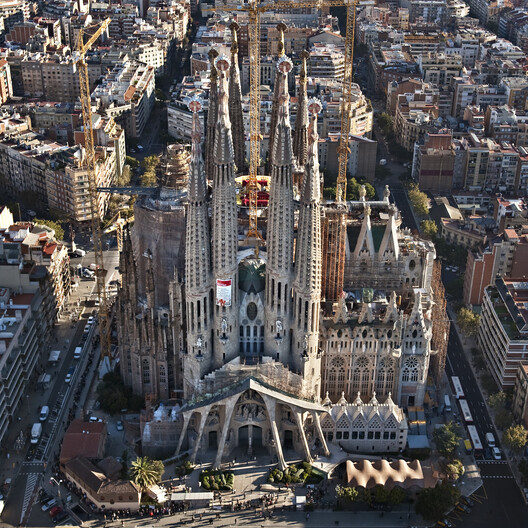
La Sagrada Familia is recognized as a testament to Gaudí's approach to architecture, combining Gothic traditions with radically innovative forms to redefine the structure of a cathedral. Gaudí preserved the Latin cross plan but replaced flying buttresses with an interior system of angled columns and hyperboloid vaults; he used complex three-dimensional ruled surfaces (such as hyperboloids, parabolas, and helicoids) to refine structural efficiency and light quality, and embedded Christian symbolism throughout the three principal façades and interior spaces. The ongoing project, guided by his models and drawings after he died in 1926, is expected to ultimately feature eighteen towers.
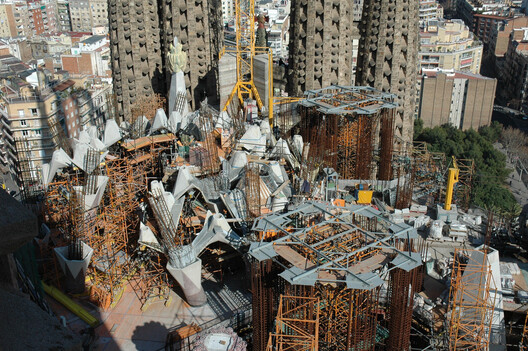
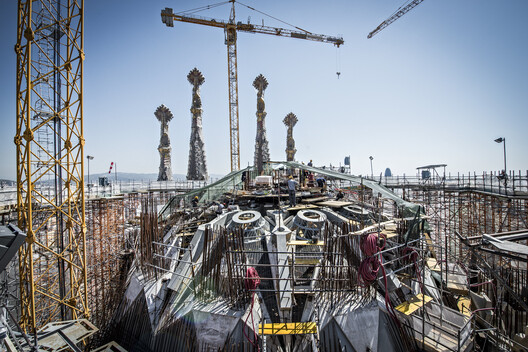
The latest construction milestone comes after the church was recognized in October 2025 as the world's tallest church, surpassing Ulm Minster in Germany, when workers placed the first section of the cross atop the central tower, reaching a height of 162.91 meters. While 2026 is expected to mark the completion of the main building, work on the Glory Façade is projected to last another 10 years. Doubts remain about the construction of the grand entrance stairway in Gaudí's original plan, which would now entail demolishing existing apartments and rehousing their inhabitants. The church is already the city's top tourist attraction, with around 5 million visitors a year. Tourism funds the construction, generating an annual income of roughly €150 million (£131 million), about half of which, according to The Guardian, has so far been spent on construction.
Related Article
UNESCO World Capital of Architecture 2026: Barcelona and the Capacity of Architecture to Transform RealityA ceremony to mark the completion of the tower is set to take place on 10 June, the centenary of the architect's death, also marking 16 years since the church was consecrated by Pope Benedict XVI. Numerous commemorative events and exhibitions are planned throughout the centenary year, which coincides with Barcelona being named the UNESCO World Capital of Architecture 2026. Updates on La Sagrada Familia come after the announcement of a new Gaudí masterpiece on 19 February 2026, when the Government of Catalonia published a report confirming him as the architect of Xalet del Catllaràs, an early 1900s chalet in northern Spain. The building, located about 80 miles from Barcelona, is said to contain elements of the architect's "naturalistic style." The analysis was carried out by the Catalan heritage department, and the knowledge acquired through the study of the building is expected to contribute to the investigation of other works attributed to Gaudí.
On the occasion of Barcelona being named UNESCO World Capital of Culture this year, the UIA World Congress of Architects will be held in the city from 28 June to 2 July 2026. The program and speakers have been announced for the international event dedicated to architectural dialogue, including activities at sites distributed throughout landmark neighbourhoods such as Montjuïc Castle and the Sagrada Família. Part of the program will also take place at the Three Chimneys, a seafront landmark once part of a controversial thermal power plant built in the 1970s, and the subject of a recent expansion project by Garcés de Seta Bonet and MARVEL Architects. Barcelona also made the news in December 2025 when Mayor Jaume Collboni announced plans to phase out tourist short-term rentals entirely by 2028, framing the decision as part of a broader effort to protect residents' right to remain in the city.


