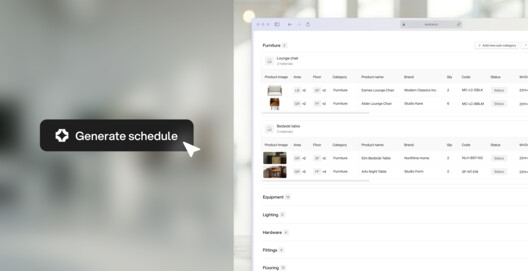
Some types of work only become visible when they are no longer done. They are discrete, repetitive, rarely celebrated, yet they quietly sustain the functioning of any operation. In architecture, this dimension rarely appears in the images that circulate. When we think about the discipline, we evoke seductive renderings, carefully lit perspectives, precise plans, drawings that promise possible or even utopian futures. Yet the layer that supports these formal gestures is not found in the image, but in specification, detailing, and documentation.
Since artificial intelligence moved to the center of architectural debate, the conversation has largely been driven by its ability to generate forms and atmospheres in seconds. Stylistic simulations, conceptual variations, and visual experimentation have come to symbolize technological advancement in the field. There is something understandable in this fascination: architecture has always engaged with representation as a way of imagining what does not yet exist.
Daily practice, however, unfolds at a different pace. Far from the glow of images, much of the work is devoted to the production, revision, and coordination of multiple layers of information, including technical specifications, code research, material coordination, compliance verification, responses to RFIs, and quality review processes. These tasks are far more than bureaucratic appendages; they are what allow architecture to become buildable, safe, and compliant. They require meticulous, fragmented, and iterative attention. The tension between creative intention and administrative obligation is not a deviation from professional practice, but one of its structural conditions.
AI Beyond Image Generation
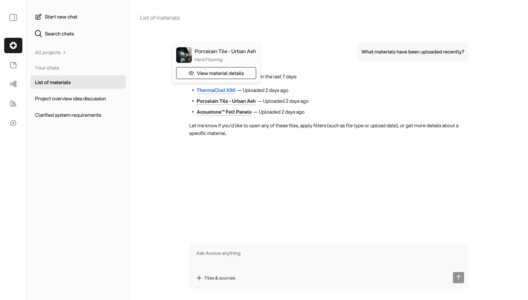
It is within this less visible territory, where decisions accumulate across documents, versions, and revisions, that initiatives such as Avoice emerge. The platform focuses on the intelligent organization of technical documentation. By interpreting drawings, specifications, schedules, materials, and codes within their project context, it supports document drafting, regulatory research, and the retrieval of a firm's accumulated knowledge.
The platform was founded by brothers Chawin and Chawit, whose family has long operated within the construction and materials sector in Bangkok. While working alongside architects during the renovation of a family-owned hotel, they observed firsthand the volume and complexity of documentation that accompanies a project, from schematic design through construction administration. Schedules, specifications, code research, revisions, and compliance checks consumed an extraordinary amount of time, precisely the kind of work well suited to computational assistance.
From Archive to Active Knowledge
Documentation processes are interdependent systems. A material decision reverberates through specifications, engages regulatory requirements, impacts detailing, and generates subsequent revisions. When these layers become dispersed across folders, emails, and disconnected platforms, accumulated knowledge ceases to function as active memory and instead becomes an inert archive.
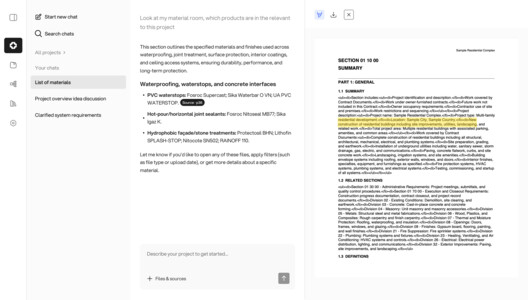
By consolidating these workflows into a unified and searchable environment, the platform allows each drafted specification, compliance check, and regulatory interpretation to become part of a structured knowledge base. Rather than starting documents from scratch or relying exclusively on generic templates, firms can retrieve internal standards, cross-reference regulatory requirements with prior decisions, and update content with greater consistency. In the realm of building codes, where complex legislation is distributed across multiple documents and versions, this centralization reduces duplication of effort and the risk of omissions. Similarly, locating the correct detail from a previous project or identifying how a particular issue was resolved no longer consumes hours scattered throughout the week.
This structured accumulation creates something close to an internal intelligence within the firm. Instead of relying exclusively on the individual memory of senior professionals, teams can consult a consolidated historical record. Recurring questions find answers that are indexed, connected, and contextualized. Some firms concentrate its use on quality assurance and quality control workflows, reviewing alignment between drawings, specifications, and compliance criteria; others prioritize structuring regulatory requirements or material research. In all cases, the objective remains the same: to structure knowledge, not to replace professional judgment.
Toward Autonomous Workflows
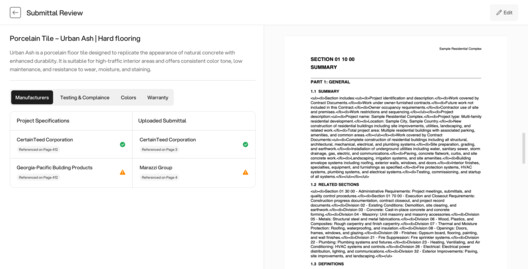
Looking ahead, the ambition extends beyond organizing documentation toward increasing degrees of workflow autonomy. The next stage of development explores the use of autonomous research agents capable of handling portions of the manual, repetitive tasks that still occupy significant time across architectural practice. These agents are designed to operate in the background once given defined parameters. A task such as identifying suppliers for a specific tile system, requesting quotations, collecting product data sheets, organizing technical information, and summarizing findings could be delegated to an agent that systematically performs these actions. Based on instructions provided by the architect, the system can search relevant sources, contact manufacturers, compile responses, structure the results into organized formats, and return consolidated summaries to the team.
The objective is not to remove architects from decision-making, but to reduce the administrative labor that precedes it. If the current platform structures accumulated knowledge, autonomous agents aim to act upon defined tasks within that knowledge environment. Seen from this perspective, the shift is less about automation and more about rebalancing professional attention. Today, much of architects' digital time is divided between design tools and communication platforms, while documentation often remains fragmented. The most transformative shifts in architecture may not appear first in images, but in the systems that make those images buildable.
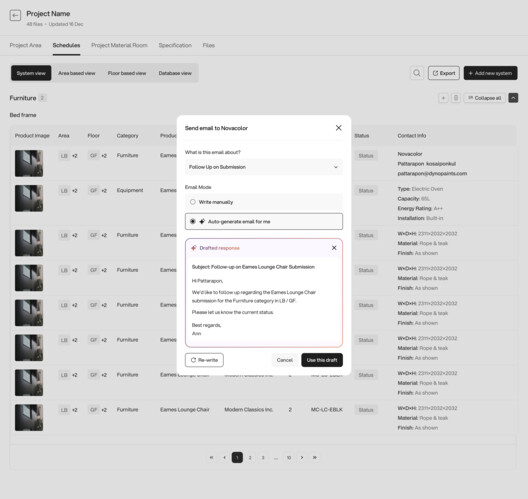
By reorganizing documentation as an active knowledge infrastructure, the cognitive friction involved in technical decision-making is reduced. Less time spent searching, rewriting repetitive content, and manually verifying inconsistencies creates more space for strategic reflection. If reorganizing documentation means recovering the ability to systematically learn from each project, then the impact goes beyond operational efficiency and touches the very foundation upon which architecture is built.

