This week's news landscape brought together diverse approaches to built and cultural heritage, ranging from the design of a Museum of Jesus' Baptism at a UNESCO World Heritage Site in Jordan to major transformations of modern industrial sites and the development of major cultural districts. The World Monuments Fund's support for 21 locally led heritage projects foregrounds conservation strategies that reinforce the role of architecture in safeguarding both material and intangible heritage. Across this week's highlighted projects, adaptive reuse, landscape integration, and the reconfiguration of civic space emerge as recurrent strategies for extending the life and relevance of existing built environments. The projects also reflect broader contemporary concerns, including material research in timber construction, zero-waste urban installations, large-scale residential efficiency, and infrastructure upgrades linked to global events like the Olympic Games. Framing these developments within a wider territorial perspective, discussions on relocating capital cities worldwide offer an example of how geopolitical discourses continue to shape architecture, revealing the evolving relationship between the built environment and structures of power over time.
A Museum of Jesus' Baptism and Major Cultural Transformations in Los Angeles and Hangzhou
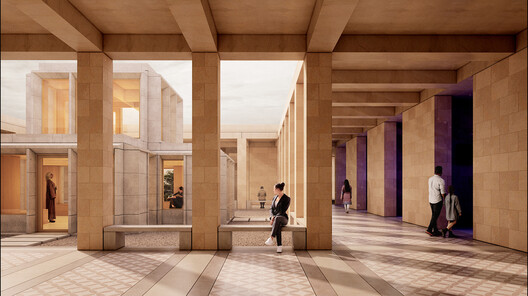
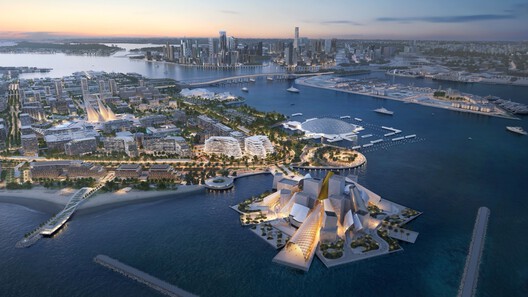
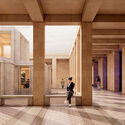
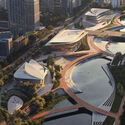
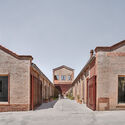
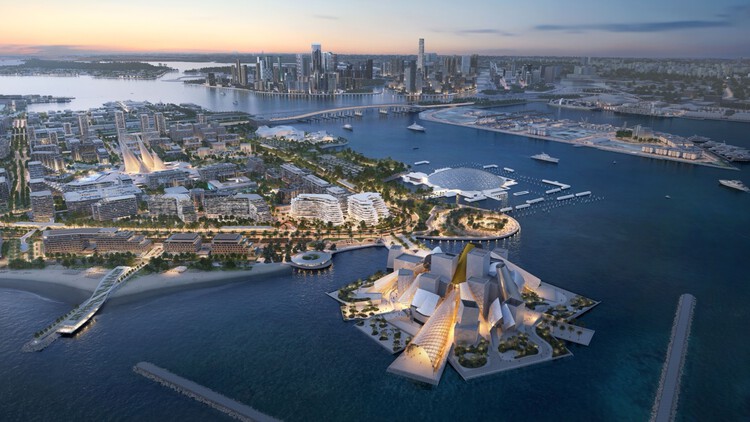
Recent announcements highlight three large-scale projects that combine cultural significance with territorial transformation. In Jordan, Níall McLaughlin Architects has won the international competition for the Museum of Jesus' Baptism at Bethany, a UNESCO World Heritage Site on the east bank of the Jordan River. The proposal is conceived as a sequence of contemplative spaces embedded within the landscape, responding to the site's archaeological and spiritual importance while accommodating pilgrims and visitors through a restrained architectural language. In Los Angeles, WEISS/MANFREDI has revealed updated designs for the La Brea Tar Pits, advancing a long-term transformation of the 13-acre site that reconfigures circulation, landscape, and museum facilities to strengthen connections between research, exhibition, and public park space. The project aims to unify the campus through a new architectural and ecological framework. Meanwhile, in Hangzhou, Zaha Hadid Architects has presented a masterplan for a new cultural district along the Qiantang Bay Central Water Axis, organizing cultural, commercial, and public functions through a fluid urban composition that extends the city toward the waterfront and establishes a new civic landmark structured around landscape and infrastructure.
Related Article
Moving Capitals Across Global Contexts: From Strategic Planning to Environmental NecessityGlobal Events, Timber Research, and Adaptive Reuse Across Europe
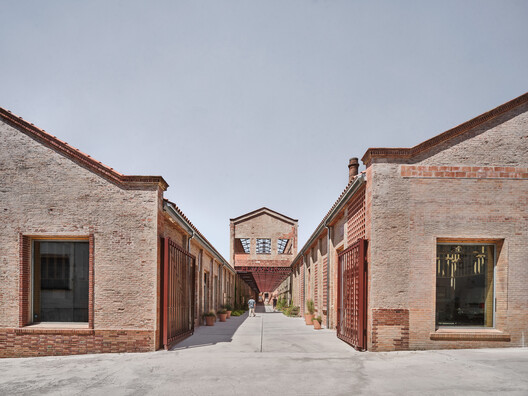
The Milano Cortina 2026 Winter Olympics officially opened on February 6, initiating a nationwide program of competitions and public events distributed between Milan and several Alpine venues. Beyond the sporting agenda, the Games have brought renewed attention to infrastructure and transport upgrades, including the adaptation of existing facilities and mobility networks linking urban and mountain clusters. A parallel cultural program has been launched across multiple Italian cities, framing the Olympics as both a sporting and cultural platform. At the same time, sustainability-related protests in Milan have raised concerns about the environmental and social implications of development associated with the event. In Paris, the exhibition matière en résonance at the Galerie d'Architecture presents sauerbruch hutton's long-term exploration of timber, using models and photographs to examine the material's technical capacities and atmospheric qualities. The show highlights how sustained material research can uncover diverse structural and spatial applications for wood in contemporary architecture. Meanwhile, the seven finalists for the 2026 EUMies Awards reveal a strong presence of large-scale adaptive reuse and heritage conservation projects, many of which convert existing buildings into cultural and community-oriented programs, extending the life of the built environment while reinforcing its public role.
On The Radar
HAS Design and Research Installs Zero-Waste Pavilion at Lan Khon Mueang Square for Bangkok Design Week 2026
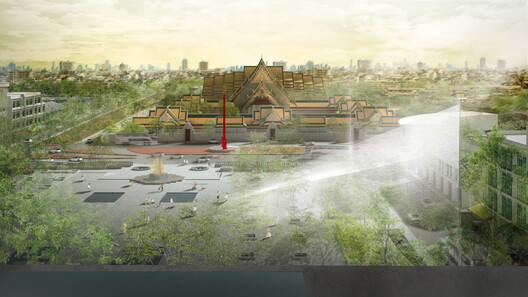
High Line Bangkok is a zero-waste thematic pavilion designed by Jenchieh Hung and Kulthida Songkittipakdee of HAS Design and Research, in collaboration with urban research firm Urban Ally, for Bangkok Design Week 2026. Installed at Lan Khon Mueang Town Square in the Phra Nakhon district, directly in front of the Bangkok Metropolitan Administration (BMA) City Hall, the project occupies one of the city's primary civic gathering spaces, which featured an installation by MVRDV during last year's edition of the festival. Developed for the Bangkok Metropolitan Administration and the Creative Economy Agency, the pavilion is based on site research observing how Bangkok's tropical climate shapes patterns of use: during the day, people gather in shaded areas, while at night activities cluster around illuminated zones. Responding to this condition, the design reuses existing streetlights as its primary structural framework, avoiding new foundations and reducing material consumption in line with the BMA's zero-waste objectives. By day, a rainbow-like canopy casts colored shade across the plaza, creating a semi-outdoor sheltered environment; by night, the structure amplifies and extends urban lighting, redefining the square through illumination. The pavilion proposes a replicable approach to upgrading existing infrastructure through shading, ventilation, and arcade-like spatial conditions, transforming street lighting into a social and spatial catalyst for public life in a tropical urban context.
Sou Fujimoto Architects Presents First Residential Project in Abu Dhabi with Undulating Twin-Building Form
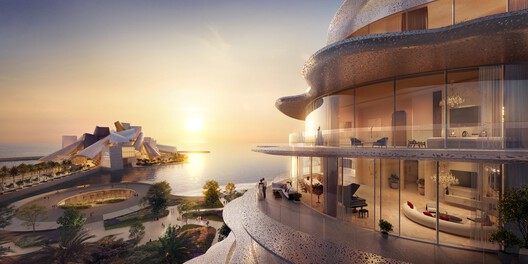
Baccarat Residences Saadiyat marks the first project in the UAE by Sou Fujimoto Architects, located within the Saadiyat Cultural District in Abu Dhabi. The residential scheme comprises 77 units, including two- and three-bedroom apartments, four-bedroom sky villas, and two penthouses, distributed across two curving buildings whose undulating forms draw on the shoreline of Saadiyat Island. Positioned with views toward the Guggenheim Abu Dhabi, Louvre Abu Dhabi, and the Arabian Sea, the project is conceived as a sculptural addition to the district's skyline. Interiors are designed by the Los Angeles-based StudioPCH, which references neoclassical principles, with options for light and dark finishes and selected customization. The development incorporates shared amenities such as a residents' spa and wellness centre, fitness facilities, landscaped gardens, and an outdoor infinity pool, alongside concierge and valet services. Baccarat's design heritage is referenced through the integration of crystal elements within the common areas and interior detailing. The project brings together Sou Fujimoto Architects, Aldar as developer, and StudioPCH as interior designer, establishing a branded residential complex within one of Abu Dhabi's principal cultural and coastal zones.
George Batzios Architects Designs a 14-Storey Residential Tower with Terraced Green Roofs in Attica, Greece
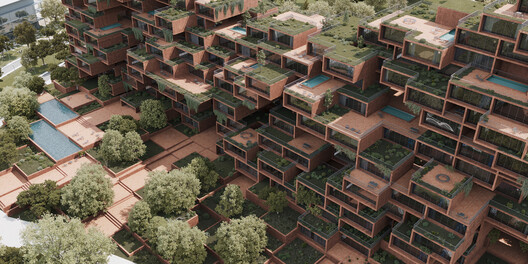
Red Hills, a residential development by George Batzios Architects in Attica, Greece, presents a sculpted, topographically integrated form that departs from conventional vertical housing typologies. Occupying a plot equivalent in scale to an urban block, the project comprises a fourteen-storey residential building with a ground floor and two basement levels. Its massing is articulated through stacked and shifted volumes that evoke tectonic stratification, establishing a rhythmic composition of repetition betand variation. Stepped green roofs cascade along the building's height, transforming the volume into a cultivated landscape where planted and water elements are meant to have an active environmental role, moderating geometry and introducing seasonal change into the urban setting. Large openings cut through the building's mass to enhance cross-ventilation and daylight penetration. The residences are organized to balance privacy and community, while circulation operates as a connective system that distributes light and air. Material choices include stone, wood, pigmented plaster, and concrete in earthy tones, and the construction strategy prioritizes standardization, repetition, and system integration.
This article is part of our new This Week in Architecture series, bringing together featured articles this week and emerging stories shaping the conversation right now. Explore more architecture news, projects, and insights on ArchDaily.


