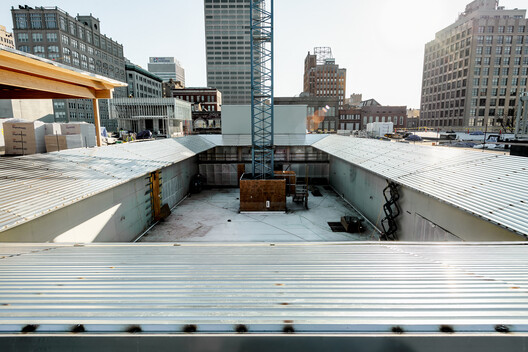
Pritzker Prize-winning architecture firm Herzog & de Meuron has released new images showing construction progress on the Memphis Art Museum, set to open in December 2026. Currently operating as the Memphis Brooks Museum of Art, the institution is both the oldest and largest art museum in Tennessee, United States, with a collection of more than 10,000 works spanning from ancient to contemporary art. Commissioned in 2019, the project marks the museum's relocation to a new site in Downtown Memphis along the Mississippi River bluff. The first images of the new cultural campus, designed by Herzog & de Meuron with architect of record archimania and landscape design by OLIN, were released in 2021. The 123,500-square-foot museum will expand gallery space by 50 percent and introduce extensive free, publicly accessible areas conceived as an open invitation to the city.
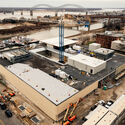
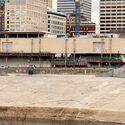
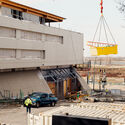
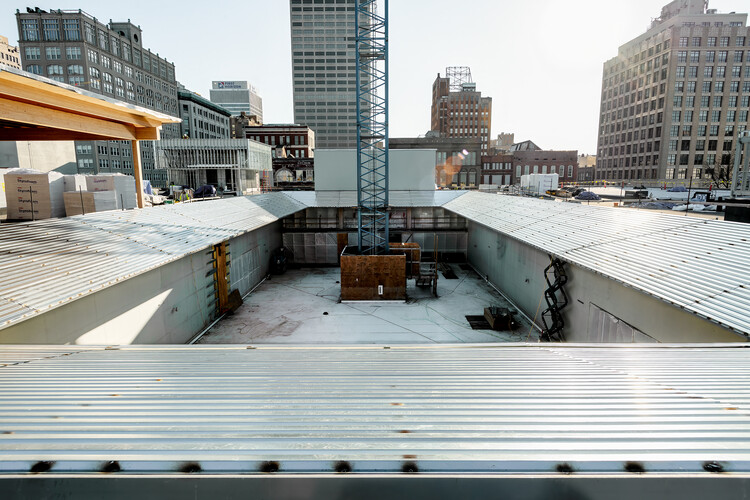
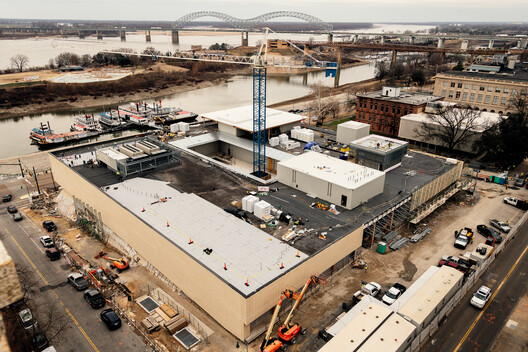
Occupying an entire city block, the new Memphis Art Museum prioritizes accessibility through a design that emphasizes transparency and public engagement. A glass façade allows passersby to view art from the street, while street-level galleries are intended to blur the boundary between the museum and its urban surroundings. Wider sidewalks will connect Downtown Memphis to the riverfront, and a public plaza shared with the historic Cossitt Library is designed to establish a cultural commons along the bluff. At the center of the complex, a shaded courtyard will function as an open gathering space. Above, a full-roof garden will feature sculptures, native plantings, an event pavilion, and panoramic views of the city center and the Mississippi River.
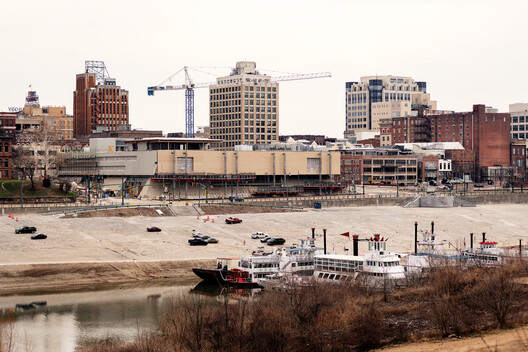
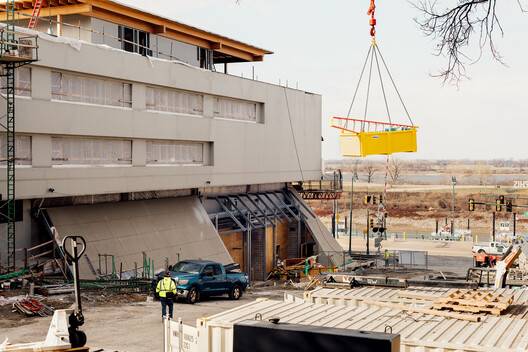
Inside, visitors will access galleries, educational spaces, a café, and a museum store primarily at street level, along with a mezzanine-level theater and direct connections to the riverfront. Galleries are arranged in a continuous, single-story loop around the central courtyard, providing flexible exhibition spaces for the museum's diverse collection. Five galleries will include large windows overlooking either the Mississippi River or the courtyard. Classrooms with northern exposure will support art-making and learning for audiences ranging from school groups to adult artists. Architectural features such as the River Window and the Riverview Terrace frame views of the historic waterway and the surrounding landscape. The museum is designed to host more than 400 cultural, creative, and community-focused initiatives annually and will also be available for private rentals.
Related Article
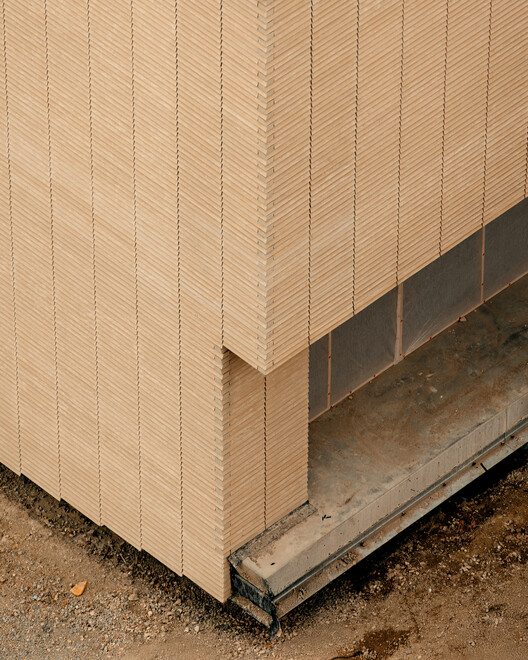
Serpentine Pavilion 2026 and Lina Ghotmeh’s House of Performing Arts: This Week’s ReviewAs shown in the newly released construction images, the museum is among the first major U.S. museums to be built using laminated timber. Alongside updated renderings and construction photography, the institution also shared an early look at its curatorial vision for the new building. Collection strengths include Old Master paintings from the Samuel H. Kress Foundation, American art from the late 19th and 20th centuries, and significant holdings in photography. Since announcing the new location, the collection has continued to grow. Upon opening, the museum's galleries will be organized into 18 distinct exhibitions that establish connections across time, geography, and medium, supported by an architectural layout designed to foster visual and conceptual dialogue. Artworks commissioned specifically for the new campus, along with details of the opening exhibition program, are expected to be announced in the coming months.
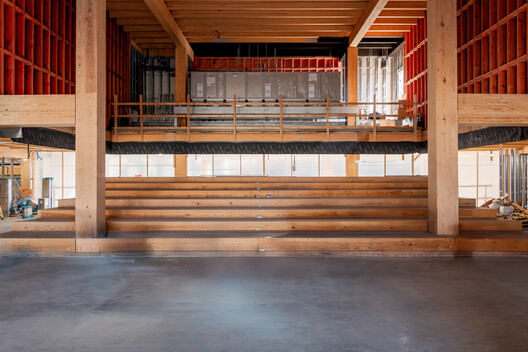
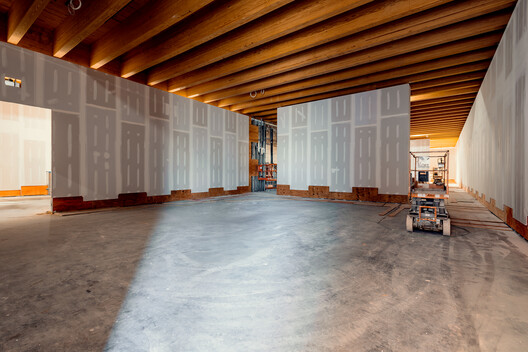
The construction of a new museum has given us a rare opportunity to not simply display more art, but to reimagine how we think about history, power, creativity, and connection. We're able to present the collection in ways that reflect the lived realities of the city that we serve. — Dr. Patricia Lee Daigle, Chief Curator of Memphis Art Museum
Other recent museum construction updates include the recent opening of the New Museum expansion by OMA on March 21, with an exhibition exploring the definition of humanity. In late December 2025, Snøhetta, in collaboration with the Beijing Institute of Architectural Design (BIAD), broke ground on the New Beijing Art Museum in Tongzhou as part of the district's cultural and civic development strategy. That same month, a new museum dedicated to the science of carbon fiber, designed by CRA–Carlo Ratti Associati with the late architect Italo Rota, opened in Fiorenzuola d'Arda, Italy.


