

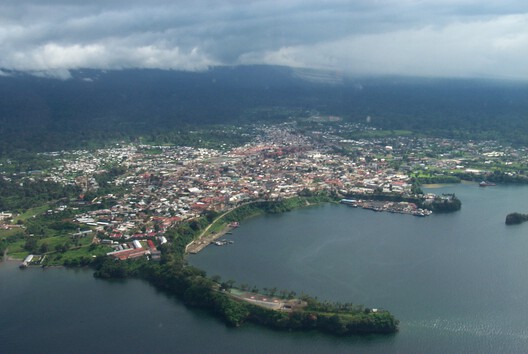
Malabo served as the capital city of Equatorial Guinea from the country's independence from Spain on October 12, 1968, until January 2, 2026, when a decree issued by President Teodoro Obiang Nguema Mbasogo officially transferred the capital to Ciudad de la Paz ("City of Peace"), located in Djibloho Province. Obiang formalized the move as part of a long-planned territorial reorganization. While the former capital remains an important economic center on Bioko Island, Ciudad de la Paz was conceived as a planned capital on Africa's mainland. The initiative to relocate the capital dates back to 2008, with construction beginning in 2011. The new capital, also referred to as Djibloho, after the province, or Oyala, has been framed by the government as a decentralization effort aimed at improving national accessibility.
According to the president, who has been in power since 1979, the decision to move the capital from the island to the equatorial forest on the mainland was driven by strategic considerations. He justified the measure by citing "the need to adopt measures that allow for the decentralization of state functions, promoting harmonious socioeconomic development in all regions of the country." As stated in the decree, the change was motivated by the rapid urban growth of Malabo and the economic capital, Bata, in recent years, a process linked to migration from rural areas and smaller towns toward both cities. This trend was described as being "fueled by the concentration of most infrastructure, public services, job opportunities, and administrative offices in these two cities."
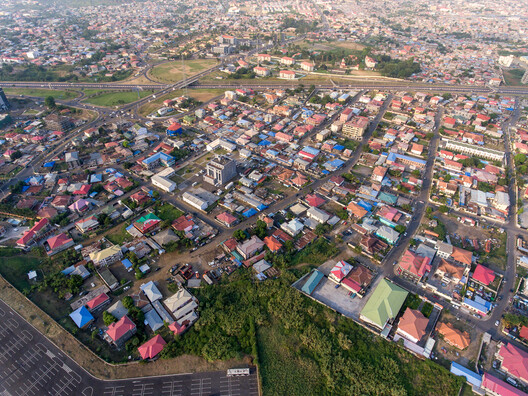
The decree further warns that this "disorderly growth" has generated "significant challenges," including heavy pressure on essential services and increased strain on transport and communication networks. It notes that, if left unaddressed, these dynamics risk accentuating territorial imbalance, weakening national cohesion, and undermining the government's sustainable development objectives. As a response, the document advocates for bringing government institutions closer to a broader portion of the population and for achieving a more balanced demographic distribution by easing population pressure on Malabo and Bata. Presidential services, state powers, constitutional bodies, government agencies, and public enterprises are required to take the necessary measures to relocate to the new capital within one year.
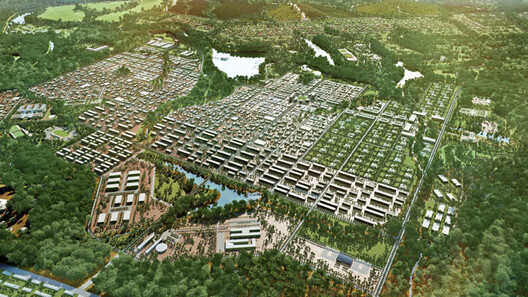
Ciudad de la Paz was designed by the Portuguese architecture and urban planning firm IDF – Ideias do Futuro. The masterplan is structured around a fusion of natural and geometric systems, combining the presence of a river landscape with an orthogonal road network. The city is planned to accommodate between 160,000 and 200,000 inhabitants across an area of approximately 81.5 square kilometers. From an urban design perspective, IDF – Ideias do Futuro's proposal is based on principles of functional zoning, hierarchical infrastructure, and symbolic representation of state power. The design organizes the capital into defined areas for government, residential, cultural, and service functions, connected by a structured road network intended to ensure legibility and operational efficiency. A monumental civic core concentrates institutional buildings and public spaces, reinforcing the city's role as a political and administrative center. The plan integrates green spaces and natural landscapes, using the surrounding forest and river systems as structuring elements.
Other recent news in urban development includes the completion of the first project within the broader renewal of Blackwattle Bay on Sydney's inner harbour, 3XN's Sydney Fish Market, set to open on January 19, 2026. In Azerbaijan, 2026 has been declared the "Year of Urban Planning and Architecture," aligning with the country's preparations to host the 13th World Urban Forum (WUF13) in Baku in May 2026. Meanwhile, on December 5, 2025, construction began on Tokyo's new global headquarters for NTT, a key component of PLP Architecture's Tokyo Cross Park large-scale regeneration project in the Tokyo metropolitan area.


