-
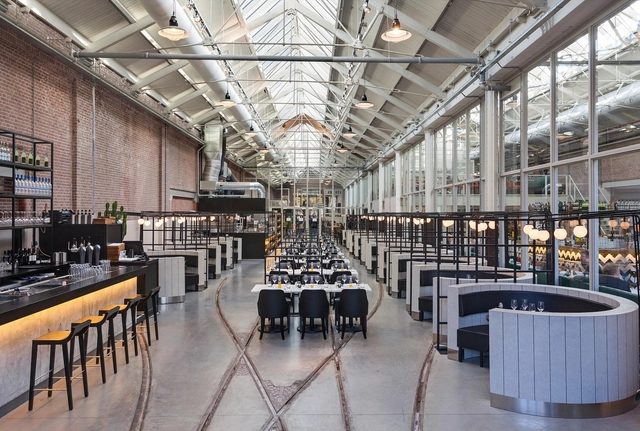
Architects: Architectuuratelier Dertien 12, Atelier Bow-Wow
- Year: 2015


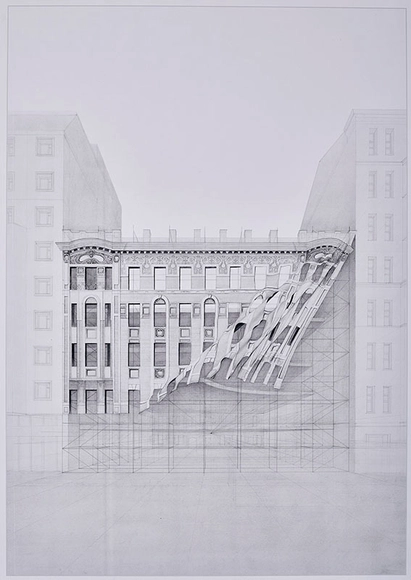
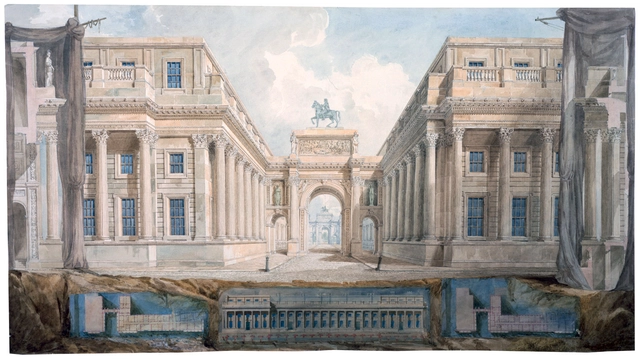
Tchoban Foundation Museum for Architectural Drawing is hosting its second exhibition from Sir John Soane's Museum, showing masterpieces of British Neoclassicism. The exhibition illustrates the ambition of leading British architects of the late 18th century who strove to create new architecture in the Classical tradition that could compete – in terms of public works, private houses, mausolea, interior detail and even furnishings - with the glories of the Ancient World.

“Reading Images: After Belonging” reflects on a group of images that frame new objects, spaces, and territories that define our transformed condition of belonging under global regimes of circulation.
The increasing movement of people, information, and goods in a global context has destabilized what we understand by residence, undermining spatial permanence, property, and identity. Circulation brings greater accessibility and more diverse goods to remote territories, transforming the way we own, exchange, and share them, but simultaneously grows inequalities for large groups, who are kept in precarious transit. These transformations concern both our attachment to places—where do we belong?—, as well as our relation to the objects we own, share, and exchange—how do we manage our belongings? Being at home has a different definition nowadays, both within domestic settings and in the spaces defined by national boundaries.

Aarhus School of Architecture, schmidt hammer lassen architects, VOLA, and the Danish Arts Foundation have announced their collaborative competition, entitled Drawing of the Year 2015, which calls for imaginative student drawings, and aims to “celebrate the oldest tool of architects.”
Students worldwide are invited to submit drawings “that inspire, communicate, and engage” with the theme of Sustainability Through Architecture. Thus, drawings “should focus on sustainability and architecture’s ambition to take an active part in the change of our society,” and “should address architecture’s ability to contribute to a sustainable environment on all scales—concepts, utopias, buildings, landscapes, and cities.”

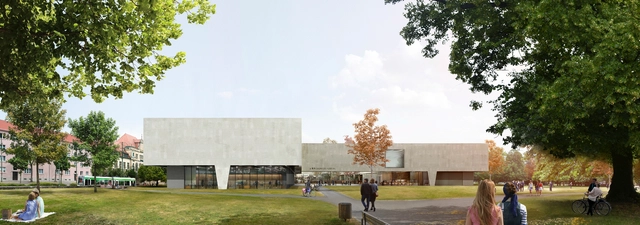
Replicating the corner of Friedrichstrabe and Kavalierstrabe, Guerra De Rossa Arquitectos and Pedro Livni Arquitecto's entry for the Dessau Bauhaus Museum is organized as an L, suspended above ground to create a passage and meeting space in the park in which it’s situated. The monolithic volume, built in reinforced concrete, acts as a single gesture, emphasizing its weight. Read more about this entry after the break.

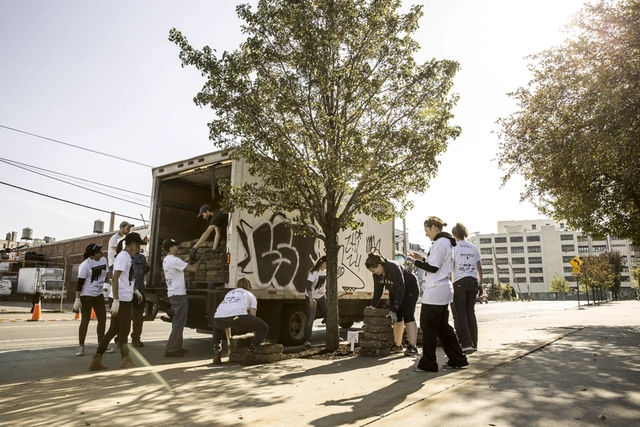
This Archtober, join over one hundred architects and design professionals in making an impact in their local communities through AFHny’s annual city-wide service day.
Participants will work alongside some of the region’s leading community-focused organizations through hands-on painting, planting, and rebuilding projects, all of which will improve New York's neighborhoods on both physical and social levels.

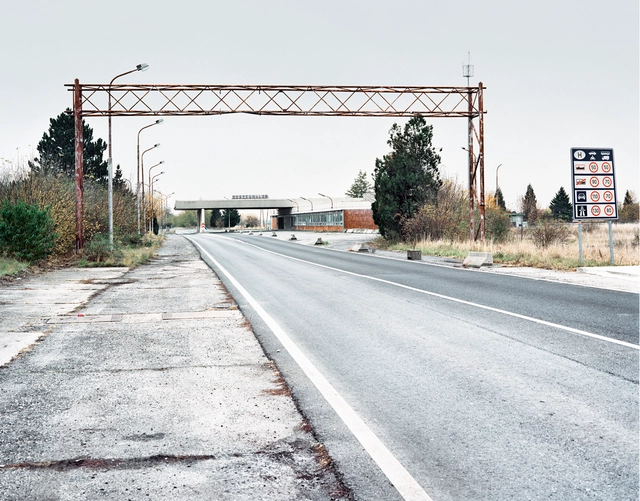
This exhibition shows 16 pictures of "After Schengen" a series from Spanish photographer Ignacio Evangelista. The "After Schengen" project shows old border crossing points between different states in the European Union. After the Schengen agreement, most of these old checkpoints remained abandoned and out of service, allowing us to gaze into the past from the present. It causes many reflections, especially at a moment in which the EU project is severely discussed.

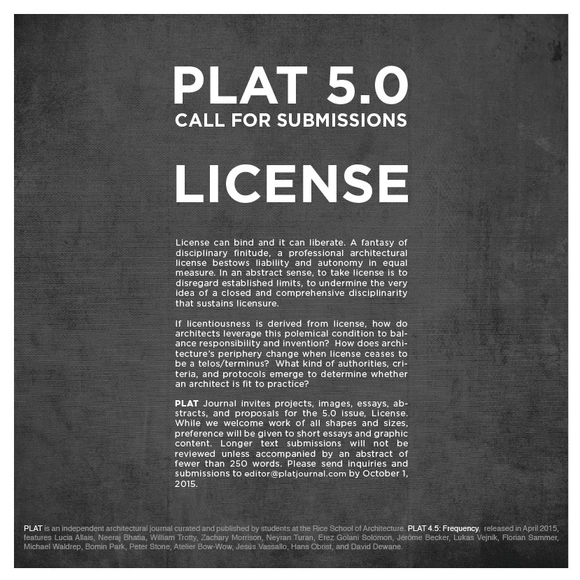
License can bind and it can liberate. A fantasy of disciplinary finitude, a professional architectural license bestows liability and autonomy in equal measure. In an abstract sense, to take license is to disregard established limits, to undermine the very idea of a closed and comprehensive disciplinarity that sustains licensure.
If licentiousness is derived from license, how do architects leverage this polemical condition to balance - or not - responsibility and invention? How does architecture's periphery change when license ceases to be a telos/terminus? What kind of authorities, criteria, and protocols emerge to determine whether an architect is fit to practice?

Archstudies.gr and DeCorbuziers, in partnership with the School of Architecture of the National Technical University of Athens, have announced their international student competition to design a conceptual funerary monument for the death of Modernism.
With this year marking the 50th anniversary of Le Corbusier’s death, the team of organizations is seeking “contemporary interpretations concerning multidisciplinary approaches over Modernism and specifically over Le Corbusier’s work, while [exploring] possible themes and directions of the memorial representation” in present day. Designs should emphasize commentary, rather than a tribute to Le Corbusier.

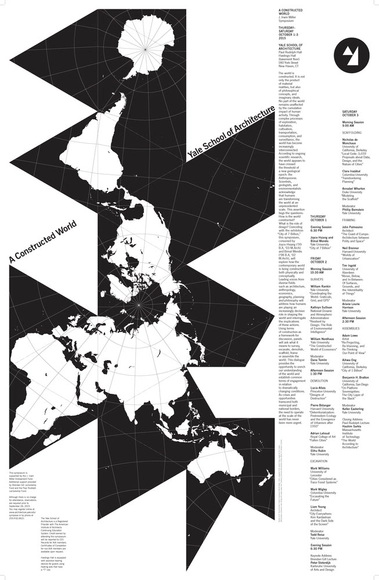
The world is constructed. It is the product of material realities, philosophical concepts, and imaginary ideals. No part of the world remains unaffected by the cumulative impact of human activity. Through complex processes of exploration, habitation, cultivation, transportation, consumption, and surveillance, the world has become increasingly interconnected. According to ongoing scientific research, the world appears to have crossed the threshold of a new geological epoch: the Anthropocene. Scientists, geologists, and environmentalists acknowledge that humans are transforming the world at an unprecedented scale. This assertion begs the questions: How is the world constructed? What is the role of design?

.jpg?1442877905&format=webp&width=640&height=580)

An award-winning anthropological case study by designer Stephen Fan, SUB URBANISMS explores the controversial conversion of suburban single-family homes into multi-family communities by immigrant Chinese casino workers in Connecticut. Addressing the norms, cultural values, and public policies that determine how most Americans live, the exhibition juxtaposes immigrant cultural beliefs and pragmatism with suburban American social, aesthetic, and financial codes. With a regional focus and global reach, it also provides insight into the long-term effects of 9/11 on the New York Chinatown service industry as a significant factor behind the influx of Chinese labor seeking employment at the region's casinos, and the formation of this satellite suburban Chinatown. With creative implications for the future of housing design and habitation in response to cultural, social, and ecological challenges, SUB URBANISMS offers a powerful inquiry into the ways in which culture shapes our lives and homes.