1. ArchDaily
  2. Young Architects

Young Architects: The Latest Architecture and News

Why "Darling" Architects Who Came Up Under Recession Are Doubling Down on Budget

This article was originally published by Metropolis Magazine as "The Build Up."

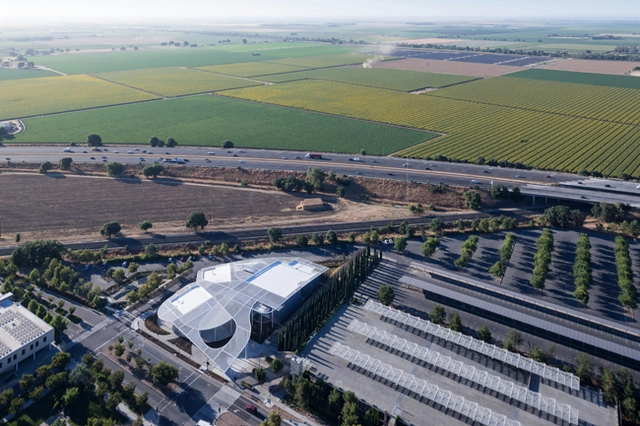
This November, the Manetti Shrem Museum on the University of California, Davis, campus opened to the public. Designed by New York City–based SO-IL with the San Francisco office of Bohlin Cywinski Jackson, the museum pays homage to the agricultural landscape of California’s Central Valley with an oversize roof canopy. The steel members of the 50,000-square-foot (4,650-square-meter) shade structure, nearly twice the size of the museum itself, reference the patterning of plowed fields and create a welcoming outdoor space for visitors. It is both expressive and practical, but getting that balance wasn’t easy.

SO-IL, founded by Florian Idenburg and Jing Liu in 2008, has a portfolio filled with smaller projects, installations, and exhibition-related work. The Manetti Shrem Museum is easily the firm’s largest work to date, demanding a rigorous design-build process while maintaining a strong conceptual vision. In short, it required architecture.

“Re-Constructivist Architecture” Exhibition Explores the Lost Art of Architectural Language

Subscriber Access | 

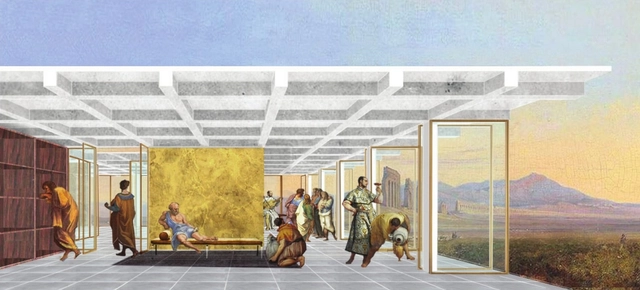
Re-Constructivist Architecture,” an exhibition now on show at the Ierimonti Gallery in New York, features the work of thirteen emerging architecture firms alongside the work of Coop Himmelb(l)au, Peter Eisenman and Bernard Tschumi. The title of the exhibition is a play on words, referring to the De-Constructivist exhibition of 1988 at the Museum of Modern Art that destabilized a certain kind of relationship with design theory.

This reconstruction is primarily of language. The architects draw from archives—mental, digital or printed on paper—distant from the typical parametric and highly schematic rationales that characterized the last thirty years of design in architecture. Within the theoretical system that drives architectural composition, these archives inevitably become homages, references, and quotes.

“Re-Constructivist Architecture” Exhibition Explores the Lost Art of Architectural Language - Image 2 of 4“Re-Constructivist Architecture” Exhibition Explores the Lost Art of Architectural Language - Image 3 of 4“Re-Constructivist Architecture” Exhibition Explores the Lost Art of Architectural Language - Image 20 of 4“Re-Constructivist Architecture” Exhibition Explores the Lost Art of Architectural Language - Image 27 of 4“Re-Constructivist Architecture” Exhibition Explores the Lost Art of Architectural Language - More Images+ 41

Why "Young Architecture" is a Detriment to the Profession

Subscriber Access | 

As one of the first organizations to implement a regular award for young architects, The Architectural Review has had its eye on youth for over a decade and a half. But with awards, exhibitions and media coverage of those conspicuously labeled as "Young Architects" proliferating in the years since, has the concept now been co-opted by those who merely seek to monetize and exploit architecture's most precarious practitioners? In this polemical article, originally published by The Architectural Review as "The problem with 'Young Architecture'," AR Assistant Editor Phineas Harper and Phil Pawlett Jackson unpick how the cult of "Young Architecture" has been absorbed into the profession, with potentially harmful ramifications.

When the romantic notion of the architect as auteur, a high priest in the cult of culture, is married to the virginal myth of untainted youth, a potent marketable commodity is brewed: the "Young Architect". All but invisible when the AR launched its Emerging Architecture prize at the end of the 20th century, this breed is now celebrated in numerous awards, exhibitions and published collections. But beware the cult of youth − there is a broad landscape of risks as well as opportunities facing designers who choose this identity willingly or have it thrust upon them.

Why "Young Architecture" is a Detriment to the Profession - Image 1 of 4

MOS Architects wins the P.S.1 competition

Subscriber Access | 
MOS Architects wins the P.S.1 competition - Image 4 of 4

We just got the news that MOS Architects won the competition to build a temporary installation at MoMA´s P.S.1 during this summer.

For this competition the P.S.1 invites each year a group of emerging architects to experiment with new shapes and materials, as Work AC did last year with their PF1 project.

MOS project is entitled Afterparty, a design that Micheal Meredith and Hilary Sample (MOS partners) say is meant  to honor and reflect current economic realities, by using basic materials. The main structure is a lightweight aluminum frame using recyclable parts which require minimal assembly, which will become a landmark for the neigborhood – all this on a USD$70,000 budget.

I spoke with Michael a few minutes ago and he refered to the name of the project: One thing about the “Afterparty,” as we’re calling it, is the need to look for new promiscuities after the party of a sort of high-formalism which has dominated academic discourse, and in our case it’s with the basic structural arch geometries, rough almost singular materiality and the production and interaction of “environment,” (literally cooling down the courtyard through stack effect) looking towards a more primitive state of architecture. – (See afterparty definition on Wikipedia).

The project is still under development, and we´ll keep you posted on further updates. We´ll try to do a good coverage on this as we did last year.

You can see other works from MOS previously featured on AD: Floating House and their ORDOS 100 villa.

More images of Afterparty after the break.

AD Interviews: Shohei Shigematsu, OMA*AMO NY

Subscriber Access | 

A few weeks ago we started conducting a series of video interviews with some of the most promising young architects. In times when “ architect may no longer mean architect“, they were asked to talk about key aspects of their role as an architect in modern society, among other topics to discuss about the direction of architecture.

Our first guest is Shohei Shigematsu (1973). He graduated from the Department of Architecture at Kyushu University in 1996, and then went to the Berlage Institute in Amsterdam. He started working at OMA in 1998, becoming an associate in 2004. He´s now the director of OMA*AMO NY, working on projects such as the CCTV Headquartes in Beijing, the design of the Whitney Museum extension in NY, the Millestain Hall at Cornell, the Stock Exchange at Shenzhen, the Torre Bicentenario in Mexico and a mixed use building in Jersey City.

Photos of OMA NY after the break.