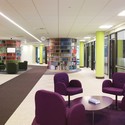
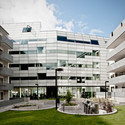
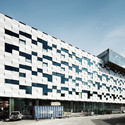
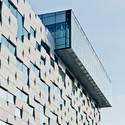
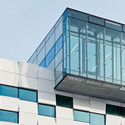
Belatchew Arkitekter has presented a concept for transforming high-rise towers into power-generating factories. The Swedish firm's proposal involves covering a Stockholm skyscraper with "electricity-generating bristles". The tower in question is Henning Larsen's Söder Torn tower on Södermalm in Stockholm. Belatchew has designed a wind farm that will top the existing building with a 16-story extension, covering the facade with "hairy-looking plastic straws designed to move with the wind".
Join us after the break for more details and images of this proposal.
Developed by Spacescape, Airport City Stockholm, in cooperation with Swedavia Swedish Airports (state), Sigtuna municipality, and Arlandastad Holding (private real estate), has a new urban design strategy and urban plan that envisions a unique airport city which emphasizes urban qualities and places sustainability in focus. Such rapid expansion has placed distinct demands on planning, which has resulted in this collaborative effort. Creating these foundations, along with offering the world within walking distance, will increase value and attract even more people and businesses. More images and architects' description after the break.
The Future of Places Forum, the inspiration for our Ten Ways to Transform Cities through Placemaking & Public Spaces article published earlier this week, will open this June in Stockholm, Sweden. The forum will be hosted by UN-HABITAT, Project for Public Spaces (PPS) and the Ax:son Johnson Foundation and will be the first of three conferences leadingup toHabitat III in 2016. Its overall aim is to "contribute to a New Urban Agenda around people and places" and to "highlight how and why cities need to embrace a people centered approach in order to achieve positive urbanization." The conference series will define examples of excellent urban practices from around the world as well as future projects that reflect sustainable and equitable processes which build community, enhance quality of life, and creates safe and prosperous neighborhoods.
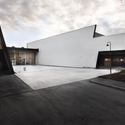
Designed by White arkitekter their Park 1 project is intended to house a traffic and emergency management center, a new fire station and a total of 1,200 new workplaces in which effective coordination will be created on an everyday basis. Located in Stockholm, the building complex inclines back from Lindhagensgatan in a generous gesture which marks the entrance while also boldly cantilevering slightly into space towards the Essingeleden highway and above all of the movement and communication at the site. More images and architects' description after the break.
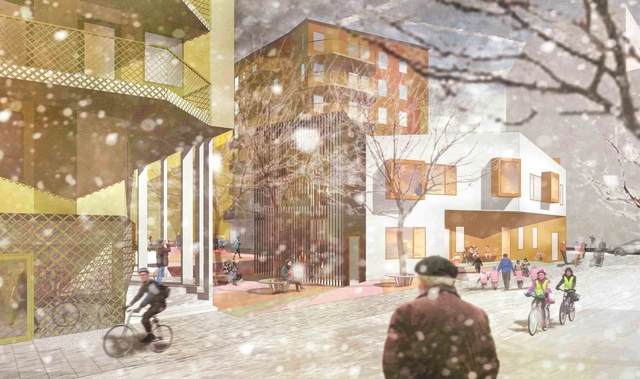
GRAD Arkitekter shared with us their proposal for a housing block in the now unbuilt area of Årstafältet, a southern suburb of Stockholm. Once finished, this area will house approximately 10,000 inhabitants. To secure this variation, the city proposes that each block is divided in two halves, with a team of a contractor and an architecture team responsible for every half. The basic design principle of their block is to shift and tilt four buildings in relation to one another, to create interesting views and a good flow of natural light. More images and architects' description after the break.
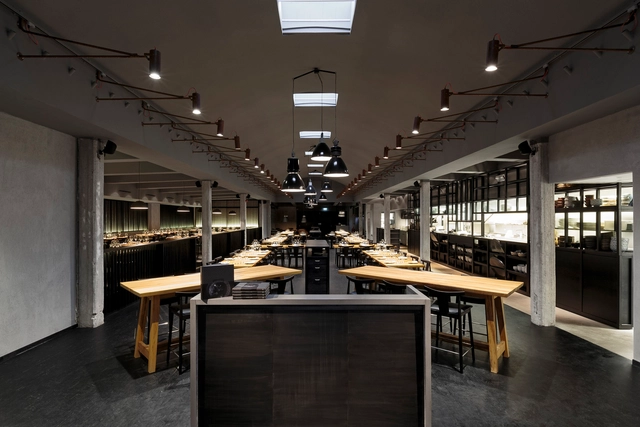
On view now until February 9th, the installation by Swedish architect Gert Wingårdh at the Furniture Fair in Stockholm suggests a church interior, with rows of high tables in front of an ‘altar’ where panels hold sway. In collaboration with Finnish illustrator Kustaa Saksi, their creative teamwork has resulted in a design that will set the stage for talks on design and architecture at the fair. Starting out from their own perspective while adhering to a shared vision, the entire dome-like structure consists of stacks of paper sheets that hang from the roof in a Venetian blind-like construction. More images and their description after the break.
Marking the entrance to Stockholm’s inner city center, the Stockholm City Station. Designed by 3XN Architects, integrates the station, a hotel, conference center, and apartments. The main idea behind the design was to create a building that gently adjusts to the area’s existing building in scale and expression, and which reinterprets a number of local Swedish design traditions. Containing a number of public and private functions, the building will contribute positively to creating life in the surrounding neighborhood. More images and architects’ description after the break.
Our friends from Visiondivision have envisioned a creative solution to respond to Stockholm’s lack of housing. While the city is growing rapidly, the pace of new construction for residences is quickly falling behind demand. Due to this lack of housing, the core of Stockholm has grown to be defined by expensive apartments, while the outer edges for those who can’t afford such prices. For Stockholm Stacked, Visiondivision responds to this segregated city by proposing a change in planning regulations to eliminate height restrictions on courtyard typologies, so as to utilize the urban spaces for efficiently and effectively. After all, “Who wants to move to a city where it is impossible to get an apartment? Which companies wants to invest in a city where their employees may have a hard time to find a place to stay? Which exchange students wants to study in a city where all the free time available will go to find a small flat with a decent rent?” asks the firm.