1. ArchDaily
  2. Sensory Design

Sensory Design: The Latest Architecture and News

A Multicolored Glass Canopy for Senses, Shelter and Hospitality: The Vertical Panorama Pavilion

 | Sponsored Content

Although the sensory approach in the built environment is often based primarily on visual aspects, such as color and light, as we delve deeper into the relationship of architecture with the senses other essential elements emerge, such as aromas, textures, sounds, and even flavors. These components are fundamental to creating a profound experience between the user and the environment in which it takes place, demonstrating that design and sensory experience are intrinsically connected.

Thus, sensory design offers an immersive atmosphere for a full spectrum of senses where its perception extends beyond physical boundaries. An example of this is the Vertical Panorama Pavilion, located in a region of California (USA) with a strong identity linked to the wine tradition. This structure, with a glass canopy of Color PVB interlayers, serves as a shelter for hospitality. Inspired by nature, the pavilion’s canopy engages all the senses: from the texture of the gravel on the walking path to the wind currents in the area and the characteristic aromas of the region.
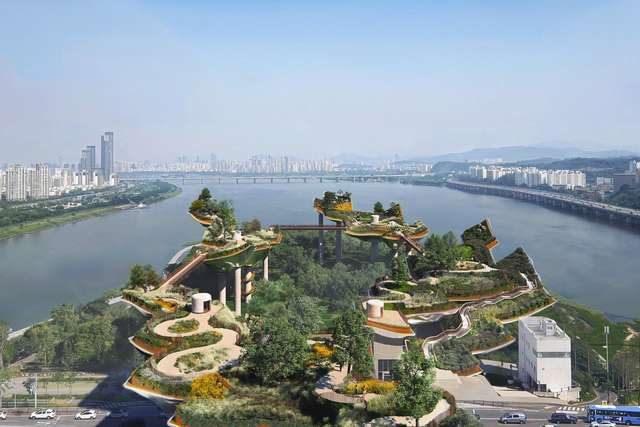

Heatherwick Studio Wins Competition to Reimagine Seoul’s Nodeul Island in South Korea

Heatherwick Studio has just won the global competition to transform Seoul’s uninhabited Nodeul Island on the Han River into a lively public park. Titled “Soundscape,” the winning project “creates a trail of dramatic spaces on different levels that can host musical performances and artistic interventions.” Situated within a green and biodiverse landscape, the design echoes Seoul's mountainous terrain and the patterns of sound waves.

3XN/GXN Presents "Aware: Architecture and Senses" at the Danish Architecture Center

3XN/GXN has just opened its exhibition “Aware: Architecture and Senses,” hosted at the Danish Architecture Center until September 15th, 2024. The display invites visitors to explore, comprehend, and interrogate their relationships with architecture. In collaboration with the Danish Architecture Center, 3XN/GXN delves into the conversation between individuals and spaces, showcasing six life-sized installations.

3XN/GXN Presents "Aware: Architecture and Senses" at the Danish Architecture Center - Image 1 of 43XN/GXN Presents "Aware: Architecture and Senses" at the Danish Architecture Center - Image 2 of 43XN/GXN Presents "Aware: Architecture and Senses" at the Danish Architecture Center - Image 3 of 43XN/GXN Presents "Aware: Architecture and Senses" at the Danish Architecture Center - Image 4 of 43XN/GXN Presents Aware: Architecture and Senses at the Danish Architecture Center - More Images+ 4

Sensory Design: Architecture for a Full Spectrum of Senses

Subscriber Access | 

A space is much more than just its appearance. Textures, smells, and sounds can strongly affect the user's experience. Based on this, sensory architecture can transform the interaction between people and the built environment into something even deeper.

Sensory Design: Architecture for a Full Spectrum of Senses - Image 1 of 4Sensory Design: Architecture for a Full Spectrum of Senses - Image 2 of 4Sensory Design: Architecture for a Full Spectrum of Senses - Image 3 of 4Sensory Design: Architecture for a Full Spectrum of Senses - Image 4 of 4Sensory Design: Architecture for a Full Spectrum of Senses - More Images+ 4

Creating Energy-Efficient Buildings: The Role of Human Interaction and Sensory Technology

How do we create buildings that use energy efficiently? Traditionally, efforts to green the built environment have centered on the physical infrastructure, often overlooking the relationships between people and space. The emergence of the technological era has ushered in "Smart Buildings." that employ machine learning and automation. These innovative structures are designed to operate with impressive energy efficiency, however, they are largely disconnected from their occupants. What if buildings could be made smarter and more sustainable by engaging with their occupants?
Creating Energy-Efficient Buildings: The Role of Human Interaction and Sensory Technology - Image 5 of 4Creating Energy-Efficient Buildings: The Role of Human Interaction and Sensory Technology - Image 1 of 4Creating Energy-Efficient Buildings: The Role of Human Interaction and Sensory Technology - Image 2 of 4Creating Energy-Efficient Buildings: The Role of Human Interaction and Sensory Technology - Image 3 of 4Creating Energy-Efficient Buildings: The Role of Human Interaction and Sensory Technology - More Images+ 1

Emotional Architecture: How Contextual Solutions Can Fight against the "Epidemic of Boringness"

Subscriber Access | 

In his latest TED Talk, Thomas Heatherwick decries a condition affecting areas of the city defined by monotonous buildings, or what he calls “an epidemic of boringness.” While recognizing the functionality which drove these designs, he states that functionality alone cannot ensure that the structures become active parts of urban life, as they often fail to provoke an emotional response from passers-by. Heatherwick explains that, in his view, this emotional function, or the ability of buildings to mean something to their users and visitors, is essential. When it succeeds, architecture can positively contribute to the quality of life and well-being of its residents, promote social cohesion and contribute to a sense of identity. So how can architecture provoke a positive emotional connection and provide an enjoyable backdrop to the communities it serves?

Emotional Architecture: How Contextual Solutions Can Fight against the "Epidemic of Boringness" - Image 1 of 4Emotional Architecture: How Contextual Solutions Can Fight against the "Epidemic of Boringness" - Image 2 of 4Emotional Architecture: How Contextual Solutions Can Fight against the "Epidemic of Boringness" - Image 3 of 4Emotional Architecture: How Contextual Solutions Can Fight against the "Epidemic of Boringness" - Image 4 of 4Emotional Architecture: How Contextual Solutions Can Fight against the Epidemic of Boringness - More Images+ 10

The Pavilion of Saudi Arabia Explores Legacy and Materiality at the Venice Biennale 2023

Saudi Arabia announced its participation at the 18th International Architecture Exhibition – La Biennale di Venezia, with an exhibition titled IRTH إرث, legacy in Arabic, exploring qualities of materials in relation to the Saudi landscape. The third round of participation the Saudi Pavilion will have at the International Architecture Exhibition, this year's edition is represented by architect AlBara Saimaldahar and curated by the duo Basma and Noura Bouzo. The Pavilion will be on display at the Arsenale – Sale d’Armi 2023.

Sensory Maps: What the Sense of Smell Can Reveal about Urban Environments

Every city is a complex environment, bringing together people, cultures, architecture, commerce, and even nature. While experiencing a city, a lot of attention is given to its appearance, but appearance is not everything. The theory of sensory design aims to go beyond vision and explore the richness of the built environment through textures, smells, and sounds. For city officials and planners, a lot of attention generally goes towards how a city looks and sounds, but in terms of smell, the focus is mainly on managing waste or cleaning unsanitary areas. Yet the sense of smell, so often overlooked, is strongly linked to the creation of emotional memories. It contributes to our understanding of the world; it reveals otherwise hidden cultural practices, and it rounds up the experience of an environment.

Sensory Maps: What the Sense of Smell Can Reveal about Urban Environments - Image 1 of 4Sensory Maps: What the Sense of Smell Can Reveal about Urban Environments - Image 2 of 4Sensory Maps: What the Sense of Smell Can Reveal about Urban Environments - Image 3 of 4Sensory Maps: What the Sense of Smell Can Reveal about Urban Environments - Image 4 of 4Sensory Maps: What the Sense of Smell Can Reveal about Urban Environments - More Images+ 6

This Week in Architecture: More than Visual

Architecture is a profession deeply dependent on the visual. It’s imagined, sold, critiqued and consumed almost entirely on the strength (or lack thereof) of drawings. We pick and prod at images presented at angles we’ll never be able to see, admiring the architectonic qualities of elements we’ll never actually experience.

Touch It, Smell It, Feel It: Architecture for the Senses

Touch It, Smell It, Feel It: Architecture for the Senses - Featured Image
Arakawa + Gins' Bioscleave House in East Hampton, New York used non-orthogonal geometries, undulating floors, and even isolation pods in their experiments to create architecture's that would "stop ageing." Image via Metropolis Magazine. Image Courtesy of Dimitris Yeros, © 2008 Estate of Madeline Gins, Reproduced with permission of the estate of Madeline Gins

This article was originally published on Metropolis Magazine as "Architecture You Can Smell? A Brief History of Multisensory Design."

What comes to mind when you encounter the term “sensory design”? Chances are it is an image: a rain room, a funky eating utensil, a conspicuously textured chair. But the way things actually feel, smell, even taste, is much harder to capture. This difficulty points to how deeply ingrained the tyranny of vision is. Might the other senses be the keys to unlocking broader empirical truths? Does the ocular-centric bias of art, architecture, and design actually preclude a deeper collective experience?

What It’s Like to Be an Architect Who Doesn’t Design Buildings

There's an old, weary tune that people sing to caution against being an architect: the long years of academic training, the studio work that takes away from sleep, and the small job market in which too many people are vying for the same positions. When you finally get going, the work is trying as well. Many spend months or even years working on the computer and doing models before seeing any of the designs become concrete. If you're talking about the grind, architects know this well enough from their training, and this time of ceaseless endeavor in the workplace only adds to that despair.

Which is why more and more architects are branching out. Better hours, more interesting opportunities, and a chance to do more than just build models. Furthermore, the skills you learn as an architect, such as being sensitive to space, and being able to grasp the cultural and societal demands of a place, can be put to use in rather interesting ways. Here, 3 editors at ArchDaily talk about being an architect, why they stopped designing buildings, and what they do in their work now.