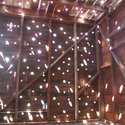
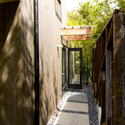
This year's Seattle Design Festival, hosted by Design in Public and AIA Seattle, will feature large scale installations, home tours, walking tours, films, lectures, exhibitions, competitions, activities, pop-up parklets, and more which is open to the general public. The city-wide event takes place September 13-22 with the hub of the festival at the ‘Design Block’ in Pioneer Square. This year's theme is ‘Design in Health’ exploring the connection between environmental design and health & well-being. Design can improve health by: promoting physical activity, increasing access to healthy food, reducing injuries, improving air and water quality, minimizing stress, and strengthening the social fabric of communities. More information after the break.
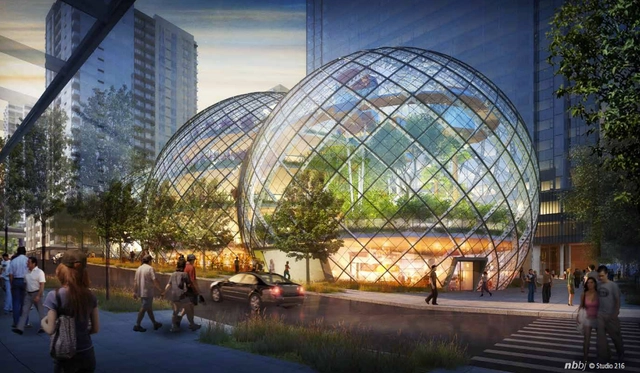
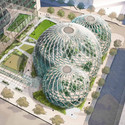
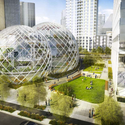
In an attempt to “create an alternative environment” in the center of Amazon’s recently approved, three-block headquarters planned for downtown Seattle, NBBJ has submitted a revision that would replace a six-story office building with a tri-sphere biodome that will host various forms of plant life and provide a more natural setting for employees to work and socialize. Perhaps this change is Amazon’s way of “keeping up with the Joneses”, as many leading corporations - Apple, Google, and Facebook - have been unveiling plans to construct one-of-the-kind office complexes centered around sustainability, innovation and collaboration.
The Bullitt Center, a six-story, 50,000 square foot office building in Seattle that aspires to be the world's greenest commercial building, opens its doors to the public today on Earth Day. This $30 million "living laboratory," designed by Miller Hull Partnership, distinguishes itself from other sustainable projects with its composting toilets, the exclusion of 350 common toxic chemicals - including PVC, lead, mercury, phthalates, BPA and formaldehyde - along with a strict energy and water budget that aims for self-sufficiency under the Living Building Challenge. The environmentally-conscious Bullitt Foundation hopes that the new center will demonstrate that carbon-neutral office space can be "commercially viable and aesthetically stunning," a series of systems that can be easily copied elsewhere without being overly demanding in upkeep.
Read more about the Bullitt Center after the break...
Seattle-based architect Jim Olson of Olson Kundig Architects has been selected by Washington State University to design a new Museum of Art. Over the years, Olson has complied a spectacular portfolio of stunning homes designed for art collectors worldwide. This experience has given Olson a “wealth of experience in not only crafting beautiful environments for works of art, but in working with artists to discover new opportunities for expressing their creativity,” according to Chris Bruce, director of the museum.
Enthusiasm for water and energy data collection for commercial and residential buildings has been growing strong across the U.S. in major cities such as Austin, New York, Washington D.C. and San Francisco. It's no surprise to learn that Earth-friendly Seattle is ahead of the game when it comes to tracking its buildings; reports show that the city is receiving data for a whopping 87% of its commercial and multi-residential buildings over 50,000 square feet, which totals to 1,160 individual properties covering over 200 million square feet of the city.
With a 3-2 vote, Seattle’s Downtown Design Review Board has voted in favor of Amazon’s plans for a three-block, high-rise complex in the Denny Triangle. The board voted after conducting five, comprehensive meetings over the last six months to review Amazon’s evolving NBBJ-designed proposal. Although this design review approval is simply a recommendation to the city’s Department of Planning and Development, it is still a milestone for the ambitious project.
The five acre site, roughly located between Sixth Avenue, Blanchard Street and Westlake Avenue, is currently occupied by expansive parking lots, the Sixth Avenue Inn and the King Cat Theater. Continue after the break to learn more.
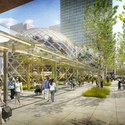
NBBJ’s design for the Amazon’s new headquarters in downtown Seattle, Washington, promises to consolidate the companies currently scattered buildings into a 3-block development that includes high-rise towers, a variety of open spaces, and landscaped plazas. The 3.3 million square foot design was presented to the city’s Design Review Board (DRB) in great detail outlining the division of the each of the buildings, their integration into the downtown urban fabric and the synthesis of the currently underdeveloped Denny’s Triangle.
The annual Seattle Design Festival, created by Design in Public, is an event that encourages all to ‘engage our world’ by offering the public an opportunity to better understand design and how it adds value to our lives, our city, and our region. This fun-filled weekend, which takes place September 20-23, is a collaboration among ten nonprofit partners that created an ambitious set of offerings: more than 35 events, including tours, films, speakers, exhibits, installations, and family programs—all aimed at a public audience. For more detailed information, including a complete list of events going on that weekend, please visit here.
Earlier we shared with you these rough clips of the recently completed CCTV Headquarters in Beijing, filmed by Tomas Koolhaas as part of a feature length documentary film that he currently making about his father, Rem Koolhaas. In this short clip, Tomas Koolhaas interviews a homeless man inside the Seattle Central Library as an attempt to capture his unique experience within the glass and steel mesh walls of the famous public library.
Tomas Koolhaas studied at the Los Angeles Film School. Upon graduating, he spend ten years working as a cinematographer and has recently switched his focused more towards directing and writing. The documentary film, REM, is set to debut in 2013. Watch for updates here on the REM Facebook page.
RETHINK REUSE, an independent group whose goal is to inspire discourse on the topic of reuse is inviting all to participate in their Transforming Seattle’s 520 Floating Bridge 2012 International Design Ideas Competition. The goal is to envision new, innovative reuse strategies. The 520 bridge will be decommissioned in 2014 due to high maintenance costs, damage, and the need for additional lanes. The Washington State Department of Transportation is requiring of the new bridge’s design-build team that it be reused or recycled in a sustainable fashion; current trends for the reuse of pontoons have been floating docks, breakwaters and piers, but what else could be done with such a feat of engineering? More information on the competition after the break.
With a challenge to make a series of random ephemeral public spaces using a simple structure in the Seattle Center, the intervention by Hoshino Architects proposes areas of such spaces to be transformed to voids and purely leave the circulation spaces on the ground level. In contrast, the public contents circles are randomly scattered on the field level. As normal urban spaces, the circulation spaces sometimes change to unexpected functions, such as a viewing gallery for the event staged at the field level. This dual layer structure intertwines and creates the complex ‘Porous-scape’. More images and architects’ description after the break.
A jury of internationally recognized design professionals and Seattle civic leaders has declared a winner among three semi-finalists in Urban Intervention: The Howard S. Wright Design Ideas Competition for Public Space. The winner is ABF, of Paris, France, for its design, In-Closure, which envisions an interactive wall around a forested landscape that is both flexible and dynamic, embracing social life in the city at multiple scales.
The ABF team consists of Etienne Feher, architect; Paul Azzopardi, urban engineer; and Noé Basch, climate engineer. Continue reading after the break for more details.