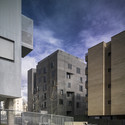
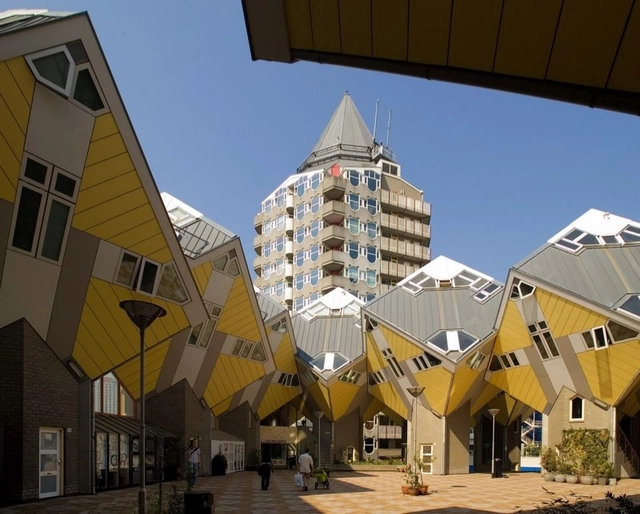
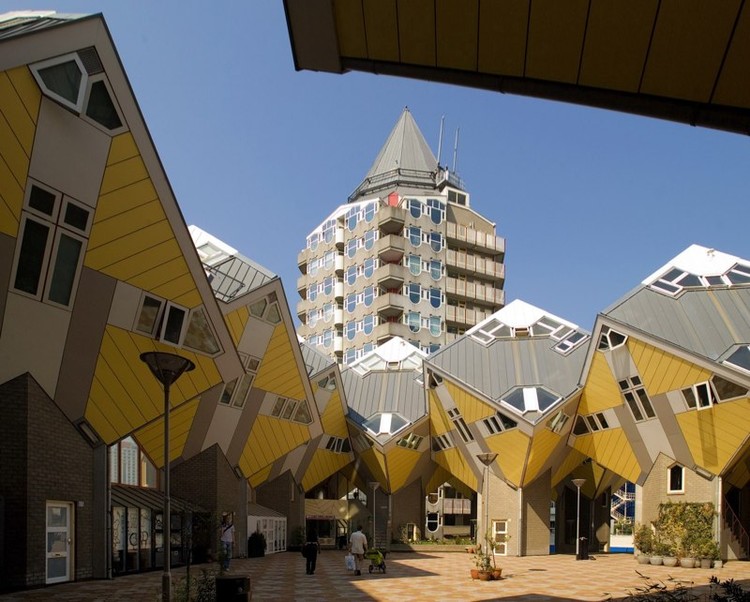
A popular tourist attraction and bizarre architectural experiment, the Kubuswoningen is located in the Oude Haven, the most historic section of Rotterdam’s port. Following the destruction of the Oude Haven during the Second World War, architect Piet Blom was asked to redevelop the area with architecture of character, presenting him the opportunity to apply his earlier cube housing exploration in Helmond to a more urban context. Known for his desire to challenge conventions, Blom did not want the Kubuswoningen to resemble typical housing; he strived to dissolve the attitude that “a building has to be recognizable as a house for it to qualify as housing.” During a time when the rebuilding of Rotterdam was pivotal, the Kubuswoningen served as an influential precedent for progressive and innovative architectural development.
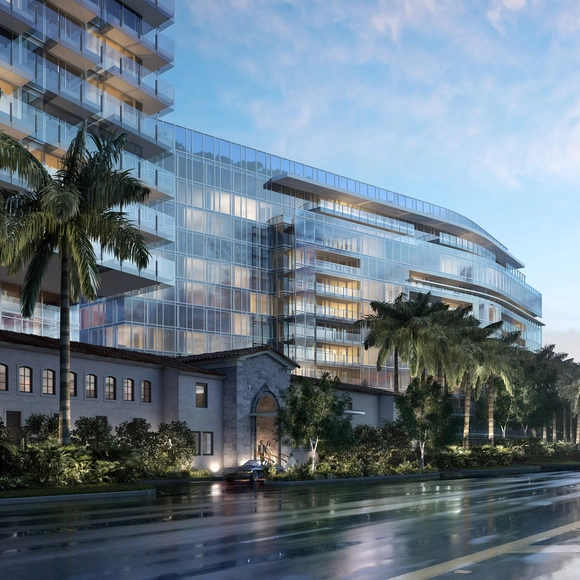
Richard Meier & Partners has unveiled designs for their first project in Bogota: Vitrvm. Conceptualized as two towers united at the base, the new 13-story residential development will provide 36 apartments along Septima Avenue in the north section of the city.
“The project is contextually inspired by the beauty of its immediate surroundings,” described the architects. “It aims to reflect and to engage the beautiful gardens and large trees at the Chico Park and the Seminario Mayor,” one of the largest and most important seminaries in Colombia.
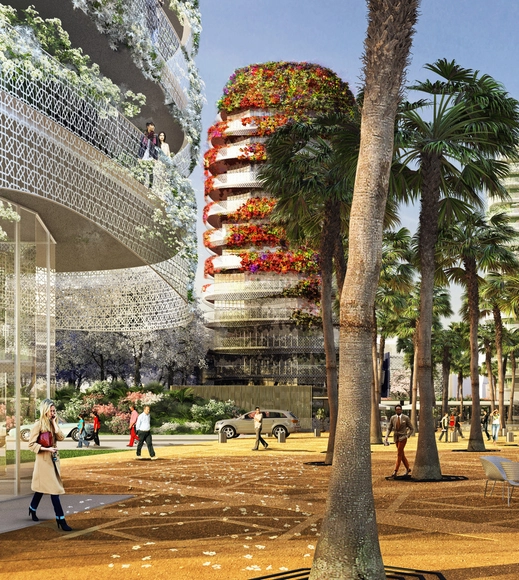
Maison Edouard Françoishas masterplanned a new mixed-use neighborhood for the Moroccan city Casablanca: “The Gardens of Anfa.” Scheduled for completion in 2017, the plan calls for three mid-rise residential towers, a low-rise office tower, and a series of residential blocks connected by a central piazza and concealed within a lush multicolored landscape. Each “organically-shaped” tower will be enhanced by a trellised facade that fosters the growth of bougainvilleas and jasmine, further camouflaging the structure and “demarcating the limits of a garden.”
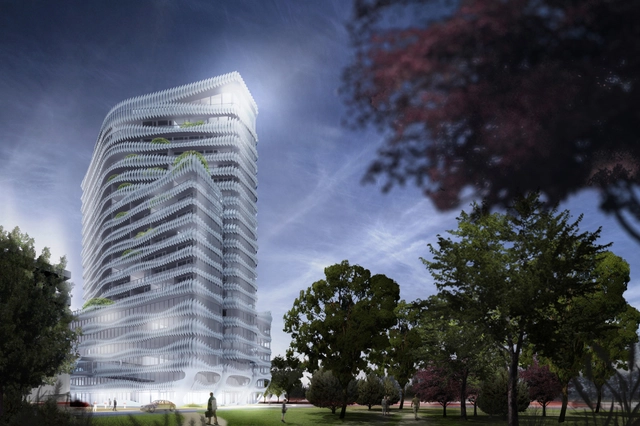
J. Mayer H. has been crowned as winner of an invited competition to design a 19-story medical services and residential high-rise in the center of the Rhine-Ruhr metropolitan region. The “sculptural” tower, which is defined by the horizontal “cloud-shaped” aluminum strips that cloak its facade, is designed to “provide a natural atmosphere” enhanced by planted terraces and balconies overlooking the adjacent landscape of the Rheinaue and views of Duesseldorf.
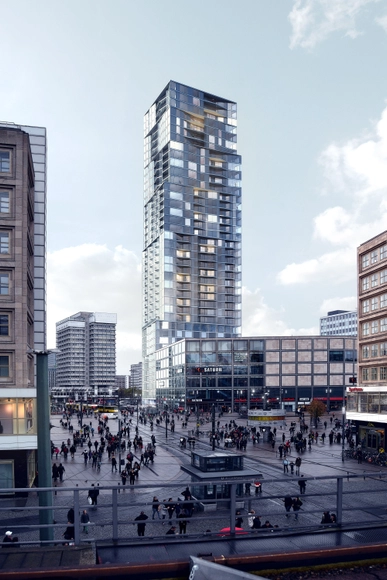
In a competition that ultimately crowned Frank Gehry as winner, Berlin’s Barkow Leibinger placed third with their 150-meter “faceted stacked building” proposal clad in glass. Aimed to be Berlin’s tallest building, the apartment and hotel tower is planned to be the city’s first high-rise residential development since the 1970s.





_DC_Towers_Michael_Nagl_Kopie.jpg?1393561879&format=webp&width=640&height=580)
_Walter_J._Sieberer_Kopie.jpg?1393561794 "© Michael Nagl")
_DC_Towers_Michael_Nagl_Kopie.jpg?1393562013 "© Michael Nagl")
_DC_Towers_Michael_Nagl_Kopie.jpg?1393561863 "© Michael Nagl")
_DC_Towers_Michael_Nagl_Kopie.jpg?1393561875 "© Michael Nagl")
_DC_Towers_Michael_Nagl_Kopie.jpg?1393561879)