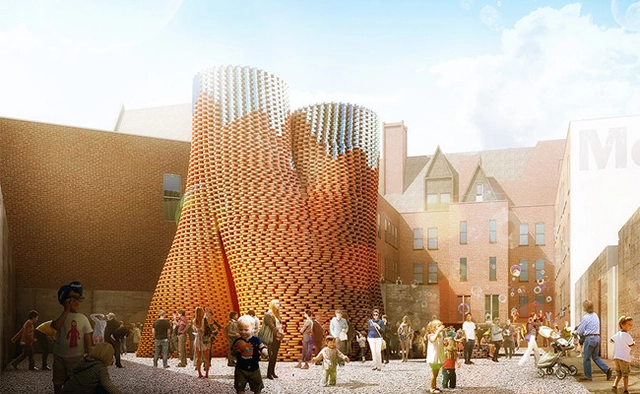
MoMA’s PS1 exhibit in Queens is a showcase for young architects with lofty ideas. This year’s winning firm “The Living” designed "Hi-Fy" - a biodegradable brick tower. Although the idea might seem far-fetched for housing, the idea is gaining traction. North Carolina start-up bioMason, recently won the Cradle to Cradle Product Innovation Challenge for their “biodegradable bricks.” So Kieron Monks at CNN had to ask the question, would you live in a house made of sand, bacteria or fungi? Find out the benefits of these modern bricks here.
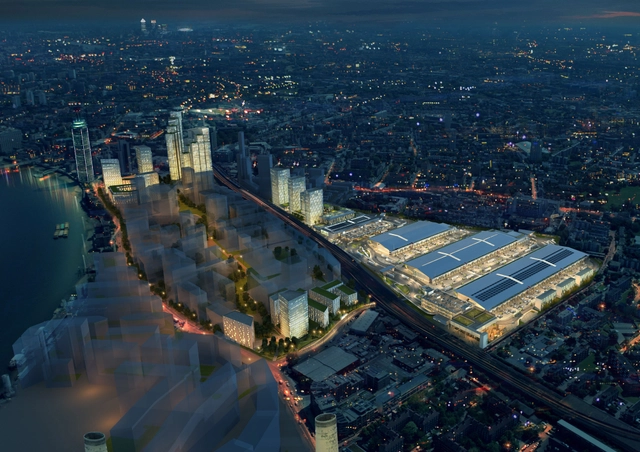
BDP and SOM have submitted plans for 'The Garden' a new market which will be the largest new development in the Nine Elms area around Battersea Power Station in London. The £2 billion plans replace the existing New Covent Garden Market, the UK's largest fruit, vegetable and flower market, in addition to adding a mixed-use neighborhood of 3,000 homes and over 200,000 square feet of office and retail space.
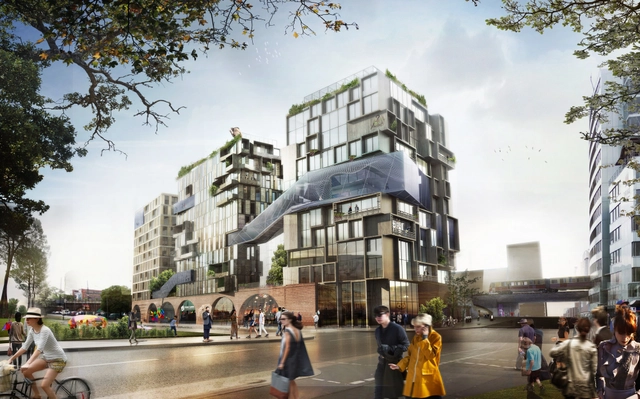
GRAFT and Kleihues+Kleihues has teamed up with Genossenschaft für urbane Kreativität (Cooperative for urban Creativity) to realize a complex of five towers centered around working and living in Berlin, Germany. Titled “Eckwerk,” the new complex is set to rise within the confines of an existing viaduct, whose shape and materiality served as the project’s main source of inspiration.
Exterior view of the observatories. Visuals by Lauren Shevills, Ross Galtress, Charlotte Knight, Mina Gospavic
Five young design graduates based in Britain have recently won a competition to design an artist’s residency in the south-western region of the United Kingdom. Titled "The Observatories," these residences are split into two separate volumes: a study and a workshop. Artists will be able to live in the private back section of the study, which has a fold-out bed and necessary amenities. The workshop will be more open, allowing artists to teach and engage with the public. Both volumes are capable of rotating 360 degrees, giving residents a fresh frame of view, and facilitating interaction between these residents and passerby.
In 2009, the Brazilian government launched the social housing program “Minha Casa, Minha Vida” (“My House, My Life”), which aims to build 3.4 million housing units by the end of 2014. Minha Casa—Nossa Cidade (Ruby Press, 2014), produced by the MAS Urban Design program at the ETH Zurich, examines the project at a critical time and presents ways to improve its design and implementation. Divided into three chapters, the book reviews the history, guidelines, and construction of the “Minha Casa, Minha Vida” program (MCMV) through long-form essays, opinion pieces, interviews, diagrams, and photographic image material. The following excerpt, written by Sandra Becker, proposes an answer to the question of why the program - despite its aims to meet the huge demand for housing for low-income families - has thus far failed to provide the Brazilian people the “quality cities [they] desire.”
From the Publisher. In June 2013, Brazil saw a wave of protests unprecedented in the country's history. Millions of people filled the streets demanding better education, public transportation, and healthcare. While the rage driving the protests was directed at politicians, it is unlikely that the problem can be reduced to the failure of the political system. Instead, shouldn't the protests point out the inequalities caused by the neoliberal policies that dominate the global economy?
In the first quarter of 2009, responding to the global financial crisis that had begun the previous year, the Brazilian government launched an ambitious social housing program to encourage the economy's construction sector. The program, “Minha Casa, Minha Vida,” was initially developed to build one million houses. In September 2011, the program launched its second phase with a goal of providing another 2.4 million housing units. The program aims to confront a historical deficiency in housing, a shortage of approximately 5.8 million dwellings.
In response to New York City’s rapidly expanding population, NBRS + Partners has proposed a 40 story tall skyscraper that could help the city embrace its rapidly shifting demographics and size. Entitled “VIVO on High Line,” the adaptable steel-frame tower is essentially the vertical extension of the city’s beloved High Line park.
“The podium screen engulfs the High Line folding it in and extending the lifeblood into the building base, like capillary action drawing it vertically,” described the team.
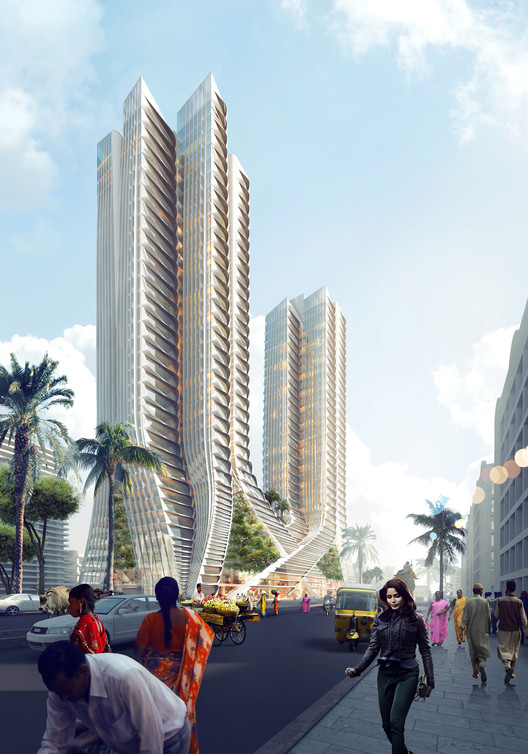
Construction has begun on 3XN’s first project in India. Aesthetically inspired by local foliage, the 136-meter “Grove Towers” are designed to interweave at their base, much like the roots of the native mangrove trees. These lower, “interwoven” floors will house retail establishments, while the upper floors will be given over to residential units.
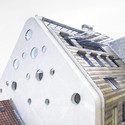
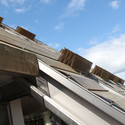
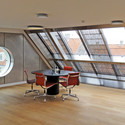
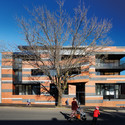
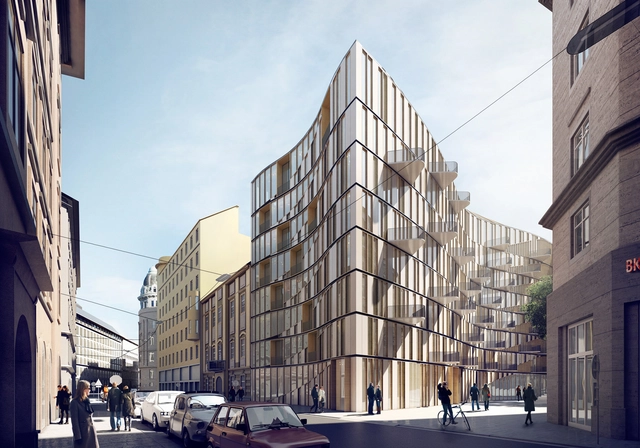
International design firm 3XN has recently won a competition to design a residential building in downtown Vienna, Austria. Being so close to the historic center of the city, the project required a unique but unobtrusive appearance. With this in mind, a subtle, curving façade composed of warm colors was developed for the exterior.



.jpg?1400477879 "© Michel Denancé")
.jpg?1400499040 "© Takuji Shimmura")
.jpg?1400478659 "© Michel Denancé")
.jpg?1400498606 "© Takuji Shimmura")