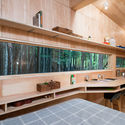
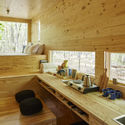
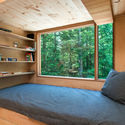
Following a successful pilot launch in Boston and $1 million in venture backing, a startup company called Getaway has recently launched their service to New Yorkers. The company allows customers to rent out a collection of designer “tiny houses” placed in secluded rural settings north of the city; beginning at $99 per night, the service is hoping to offer respite for overstimulated city folk seeking to unplug and “find themselves.” The company was founded by business student Jon Staff and law student Pete Davis, both from Harvard University, out of discussions with other students about the issues with housing and the need for new ideas to house a new generation. From that came the idea of introducing the experience of Tiny House living to urbanites through weekend rentals.
Inspired by the notion of micro-housing and the powerful rhetoric of the Tiny House movement, initiatives like Getaway are part of a slew of architectural proposals that have emerged in recent years. Downsizing has been cited by its adopters as both a solution to the unaffordability of housing and a source of freedom from the insidious capitalist enslavement of “accumulating stuff.” Highly developed and urbanized cities such as New York seem to be leading the way for downsizing: just last year, Carmel Place, a special micro-housing project designed by nARCHITECTS, was finally completed in Manhattan to provide studio apartments much smaller than the city’s current minimum regulation of 400 square feet (37 square meters). Many, including Jesse Connuck, fail to see how micro-housing can be a solution to urban inequality, yet if we are to judge from the early success of startups like Getaway, micro-architecture holds widespread public appeal. Isn’t user satisfaction the ultimate goal of architecture? In that case, it’s important to investigate the ingenuity behind these undersized yet often overpriced spaces.
In this interview, presented in collaboration with PLANE—SITE, Jack Self—co-curator of the British Pavilion at the 2016 Venice Biennale—reveals how the frontline of architecture in Britain today is not just a housing crisis, but "a crisis of the home." In provocatively presenting "the banal," Self reveals why the British participation at the 2016 Venice Biennale proposes five new models for domestic life, each curated through time of domestic occupancy, alongside how it seeks to address the ways in which we might live in the future.
https://www.archdaily.com/790670/video-designing-through-time-home-economics-2016-venice-biennaleAD Editorial Team
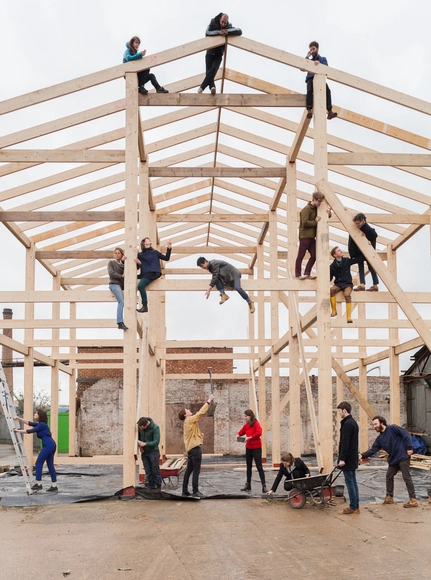
Assemble. Award winning housing artist-architects - Keynote speakers
Keynote Speakers:
Art and Architecture Collective (Turner Prize Winners), Assemble | David Waterhouse, Commission of Architecture and the Built Environment | Andy von Bradsky, Royal Institute of British | Steve Cole, National Housing Federation | Mayor of Liverpool, Liverpool City | Charlotte Harrison, Northern Housing Consortium
The role of government in ensuring social and affordable housing is complex. With budget cuts and shifts in political priorities changing the terrain constantly what the governments of our cities need are new long term ideas
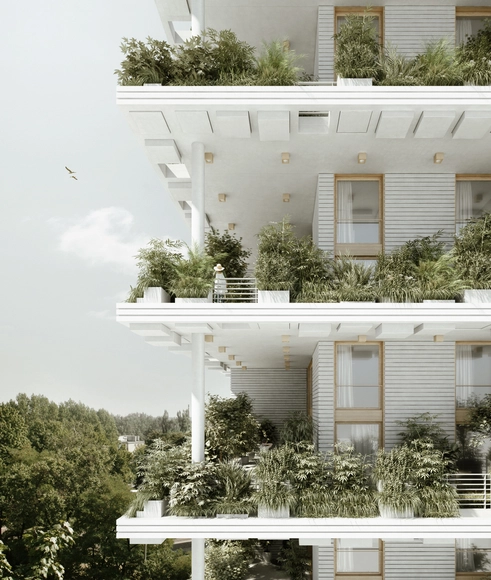
Penda has released plans for a series of stacked villas that will bring gardens high into the skies of Hyderabad, India. The complex is the second stage of the Magic Breeze project for Pooja Crafted Homes – the first stage featuring a landscape design inspired by Indian stepwells and water mazes. The 450,000 square foot (42,000 square meter) development will include 127 duplex sky villas, ranging in size from 2,600 to 4,000 square feet (240 to 370 square meters), each separated by a double-height private garden terrace. The structure will be integrated into the landscape design, turning the park on its side to continue vertically up the side of the building.
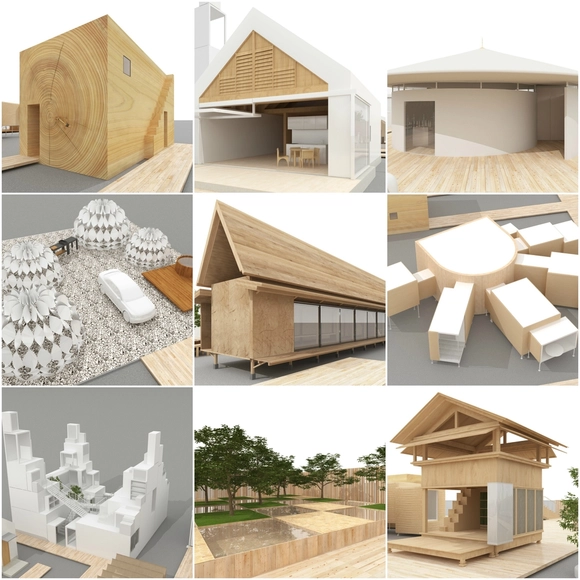
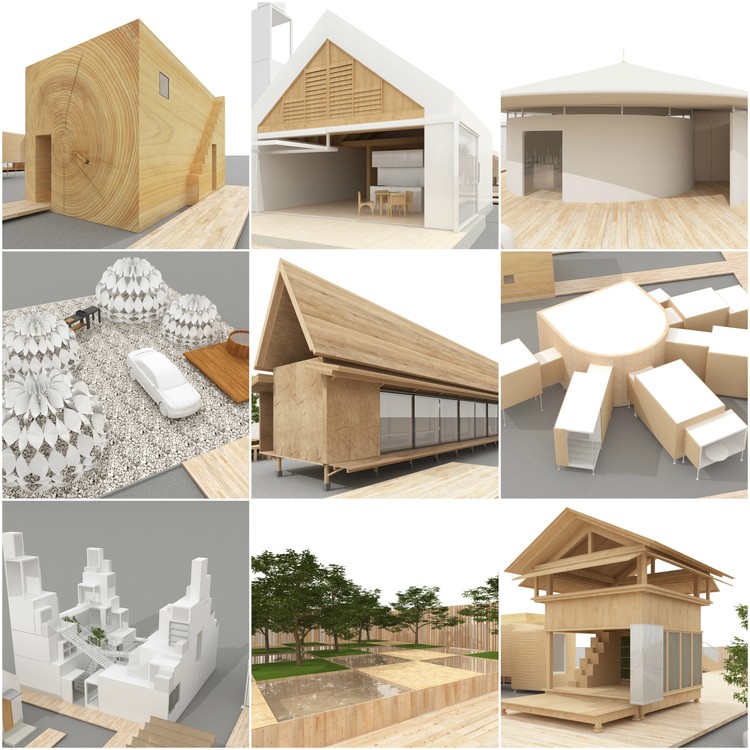
Following the success of the inaugural HOUSE VISION Tokyo in 2013, the exhibition is set to return again this summer under the theme of “Co-Dividual: Split and Connect / Separate and Come Together.” Once again curated by Kenya Hara, designer and creative director for minimalist housewares retailer Muji, the month-long event will tackle the objective of “thinking about how to create new connections between individuals,” as well as build upon the topics explored by its previous edition, namely the ways in which Japanese housing can adapt to recent demographic, technological and cultural shifts, and the vision of the house as the intersection between industries.
This year’s exhibition will feature house designs by top Japanese architects such as Sou Fujimoto, Kengo Kuma, Shigeru Ban and Atelier Bow-Wow, each paired with a leading company to envision and implement new strategies in housing design. The houses will be constructed at full-scale, allowing event-goers to fully experience and reflect upon each design.
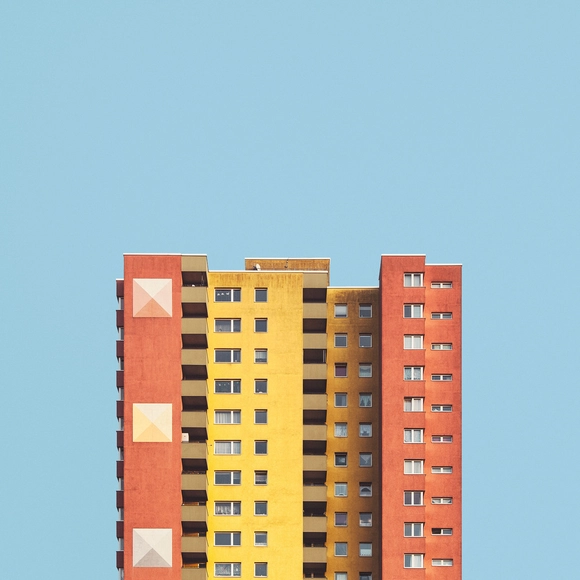
In this series, entitled Stacked, photographer Malte Brandenburg takes a closer look at the architectural merits of Berlin’s post-war housing estates. Captured against a flat blue sky, the images seek to strip away the historical and social burdens carried by the buildings, presenting them instead as pieces of pure architecture.
As part of ArchDaily's coverage of the 2016 Venice Biennale, we are presenting a series of articles written by the curators of the exhibitions and installations on show.
Britain is suffering from a terrible housing crisis – one that is an incredibly predictable outcome of decades of neoliberal economic policy. The Chilean architect Alejandro Aravena has become well-known for building “half a house” – only completing core infrastructure in social housing, then encouraging residents to finish the other half with their own money over time. In effect, the first generation get a significantly cheaper home, but once the house has been doubled it could be sold at market rate. The discount, and profit, only applies to the original owners.
A new video by JDS Development Group, Building Knowhow: Skybridge, begins with an anecdote of a day when the firemen showed up at the site. “We got a call – the buildings are falling down!” the chief fireman told Michael Jones, director of JDS. Jones responded with a chuckle, "they're supposed to be like that!"
Located on the East Side of Manhattan, the American Copper Buildings, designed by New York-based SHoP Architects, test the boundaries of engineering. In an informative video, JDS Development Group documents the building of a skybridge between the towers, outlining their detail-oriented, step-by-step approach. Located 300 feet in the air, it is New York's first major skybridge in 80 years.
Growing out of the success of coworking, the latest big phenomenon in the world of property is coliving. Like its predecessor, coliving is predicated upon the idea that sharing space can bring benefits to users in terms of cost and community. And, like its predecessor, there are already many variations on the idea with numerous different ventures appearing in the past year, each tweaking the basic concept to find a niche.
There are a lot of existing accommodation types that are “a bit like” coliving—depending on who you ask, coliving might be described as either a halfway point between apartments and hotels, “dorms for adults” or “glorified hostels.” And yet, despite these similarities to recognizable paradigms, countless recent articles have proclaimed that coliving could “change our thinking on property and ownership,” “change the way we work and travel,” or perhaps even “solve the housing crisis.” How can coliving be so familiar and yet so groundbreaking at the same time? To find out, I spent a week at a soon-to-open property in Miami run by Roam, a company which has taken a uniquely international approach to the coliving formula.
Housing blocks come in all different shapes, sizes and layouts. So searching for the precedent that matches every category you desire can sometimes be a tedious process of clicking in and out of an unorganized list. Enter the Collective Housing Atlas, an online library of housing projects that is organized into categories.
At Home in Britain re-examines how we live and speculates on the future of housing in Britain. Taking the cottage, the terraced house and the flat as a starting point and using RIBA Collections as stimulus, six newly commissioned works from contemporary architecture practices Jamie Fobert Architects, Mae, Maison Edouard François, Mecanoo, Studio Weave and vPPR transform these three familiar housing types to reflect the way we live and work in the 21st century.
matterbetter.com has initiated an international open ideas competition for architecture students and young architects to research new housing concepts for the future of post-war Syria. The civil war in Syrian Arab Republic, which started in 2011, has created the biggest refugee crisis since World War II. According to UNHCR, over 4,300,000 people have left the country and fled to Turkey, Lebanon, Jordan, Iraq and now Europe. While world leaders are looking for an international solution to the Syrian civil war and refugee crisis, many Syrians are looking forward to the opportunity to come back home as soon as the war is over.
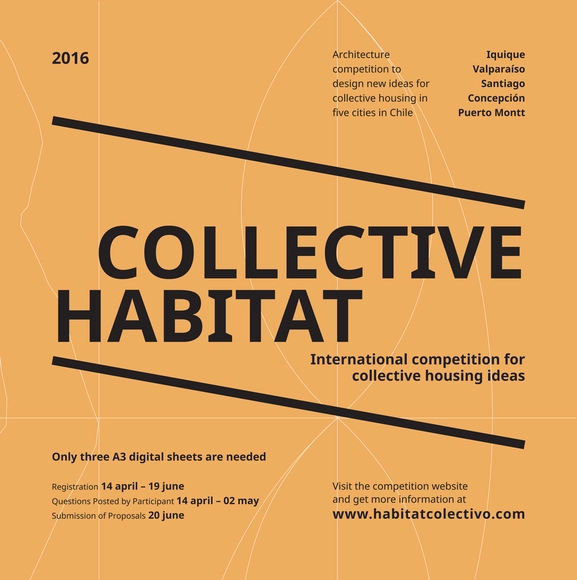
Collective Habitat is a competition for students and professionals which seeks to produce ideas to densify areas in or near the centers of 5 Chilean cities with collective housing. The goal is collect innovative architecture proposals that offer access to housing for middle and lower class families in well-served urban areas of Iquique, Valparaíso, Santiago, Concepción and Puerto Montt.
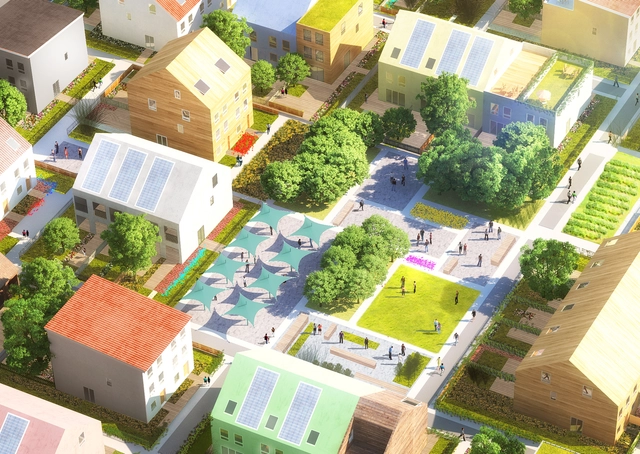
MVRDV and Traumhaus, a producer of low-cost, high-quality homes based on standardized elements, have teamed up to develop a 27,000 square meter project redeveloping former US Army barracks in Mannheim, Germany.
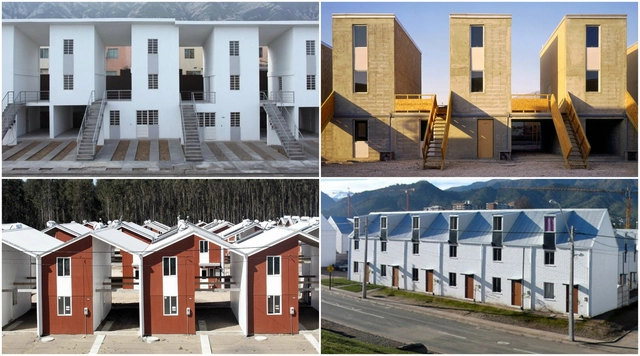
The 2016 Pritzker laureate Alejandro Aravena has announced that his firm, ELEMENTAL, has chosen to release four of their social housing designs to the public for open source use. Speaking in a panel discussion held by the Pritzker Prize earlier tonight titled Challenges Ahead for the Built Environment, Aravena stressed the need to work together to tackle the challenge of rapid migration that is taking place all around the globe, a message closely tied to the theme of the upcoming Venice Biennale which Aravena is directing. In this spirit, DWGs of these four designs - which offer the basic elements of a house at a low budget and encourage the residents to expand into an adjacent space as they find the money to do so - will be available for architects worldwide to learn from.


.jpg?1468436746&format=webp&width=640&height=580)

.jpg?1468436746)






.jpg?1466473977 "© manufatura creative")
.jpg?1466473911 "© manufatura creative")
.jpg?1466474458 "© manufatura creative")
.jpg?1466474530 "© manufatura creative")






.jpg?1464850078&format=webp&width=640&height=580)
.jpg?1464850424 "© Laurian Ghinitoiu")
.jpg?1464850228 "© Laurian Ghinitoiu")
.jpg?1464850222 "© Laurian Ghinitoiu")
.jpg?1464850126 "© Laurian Ghinitoiu")
.jpg?1464850078)
.jpg?1464091234&format=webp&width=640&height=580)




.jpg?1464091234)
.jpg?1462898782&format=webp&width=640&height=580)

.jpg?1460553184 "© Manuel Aguiar")
.jpg?1460553001 "© Manuel Aguiar")
.jpg?1460552628 "© Manuel Aguiar")
.jpg?1460552885 "© Manuel Aguiar")